One of the most persistent frictions in blockchain payments is not speed, and not even scalability. It is economic unpredictability. On most networks, sending stablecoins still depends on volatile gas tokens, fluctuating fees, and congestion-driven costs. This creates a paradox: users move “stable” money through an unstable economic layer.
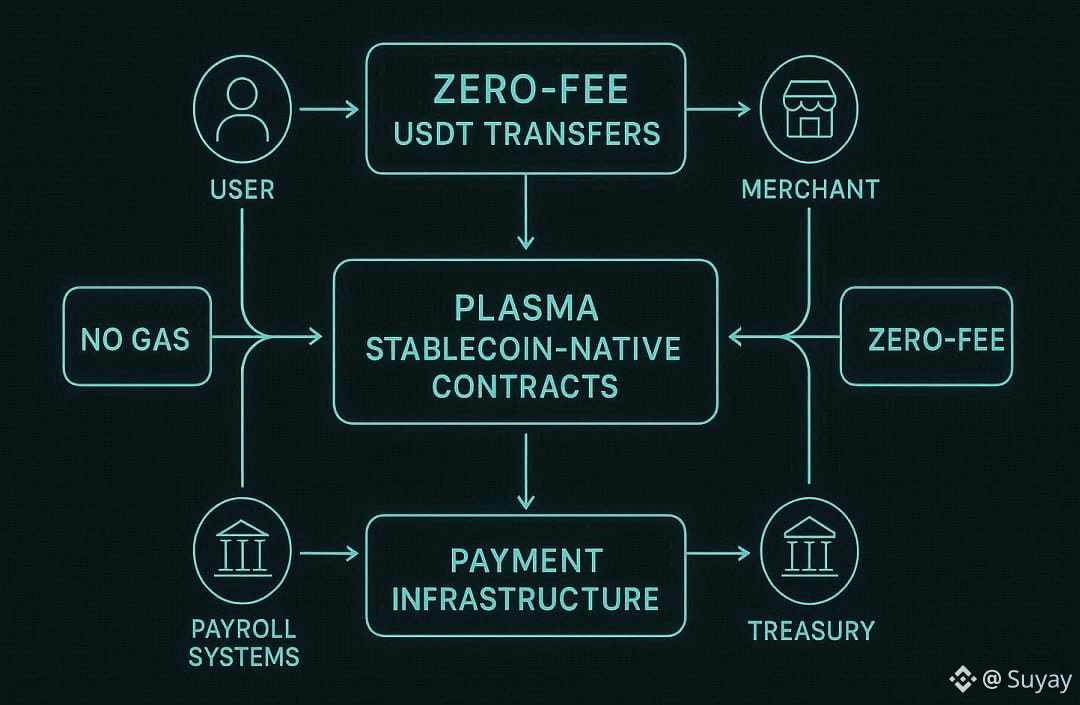
Plasma addresses this contradiction directly with a radical design choice: zero-fee USDT transfers at the protocol level. This is not a temporary subsidy model or an application-layer promotion. It is a structural redesign of how payment economics work on-chain.
The hidden cost of traditional gas models
On general-purpose blockchains, stablecoin transfers inherit the economic logic of smart contract platforms. Every transaction competes for blockspace, prices fluctuate in real time, and the fee asset itself behaves like a speculative instrument.
For everyday payments, this model is deeply inefficient.
A user sending ten dollars should not need to hold a volatile token.
A merchant should not need to estimate gas conditions.
A payment system should not change its cost structure hourly.
When stablecoins rely on external gas assets, the user experience is shaped by market speculation rather than financial utility. Plasma’s zero-fee transfers emerge from the recognition that payment infrastructure cannot be built on top of unstable incentives.
Zero-fee as protocol architecture
Plasma integrates zero-fee USDT transfers into its native financial layer. Instead of charging users per transaction, the network restructures how economic security and operational costs are handled internally.
This reframes the role of fees entirely.
Rather than being the primary user-facing mechanism, fees become an infrastructural concern — absorbed, optimized, and abstracted away from the act of payment itself. The result is that stablecoin transfers behave more like digital cash flows than smart contract calls.
From the user’s perspective, sending USDT becomes economically neutral. There is no secondary asset to manage, no timing games, and no cost anxiety. This is not an optimization of the old system. It is a replacement.
Why zero-fee changes behavior
When transactions cost money, behavior adapts around fees. Users batch payments. Applications throttle interactions. Businesses introduce minimums. Entire product designs are shaped by the need to reduce on-chain operations.
Zero-fee transfers remove these distortions.
Micropayments become viable.
High-frequency settlement becomes rational.
Automated financial processes can run continuously instead of periodically.
This unlocks patterns closer to traditional financial systems, where value moves fluidly and invisibly in the background. Plasma’s approach allows stablecoins to function not as “crypto assets,” but as programmable digital dollars.
Redesigning payment economics
In most blockchains, transaction fees are both revenue and security. Plasma separates payment usability from speculative congestion markets by designing an environment where stablecoin flows are not burdened by gas volatility.
This redesign has deep implications.
It enables payment systems where costs are predictable.
It supports platforms where users never see a gas interface.
It allows businesses to build financial products without exposing clients to crypto mechanics.
Instead of monetizing each transaction, Plasma focuses on sustaining the network through infrastructure-level mechanisms aligned with institutional-grade payment rails. This is closer to how real financial networks operate: end users experience frictionless transfers, while complexity remains under the hood.
From blockchain transactions to financial flows
Zero-fee USDT transfers push Plasma out of the category of “efficient blockchains” and into the domain of financial payment infrastructure.
Here, the core unit is not a transaction, but a flow.
Stablecoins move between wallets, applications, and services without micro-tolls at every step. This makes it possible to embed payments into software the way APIs are embedded today — always available, always on, and economically invisible.
When fees disappear from the user experience, blockchains stop feeling like networks and start behaving like systems.
Strategic implications
The long-term competition in crypto will not be about who can host the most applications, but who can support the most real financial activity.
Zero-fee USDT transfers position Plasma as a network optimized not for experimentation, but for circulation. It is designed for the reality that the majority of blockchain volume in the coming decade will be stable, repetitive, and financial.
By redesigning payment economics at the base layer, Plasma removes one of the final psychological and structural barriers to blockchain-based money.
Not faster payments.
Not cheaper payments.
But payments that no longer feel like blockchain transactions at all.