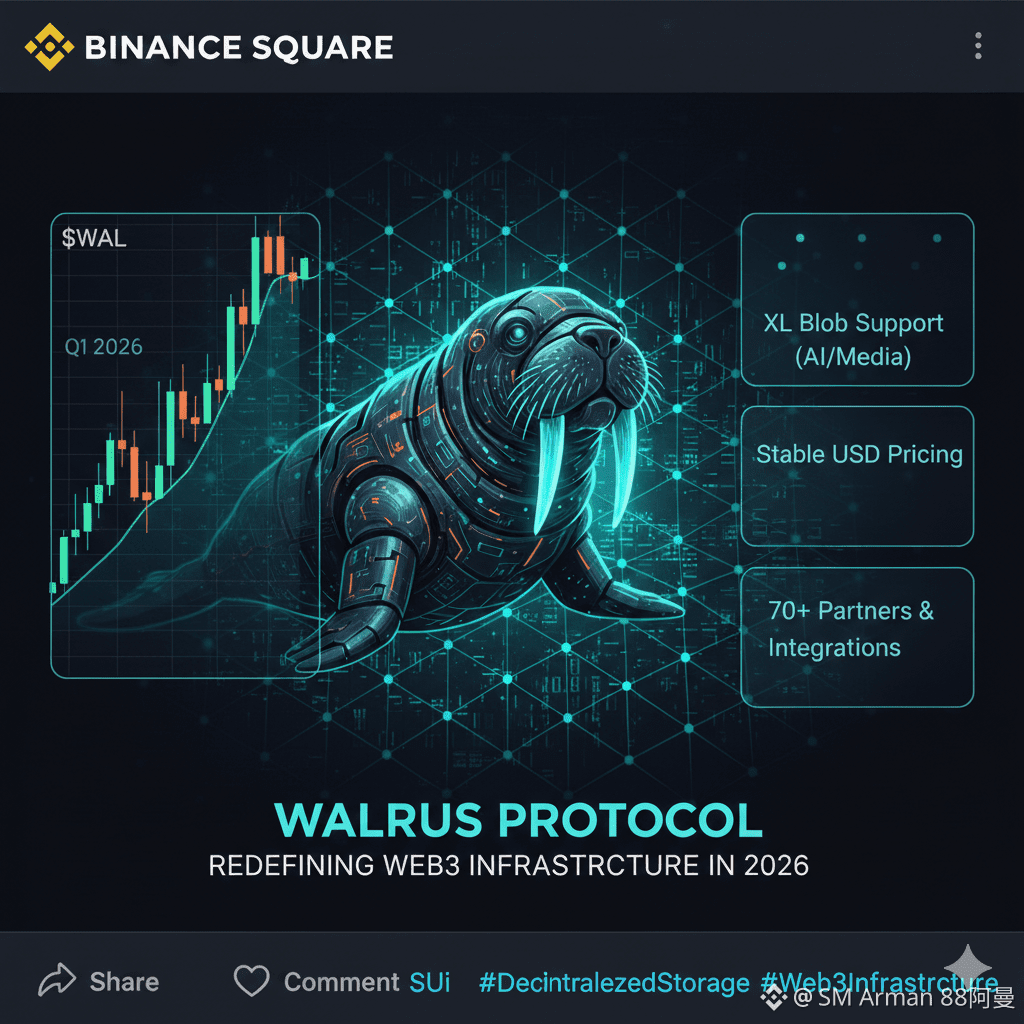
The Web3 landscape is no longer satisfied with "theoretical" tech—the market is demanding real-world utility. While many decentralized storage solutions have struggled with high latency and complex pricing, @walrusprotocol is quietly positioning itself as the indispensable data availability layer for the Sui ecosystem and beyond.
The secret sauce behind Walrus is its proprietary Red Stuff encoding. Most legacy storage protocols rely on simple replication (copying files 3-5 times), which is expensive and inefficient.
Walrus uses a two-dimensional erasure-coding algorithm that breaks data into "slivers." This allows the network to reconstruct a file even if two-thirds of the storage nodes go offline. The result? High durability with a fraction of the storage overhead. For developers building AI-heavy dApps or SocialFi platforms, this means enterprise-grade reliability at a price point that actually makes sense.
The most bullish catalyst on the immediate horizon is the upcoming Quilt upgrade. While Walrus is already a leader in "Blob" storage, the Quilt update is specifically designed to optimize "small-data" storage. This fills a critical gap, allowing developers to manage everything from massive AI training sets (XL Blobs) to tiny metadata slivers within a single, unified API.
Utility isn't just a roadmap item anymore. On January 14, 2026, the Myriad prediction market officially integrated Walrus to store its market artifacts. This shift from hybrid cloud solutions to a fully decentralized, tamper-proof storage layer on Walrus proves that the protocol can handle high-stakes, verifiable data for DeFi and regulatory compliance.
The WAL token is more than just a ticker; it is the fuel for the entire ecosystem:
Stable Pricing: Walrus has pioneered USD-anchored storage pricing, protecting builders from the volatility of the crypto market.
Staking & Security: With the Delegated Proof-of-Stake (dPoS) model, WAL holders can delegate tokens to storage nodes, earning a share of protocol emissions while securing the data layer.
Ecosystem Incentives: With 43% of the supply dedicated to the Community Reserve, the "Walrus User Drop" and developer grants are actively fueling a surge in new dApps.
With over 70+ partners already building on the protocol and the network scaling horizontally to thousands of nodes, @walrusprotocol is no longer a "project to watch"—it’s a project to use. If Web3 is to truly scale to the next billion users, it needs a storage layer that is fast, programmable, and affordable. WAL is checking all those boxes.