
Blockchains don’t fail because they’re slow anymore. They fail because they don’t connect.
Liquidity gets stuck. Users jump between chains. Developers rewrite the same logic again and again. Even the best DeFi protocols lose power when they live in isolation. In today’s environment, performance alone isn’t enough. Interoperability is the real differentiator, and ecosystems that understand this early tend to outgrow those that don’t.
Plasma is built around that reality. Instead of treating interoperability as an afterthought, Plasma places it at the center of its design through what it calls ecosystem contracts. These contracts act as connective infrastructure, allowing DeFi and payment protocols to work together naturally. Tools like Uniswap, LayerZero, and Stargate don’t sit on the edges of Plasma — they plug into its core logic.
The result is an ecosystem where liquidity flows freely, developers build faster, and users experience finance as a single, coherent system rather than a collection of fragmented tools.
Interoperability Isn’t a Feature — It’s the Foundation
Most blockchain ecosystems approach interoperability reactively. A bridge here. A wrapper there. A custom integration when demand becomes unavoidable. That approach works in the short term but collapses under scale.
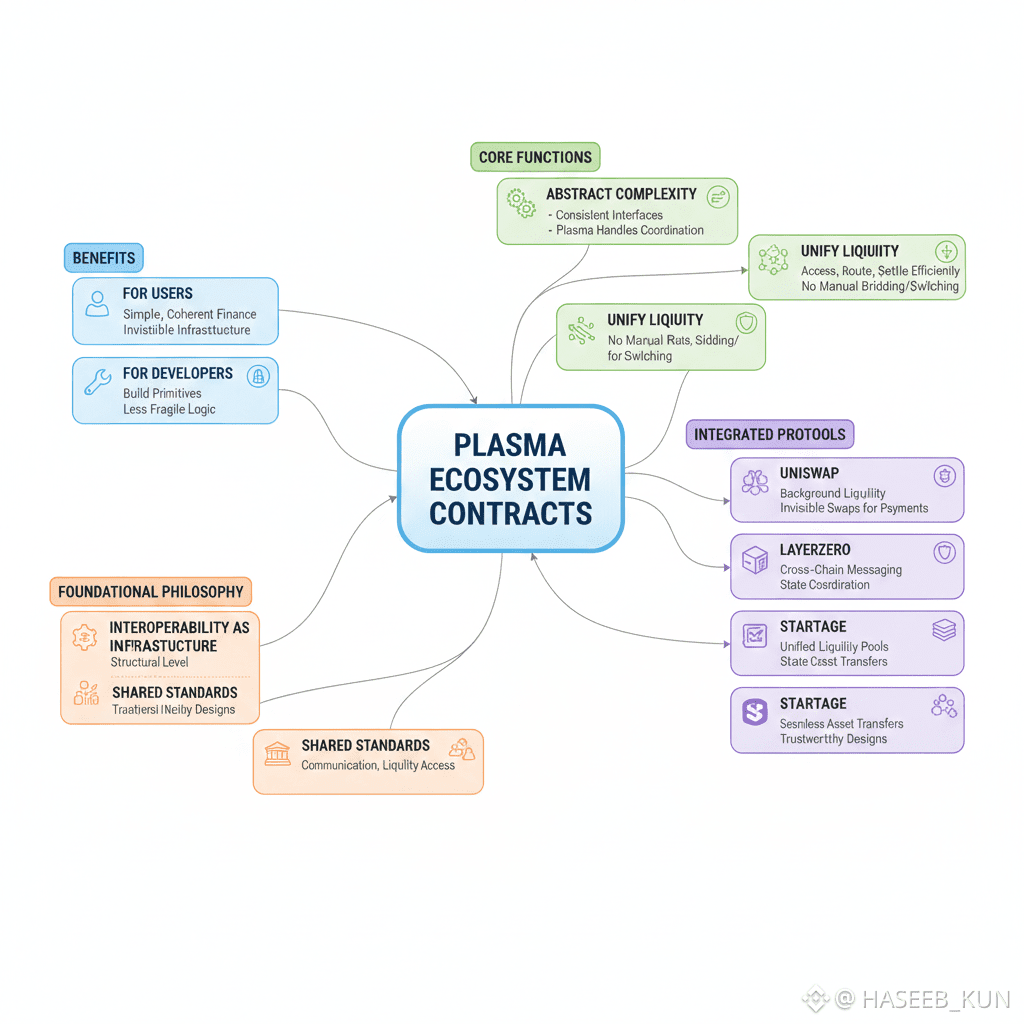
Plasma takes a different path. Interoperability is treated as infrastructure, not decoration. Ecosystem contracts define how external protocols interact with Plasma at a structural level. They standardize communication, settlement, and liquidity access so different systems don’t have to “learn” each other from scratch.
Think of Plasma like a modern financial district. Different institutions operate independently, but they all follow shared standards — roads, power grids, legal frameworks. Ecosystem contracts provide those shared standards for DeFi and payments.
This design choice matters because DeFi is no longer a single action. A user might swap assets, move liquidity cross-chain, trigger a message, and settle a payment — all in one flow. Plasma ensures those steps feel continuous, not stitched together.
What Ecosystem Contracts Actually Unlock
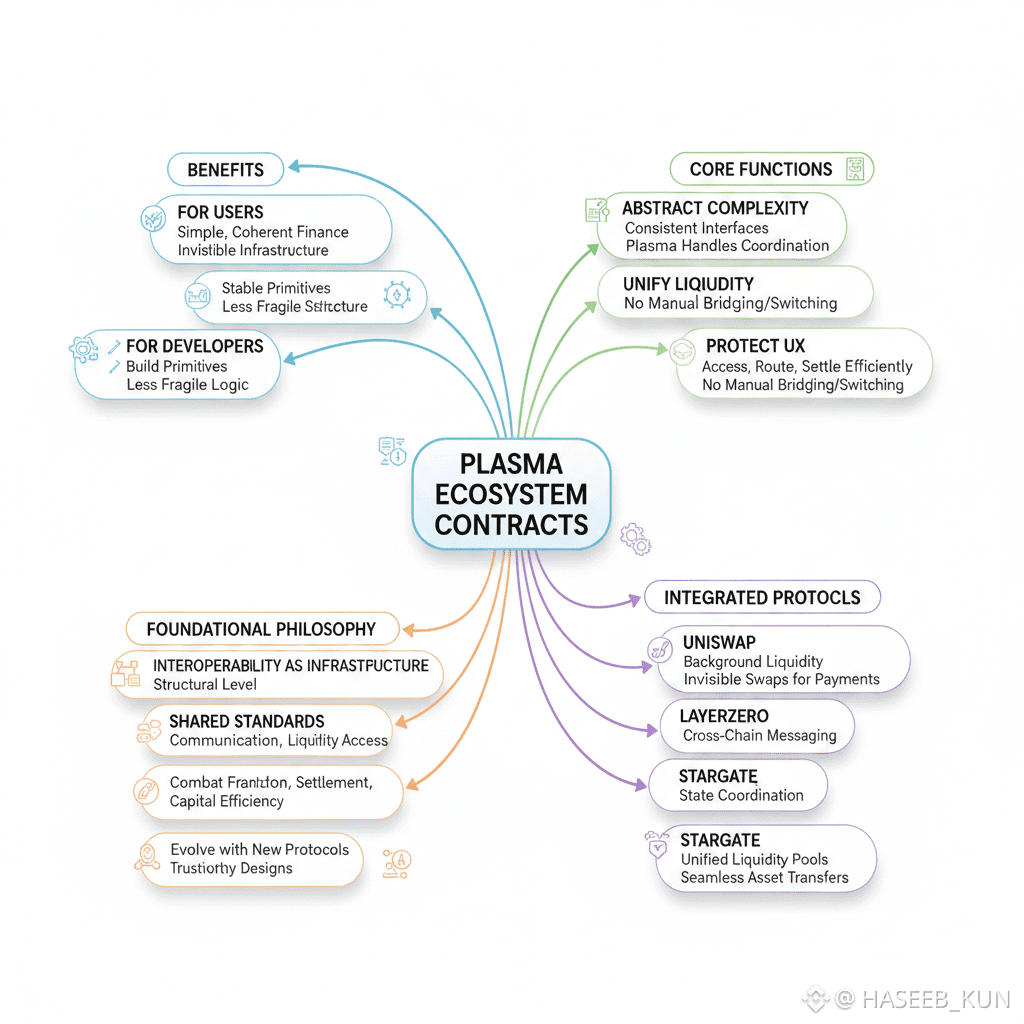
Ecosystem contracts do three important things inside Plasma.
First, they abstract protocol complexity. Developers don’t need to manage the quirks of every external system. They interact with consistent interfaces while Plasma handles the coordination underneath.
Second, they unify liquidity. Instead of fragmenting capital across isolated pools and chains, ecosystem contracts allow liquidity to be accessed, routed, and settled efficiently.
Third, they protect the user experience. Even when multiple protocols are involved, the interaction feels like a single action. No manual bridging. No switching networks. No unnecessary friction.
This is the difference between interoperability that exists on paper and interoperability that actually gets used.
Uniswap: Liquidity That Works in the Background
Uniswap is one of the most familiar names in DeFi, but in many ecosystems its liquidity is trapped inside one environment. Users have to go to Uniswap, perform a swap, then move assets elsewhere.
Plasma removes that mental overhead.
Through ecosystem contracts, Uniswap-style liquidity becomes a shared resource. Payments, transfers, and applications can tap into that liquidity automatically. A user might initiate a payment on Plasma, and behind the scenes a swap happens using Uniswap logic — without the user ever touching a DEX interface.
Liquidity stops being a destination and becomes invisible infrastructure. It’s there when needed and silent when not.
LayerZero: Messaging That Connects Chains Without Friction
As DeFi becomes multi-chain by default, messaging matters as much as asset transfers. LayerZero introduced a powerful idea: chains should be able to communicate intent and state, not just move tokens.
Plasma integrates this concept directly through ecosystem contracts.
Contracts on Plasma can respond to events on other networks, coordinate actions across chains, and maintain consistent state without manual intervention. This allows applications to behave as if they’re operating in one environment, even when multiple chains are involved.
For users, this feels seamless. For developers, it removes a massive amount of complexity. Cross-chain logic stops being fragile glue code and becomes a first-class capability.
Stargate: Liquidity Without Fragmentation
Bridging often creates liquidity silos. Assets get locked, wrapped, and duplicated, spreading capital thin and increasing risk.
Stargate approaches this differently by using unified liquidity pools. Plasma’s ecosystem contracts align naturally with that model. Instead of forcing users to think about routes or bridges, Plasma coordinates liquidity access and settlement automatically.
A transfer feels like a transfer — not a technical exercise. The ecosystem contracts handle verification, routing, and finality behind the scenes.
This is critical for scale. Liquidity works best when it’s shared, not split.
Why Developers Build Faster on Plasma
One of the quiet problems in Web3 is developer exhaustion. Every ecosystem promises flexibility, but each one comes with new rules, tools, and integration costs.
Plasma reduces that burden.
Ecosystem contracts give developers a stable set of primitives. Whether they’re working with swaps, cross-chain messaging, or liquidity routing, the interfaces stay consistent. Developers build once and reach across multiple protocols.
That consistency lowers risk, speeds up development, and encourages experimentation. When building becomes easier, ecosystems grow naturally — not through forced incentives, but through momentum.
User Experience That Doesn’t Feel Like Infrastructure
The best infrastructure is invisible.
Users shouldn’t need to understand bridges, liquidity pools, or messaging layers to move value. Ecosystem contracts are designed to remove those decisions from the user’s path.
A user initiates an action. Plasma handles the rest.
Whether it’s a payment that sources liquidity from Uniswap, moves across chains via Stargate, and confirms state through LayerZero, the experience feels single-step. This simplicity is what makes advanced DeFi usable beyond power users.
For payments especially, this matters. People don’t tolerate friction when sending money. Plasma’s design respects that reality.
When DeFi and Payments Stop Competing
Historically, DeFi focused on experimentation and yield, while payments focused on predictability and scale. Plasma’s ecosystem contracts allow these worlds to merge without compromise.
Payments can tap into DeFi liquidity without exposing users to volatility or complexity. DeFi applications can rely on payment-grade settlement guarantees. The boundary between infrastructure and application starts to fade.
This is where real adoption happens — when financial tools stop feeling like experiments and start behaving like systems people can trust.
Governance, Safety, and Long-Term Stability
Interoperability without structure leads to fragility. Plasma avoids this by defining shared standards through ecosystem contracts.
These standards control how assets move, how failures are handled, and how upgrades occur. If one protocol encounters an issue, it doesn’t destabilize the entire network.
Just as important, ecosystem contracts are designed to evolve. New protocols can be integrated. Existing ones can be upgraded. All without breaking what already works.
That balance between stability and adaptability is rare — and essential for long-term ecosystems.
A Network That Grows Stronger With Every Connection
Ecosystem contracts are not static integrations. They’re a living framework.
As new DeFi tools emerge, Plasma doesn’t need to reinvent itself. It absorbs them. As liquidity models evolve, Plasma adapts. As cross-chain infrastructure improves, Plasma benefits automatically.
This makes Plasma less like a closed product and more like a financial network that compounds over time.
Why This Matters for the Bigger Market
Fragmentation is expensive. It wastes liquidity, slows innovation, and confuses users.
By centering interoperability through ecosystem contracts, Plasma attacks fragmentation at its core. Capital moves efficiently. Developers build with confidence. Users experience simplicity.
This is how ecosystems win — not by locking users in, but by connecting systems intelligently.
Final Thoughts: Ecosystem Contracts Are Plasma’s Quiet Edge
Ecosystem contracts may not be the loudest feature in Plasma, but they are one of the most important.
They turn protocols like Uniswap, LayerZero, and Stargate into native building blocks. They remove friction without sacrificing control. They let complexity exist without exposing it.
For developers, Plasma feels flexible.
For users, it feels simple.
For liquidity, it feels alive.
That combination is rare — and it’s exactly what modern DeFi and payment ecosystems need to scale.

