

Regulated financial systems require that every transaction and asset transfer adhere to strict compliance standards. The Dusk Network addresses this requirement by integrating automated compliance logic directly into its blockchain protocol, ensuring that operations are verifiable, auditable, and compliant with regulatory frameworks such as MiFID II, MiFIR, and GDPR-style regimes. This approach eliminates the need for external compliance intermediaries for many operations and ensures that both private and transparent transactions can meet legal standards automatically.
Purpose of On-Chain Compliance
In traditional financial systems, compliance checks are manual, error-prone, and slow. When moving to blockchain, automated enforcement of compliance rules becomes essential. Dusk’s on-chain compliance logic allows the network to:
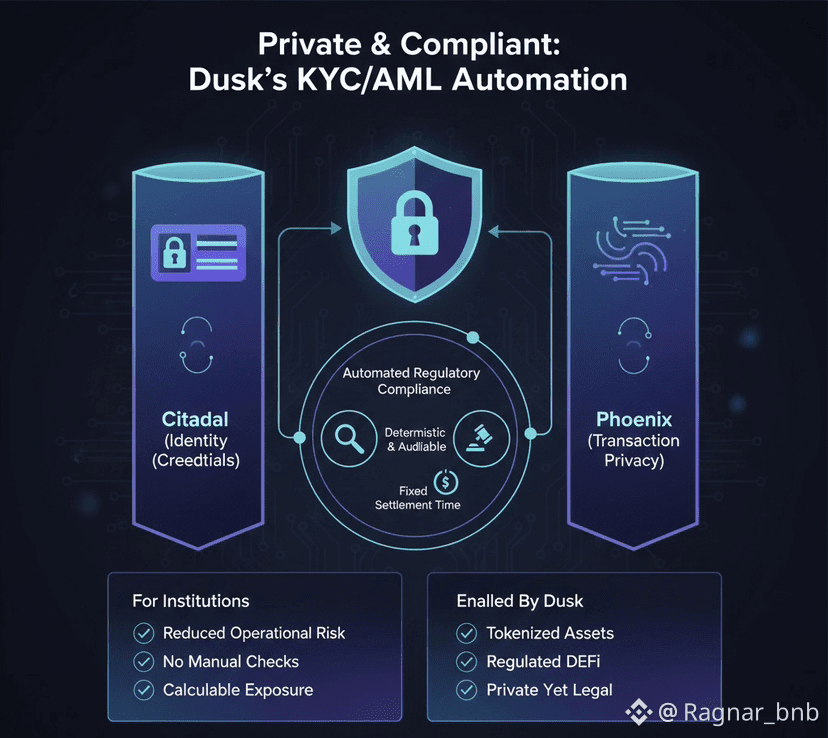
Enforce KYC/AML rules programmatically for tokenized assets and financial operations.
Prevent unauthorized transactions from non-compliant participants.
Ensure transaction restrictions based on jurisdiction, investor accreditation, or regulatory requirements.
Provide immutable audit trails for regulators and authorized auditors without exposing private data to the public network.
By embedding compliance logic into the protocol, Dusk reduces operational risk, accelerates transaction settlement, and enables institutional participants to interact with the blockchain confidently.
Integration with Dual Transaction Models
The Dusk Network’s dual transaction model—Phoenix (private) and Moonlight (transparent)—relies on automated compliance logic:
Phoenix Transactions: Maintain confidentiality of balances and identities while still enforcing regulatory rules through zero-knowledge proofs. Compliance rules are executed in the background without revealing sensitive data to other participants.
Moonlight Transactions: Provide transparency required for auditing, while automatically verifying that participants meet regulatory eligibility criteria before settlement.
This dual model ensures that all transaction types—confidential or transparent—comply with pre-defined legal rules, combining privacy and regulatory oversight effectively.
Technical Implementation
Automated compliance logic in Dusk is achieved through a combination of smart contracts, cryptographic proofs, and identity integration via Citadel:
Smart Contracts: Compliance rules are coded directly into the blockchain’s contract layer. For example, token transfer contracts can include conditions such as “only accredited investors may receive this token,” which are verified automatically during execution.
Zero-Knowledge Proofs (ZKPs): Privacy-preserving proofs allow the network to confirm that compliance requirements are met without exposing personal or transactional data. For instance, a user can prove they are legally allowed to hold an asset without revealing their full identity.
Identity Integration: On-chain identity proofs from Citadel provide verifiable credentials that the compliance logic references. This allows rules to check KYC status, jurisdiction, and other attributes automatically.
Event Handling via RUES: The Rusk Universal Event System (RUES) propagates compliance-related events throughout the network, ensuring that all relevant nodes apply the logic consistently.
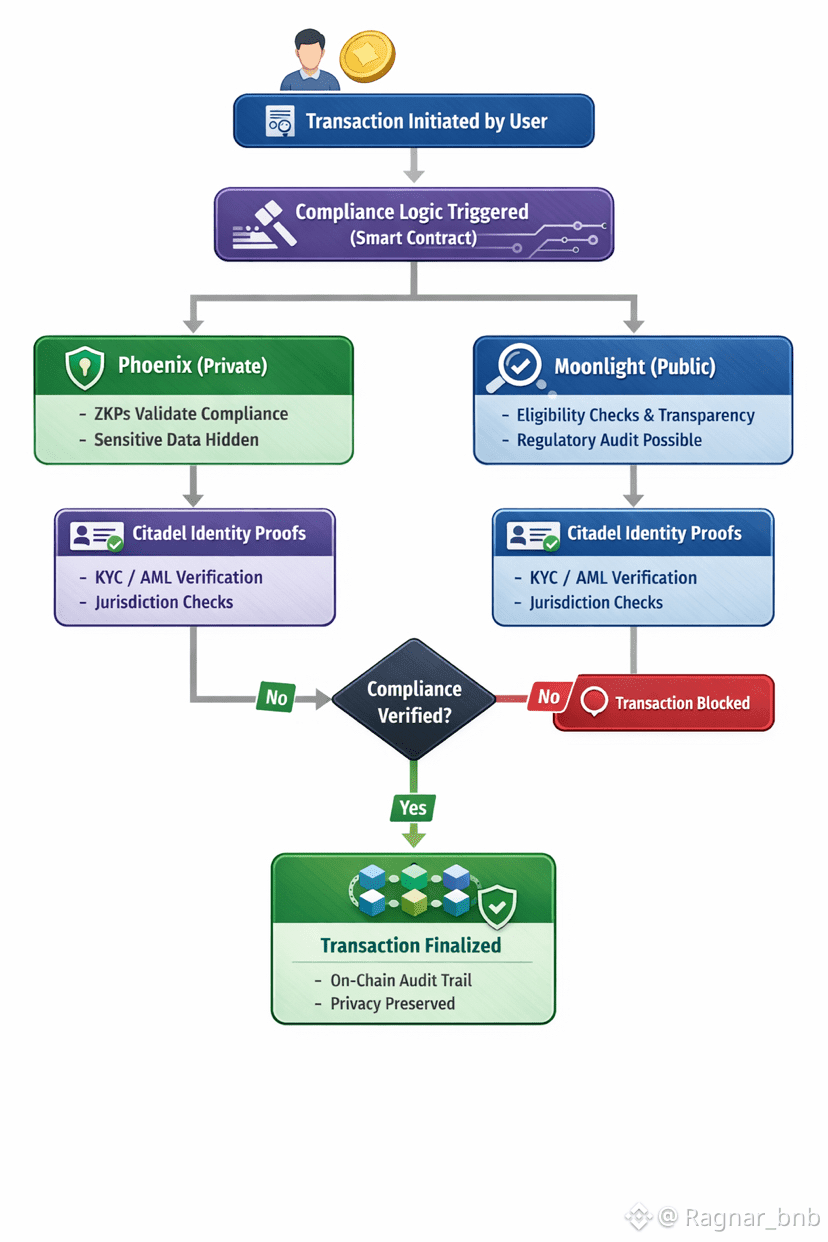
This architecture ensures that regulatory constraints are enforced at the protocol level, reducing reliance on off-chain compliance processes and manual verification.
Benefits for Institutional Use
Automated on-chain compliance logic provides several advantages for institutional participants:
Reduced Compliance Costs: Many verification steps are automated, reducing the need for labor-intensive processes.
Real-Time Settlement: Transactions can settle without delays from off-chain compliance checks.
Auditability: All compliance checks are logged on-chain, creating an immutable trail for regulators.
Privacy Preservation: Confidential data is never exposed unnecessarily, maintaining both regulatory compliance and participant privacy.
This makes Dusk particularly suitable for regulated DeFi, tokenized securities, and real-world asset settlements, where strict legal adherence is mandatory.
Security and Verification
The Dusk Foundation has audited its smart contracts and compliance logic, confirming that:
Rules are executed consistently across the network.
Zero-knowledge proofs correctly enforce conditions without leaking sensitive data.
Integration with Citadel ensures only authorized participants can pass compliance checks.
These audits verify that the automated compliance framework is secure, reliable, and aligned with the network’s privacy and regulatory goals.
Conclusion
Automated on-chain compliance logic is a core feature that enables the Dusk Network to operate in regulated financial environments. By embedding KYC, AML, jurisdictional, and investor eligibility checks into smart contracts and integrating them with privacy-preserving proofs, Dusk ensures that all transactions adhere to legal requirements without compromising confidentiality or operational efficiency.
This feature bridges a critical gap between traditional finance and blockchain technology, making Dusk a suitable platform for institutional adoption, regulated tokenized assets, and compliant decentralized finance solutions.
