
Blockchain technology has often been celebrated for decentralization, transparency, and innovation. Yet as the ecosystem grows, one question is becoming impossible to ignore: what is the environmental cost? Many early networks relied on energy-intensive consensus mechanisms that consumed more electricity than entire countries. While security and decentralization were preserved, sustainability was often treated as an afterthought. For investors, regulators, and institutions prioritizing ESG principles, this created friction: how could one embrace blockchain without contributing to environmental strain?
Dusk approaches this challenge differently. Its design philosophy integrates energy efficiency directly into the network, demonstrating that security, decentralization, and sustainability can coexist. In Dusk, energy efficiency is not a compromise—it is a foundational principle that shapes every layer of the protocol. From consensus mechanisms to transaction processing, the network is built to maximize utility while minimizing environmental impact, making it a natural choice for ESG-focused participants.
At the heart of Dusk’s approach is its innovative consensus mechanism, engineered to secure the network without consuming unnecessary energy. Unlike proof-of-work networks, which rely on brute computational force, Dusk achieves security and decentralization with a fraction of the energy. Validators contribute meaningfully to the system’s integrity without resorting to wasteful cycles. This balance between robustness and efficiency allows Dusk to maintain high performance while minimizing its carbon footprint—a critical requirement for real-world financial adoption.
Energy efficiency is reinforced by Dusk’s holistic protocol architecture. Every process, from transaction validation to block propagation, has been optimized to avoid redundant computation and reduce idle resource use. The system scales naturally: energy consumption grows proportionally with network activity, rather than exponentially. For institutions deploying financial products, this means the network can handle high-volume activity without imposing hidden environmental costs.
Dusk’s modular design further enhances efficiency. By isolating resource-intensive operations and optimizing critical processes, energy usage remains predictable and controlled. Traditional networks often see energy demands spike disproportionately as transaction volumes increase. Dusk, in contrast, maintains a linear growth in consumption, ensuring that both scaling and sustainability go hand in hand. This is particularly relevant for ESG-conscious investors, who prioritize growth without environmental compromise.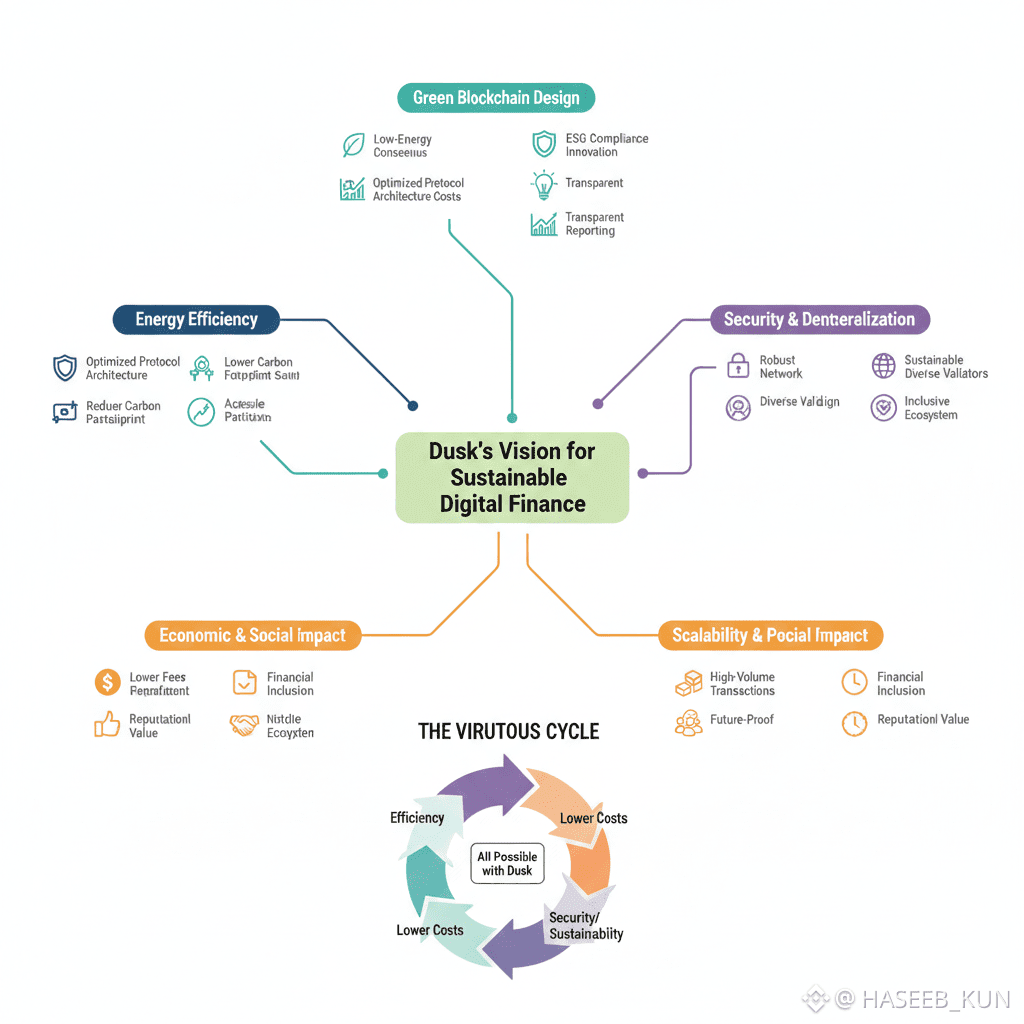
Operationally, energy efficiency benefits participants as well. Nodes require less computational power, reducing electricity costs and making participation accessible to a wider range of validators. This lowers barriers to entry, encourages decentralization, and fosters an inclusive ecosystem. Small institutions, regional operators, and community nodes can contribute to network security without the prohibitive energy requirements seen in traditional blockchain models.
Dusk’s green design is not limited to efficiency—it aligns with institutional and regulatory priorities. ESG-focused investors are increasingly scrutinizing digital asset infrastructure, and networks with high energy consumption face reputational and regulatory risks. By embedding sustainability into the core protocol, Dusk offers an infrastructure that supports both innovation and compliance. Institutions can deploy regulated products, tokenized assets, and multi-chain strategies with confidence, knowing that the underlying blockchain meets high environmental standards.
Efficiency on Dusk also ensures long-term scalability. As digital finance grows, networks must process increasing transaction volumes without spiraling energy costs. Dusk’s architecture allows the system to scale sustainably, maintaining throughput, performance, and security while keeping energy consumption in check. This makes the network suitable for high-volume applications, institutional deployments, and complex financial workflows, all while remaining environmentally responsible.
Dusk’s approach also benefits developers. By reducing energy demands at the protocol level, applications built on Dusk can operate without generating the high operational costs associated with energy-intensive networks. Smart contracts, tokenized real-world assets, and financial workflows can function efficiently, giving developers the freedom to innovate without compromising sustainability. This combination of performance, security, and environmental responsibility is rare and positions Dusk as a next-generation platform for digital finance.
Beyond operational and institutional advantages, Dusk’s green design carries symbolic and strategic value. In a world where climate considerations are central to corporate strategy and public perception, energy-efficient blockchain systems signal responsibility. Dusk demonstrates that blockchain innovation can coexist with environmental stewardship. This messaging resonates with investors, institutions, and communities, fostering trust and long-term adoption.
The network’s sustainability approach also prepares it for future ESG compliance and reporting standards. By reducing energy consumption, Dusk enables financial products built on the platform to meet emerging disclosure requirements and carbon accounting standards. Sustainability is baked into the network, not retrofitted as an afterthought, creating a resilient foundation for the future of decentralized finance.
Lower energy consumption also improves network economics. Reduced operational costs for validators translate into lower fees, increased participation, and more equitable incentives. This encourages decentralization while maintaining robust network security—a rare synergy that reinforces both environmental and financial efficiency.
Energy efficiency is further strengthened by Dusk’s attention to security and privacy. Optimized execution ensures that transactions and smart contracts are verified and validated without unnecessary computational redundancy. Security is preserved, privacy is maintained, and every unit of energy contributes directly to network integrity rather than being wasted. This is a practical, measurable demonstration of sustainable blockchain design.
For ESG-conscious institutions, Dusk offers a unique proposition. It combines regulatory readiness with environmental responsibility, allowing financial products to operate on-chain without introducing reputational or operational risk. Tokenized securities, decentralized finance applications, and multi-chain strategies can be deployed confidently, knowing that the infrastructure supporting them meets both security and sustainability benchmarks.
Dusk’s design also supports transparent energy reporting. Validators and institutions can monitor network energy metrics, node efficiency, and overall consumption. This transparency is crucial for accountability and aligns with ESG principles. It allows participants to demonstrate responsible digital asset management and provides data for institutional sustainability reporting.
The network’s green approach encourages a culture of sustainable innovation. Developers are incentivized to design applications that respect energy efficiency, embedding sustainability into the ecosystem’s growth. Over time, this mindset reinforces Dusk’s position as a blockchain that prioritizes both technological advancement and environmental responsibility.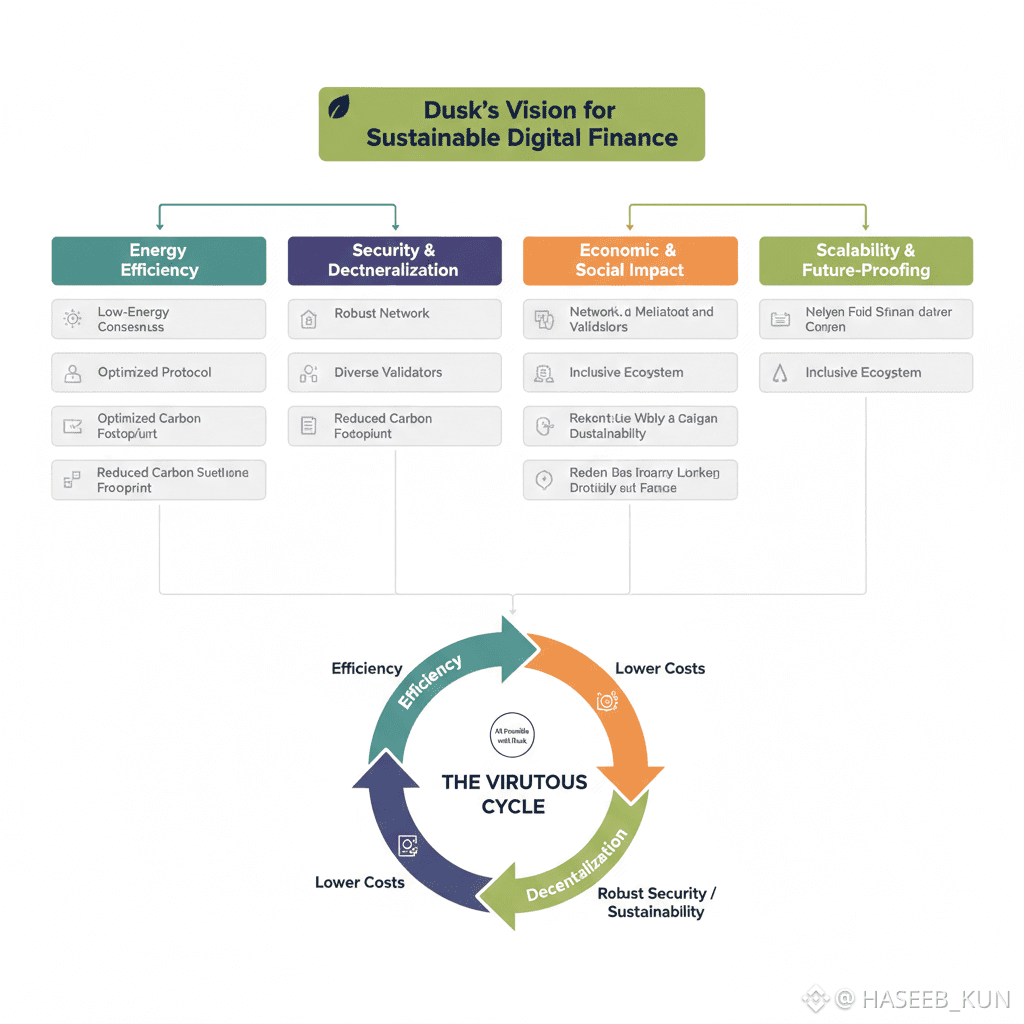
By proving that high-performance, secure blockchain systems can operate efficiently, Dusk challenges the assumption that energy-intensive networks are the only viable model. Every design choice—from consensus to protocol optimization—is guided by the principle that security, decentralization, and sustainability can coexist. For investors, institutions, and developers, this represents a rare alignment: participation in cutting-edge digital finance that also respects environmental priorities.
Dusk’s energy efficiency also has a compounding effect on adoption and network resilience. By lowering operational requirements, the network encourages participation from a broad array of nodes. Decentralization increases, network security strengthens, and the overall energy footprint remains manageable. This creates a virtuous cycle, where sustainability and network health reinforce each other.
Importantly, Dusk demonstrates that sustainable blockchain design scales. High-volume transaction processing, multi-chain strategies, and complex financial instruments can operate efficiently without generating excessive energy consumption. This proves that green blockchain design is not merely aspirational—it is practical and deployable at scale.
The network’s design philosophy underscores a broader principle: blockchain technology can—and should—serve both financial innovation and environmental responsibility. Dusk embodies this principle in its architecture, its operations, and its community. By integrating energy efficiency into the network’s DNA, Dusk positions itself as the platform of choice for future-facing institutions, ESG-focused investors, and developers committed to responsible digital finance.
Through careful consensus design, optimized protocol layers, and energy-conscious execution, Dusk achieves what few networks can: a high-performance, secure, decentralized blockchain that is also environmentally responsible. This combination positions it uniquely in the market, appealing to both financial pragmatism and environmental ethics.
Ultimately, Dusk shows that sustainability and innovation are not mutually exclusive. By treating energy efficiency as a core principle rather than an optional feature, the network provides a blueprint for responsible digital infrastructure. For investors, developers, and institutions looking to build, trade, or deploy on-chain financial products, Dusk offers a platform that aligns with both technological ambitions and ESG priorities.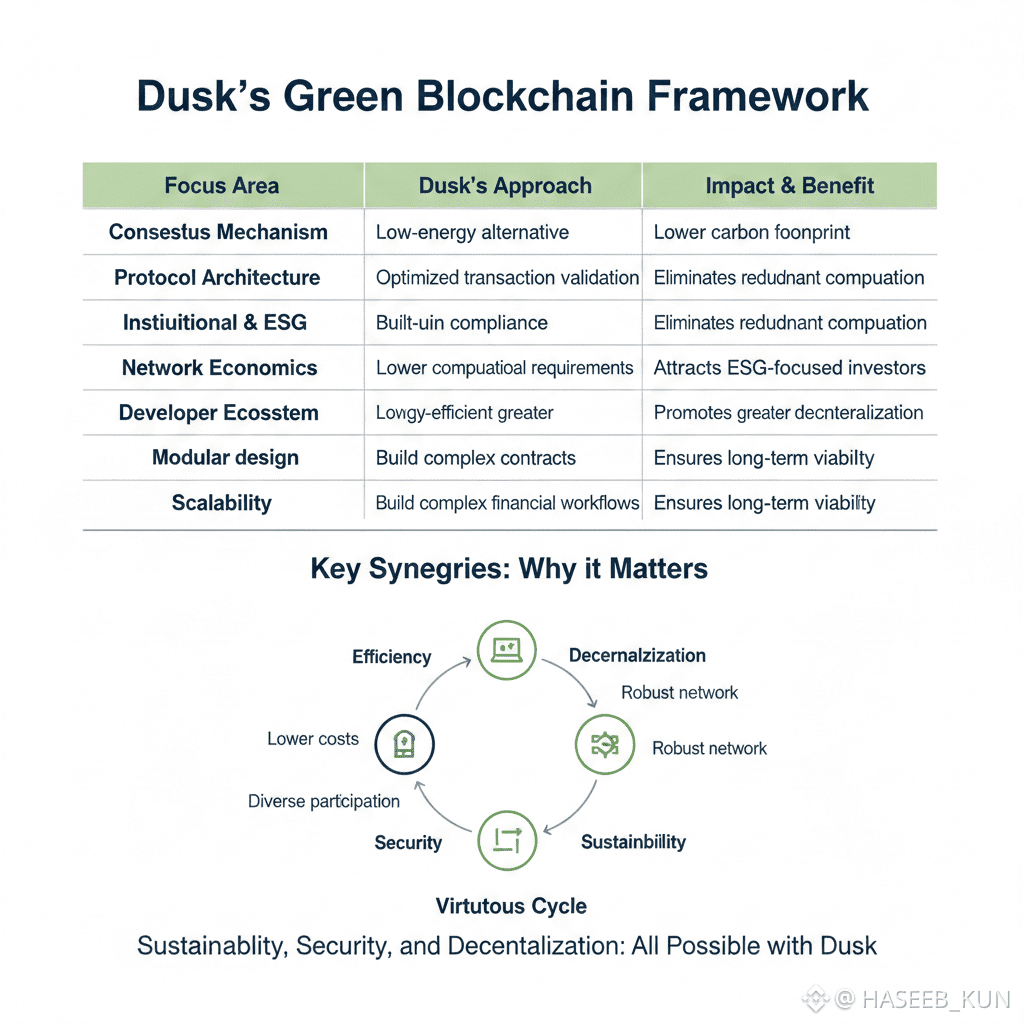
By prioritizing green design, Dusk demonstrates that blockchain networks can contribute to a sustainable future without compromising on security, decentralization, or performance. Every validator, every transaction, and every block processed on Dusk reflects a careful balance: the blockchain moves forward, innovation accelerates, and the planet’s resources are respected.
In conclusion, Dusk sets a new standard for sustainable digital finance. Its energy-efficient, environmentally responsible design proves that blockchains can be powerful, secure, and green. For ESG-conscious investors and forward-looking institutions, Dusk is more than a platform—it is a statement: that digital finance can grow, innovate, and scale without leaving a carbon footprint behind.
