The Dusk Network represents a deliberate shift in how blockchain technology approaches privacy, scalability, and real-world financial usability. Rather than treating confidentiality as an optional feature, Dusk was architected from the ground up to make privacy a native property of the protocol while remaining compatible with regulated financial environments. Its evolution reflects a broader industry realization: institutional adoption of blockchain requires not radical transparency, but selective disclosure, cryptographic guarantees, and compliance-ready design.
At its foundation, Dusk was conceived to solve a critical weakness in early blockchain systems—the exposure of transactional data and participant identities. Traditional public ledgers make balances, transaction flows, and counterparties visible to anyone, which is incompatible with financial confidentiality and corporate operations. Dusk addresses this problem by embedding privacy at the protocol level, ensuring that users can transact, communicate, and deploy applications without leaking sensitive information.
A core element of the Dusk architecture is its advanced privacy model. Transactions are designed so that sender identities, recipient addresses, and transferred amounts remain confidential by default. This is achieved through cryptographic techniques that generate one-time addresses, obscure transaction inputs among multiple decoys, and hide value transfers without compromising auditability. The result is a system where transactional validity can be proven mathematically without revealing the underlying data.
Beyond transactions, Dusk extends privacy to the network layer itself. In many blockchain systems, even if transaction details are hidden, network metadata can still reveal who is communicating with whom. Dusk counters this through encrypted peer-to-peer communication, anonymous routing, and dynamic tunnel switching. These mechanisms make it extremely difficult to correlate network traffic with real identities, enabling secure data exchange, private messaging, and confidential application traffic alongside financial operations.
Consensus is another area where Dusk diverges sharply from conventional blockchain designs. Instead of energy-intensive Proof-of-Work or balance-exposing Proof-of-Stake models, Dusk introduced a privacy-preserving Byzantine agreement mechanism. Validators and block producers are selected through cryptographic processes that do not reveal stake balances or participant identities during consensus. This approach allows the network to achieve fast finality and strong security guarantees while preserving confidentiality at every stage of block production.
This consensus design is particularly important for financial applications. In regulated markets, revealing the size of positions, liquidity providers, or institutional participants can create systemic risks. Dusk’s architecture allows these actors to participate in decentralized infrastructure without exposing sensitive financial data to competitors or the public, while still maintaining verifiable correctness and network integrity.
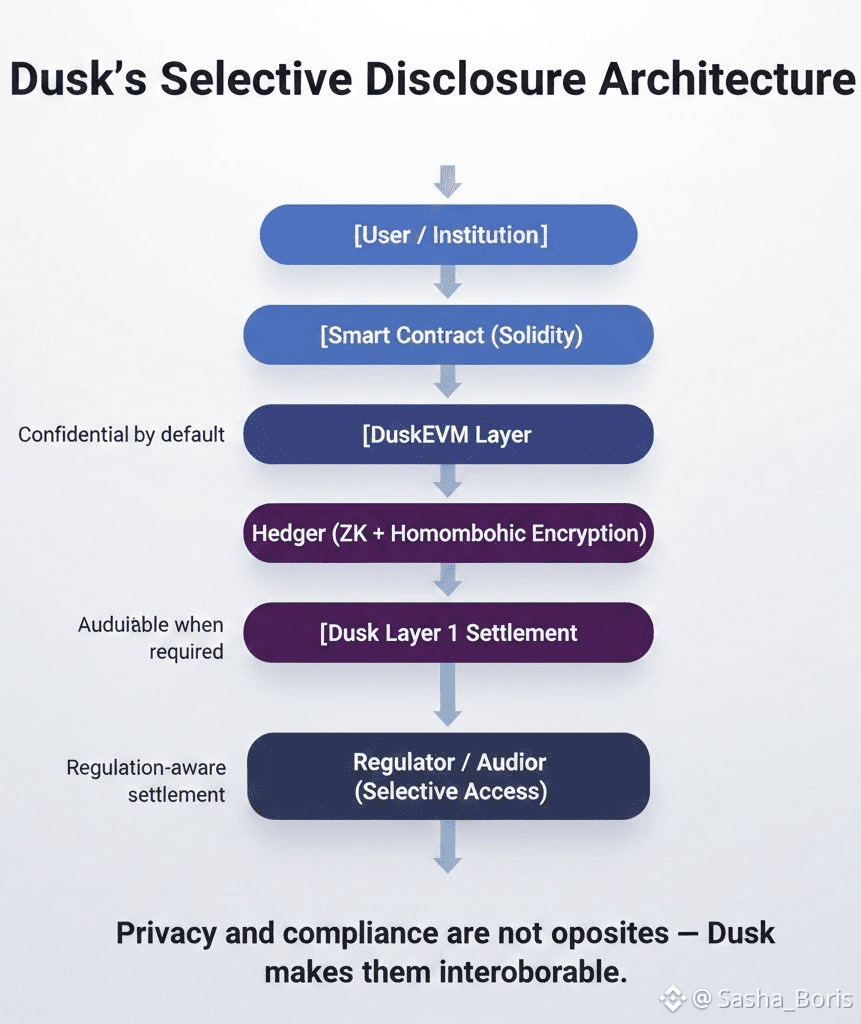
Over time, Dusk has expanded beyond its original scope as a privacy and networking protocol into a full-fledged Layer-1 blockchain optimized for financial use cases. Its modern architecture is modular, separating consensus, execution, and application layers. This modularity enables compatibility with existing smart contract ecosystems while preserving the option to introduce privacy-optimized virtual machines for confidential computation in the future.
One of the most significant developments in Dusk’s evolution is its alignment with real-world financial markets. The network has been positioned to support the issuance, trading, and settlement of regulated digital assets such as tokenized equities, bonds, and other real-world instruments. By combining on-chain privacy with selective disclosure and compliance-friendly design, Dusk aims to bridge the gap between decentralized infrastructure and traditional financial regulation.
Interoperability also plays a growing role in the Dusk ecosystem. Integration with external data providers and cross-chain infrastructure allows smart contracts on Dusk to access real-time market data and interact with other blockchain networks. This capability is essential for building sophisticated financial products that require accurate pricing, settlement logic, and cross-platform liquidity while maintaining confidentiality.
From a strategic perspective, Dusk occupies a unique position in the blockchain landscape. It is neither a purely anonymous network detached from regulation, nor a transparent ledger unsuitable for professional finance. Instead, it operates in the middle ground, offering privacy as a technical guarantee and compliance as an architectural option rather than an afterthought. This positioning makes it particularly attractive for institutions, exchanges, and asset issuers exploring blockchain adoption without compromising legal or operational standards.
Looking ahead, Dusk’s long-term relevance depends on its ability to scale this vision across developers, enterprises, and regulators. As global financial systems increasingly explore tokenization and on-chain settlement, the demand for confidential, auditable, and regulation-aware infrastructure is expected to grow. Dusk’s early focus on privacy, combined with its ongoing evolution toward modular execution and real-world asset support, places it among the most purpose-built blockchains for this emerging era.
In essence, Dusk Network is not simply another Layer-1 protocol—it is an attempt to redefine how privacy and finance coexist on decentralized infrastructure. By treating confidentiality as a foundational principle rather than a bolt-on feature, Dusk outlines a future where blockchain technology can serve both individual users and global financial institutions without forcing a compromise between transparency, security, and trust.