

When I first started experimenting with Plasma’s architecture, I wasn’t looking for some radical rethinking of blockchain UX; I simply wanted to understand why so many chains talk about “user-friendly onboarding” yet still force new users into the same predictable dead end: they have the token they want to use, but not the gas token required to move it. But the deeper I went into Plasma’s documentation and testnet demos, the more I realized something surprising — Plasma doesn’t treat gas abstraction as a convenience layer or a marketing checkbox. It treats it as a fundamental part of the chain’s identity. And for the first time in a long time, I saw a system where gas design wasn’t an afterthought, but the core engineering principle around which everything else quietly aligns.
What struck me immediately was how Plasma eliminates the classic “wallet broken experience,” the scenario where a user receives USDT, wants to make a simple transfer, and immediately gets slapped with the message every beginner hates: “Insufficient XPL for gas.” On most networks, that moment kills 70% of real-world onboarding. On Plasma, that moment never occurs, because the chain maintains a purpose-built paymaster that covers gas for native USD₮ transfers. This isn’t a gimmick. This isn’t sponsored by a third party. The protocol itself enforces identity checks and scoped allowances so that gasless transfers are sustainable rather than exploitable. And as someone who has watched countless onboarding attempts fail over this exact issue, I felt something I rarely feel in crypto: actual relief.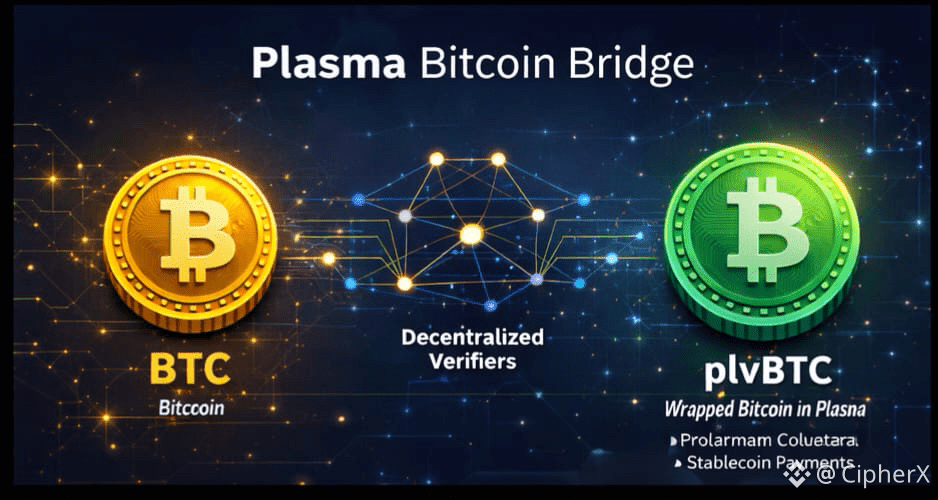
The next thing that really made me pause was the way Plasma extends the same logic to broader custom gas tokens. While most chains either require you to build your own gas sponsor system or use fragile middle layers that break during congestion, Plasma integrates custom gas tokens directly at the protocol level. That means a project can designate its own token — or a stablecoin — as the token users will spend for everyday interactions. No more “buy $5 of the native token before you can even begin.” No more preloading every new wallet with airdropped gas subsidies. No more blocking the onboarding funnel at the very first step. This is the kind of design that, if widely adopted, would fundamentally change how mainstream audiences perceive Web3.
As I studied the developer documentation, I realized something even more important: Plasma doesn’t treat gas abstraction as a blanket solution. It recognizes that payments, DeFi actions, bridging flows, and stablecoin transfers all have different UX constraints. So instead of offering a single generic abstraction mechanism, it provides multiple integrated primitives — the native paymaster for USDT, scoped custom gas token contracts for builders, and a clear pathway for future confidential payment modules. That layering is subtle, but it demonstrates something I deeply appreciate: Plasma isn’t chasing generic convenience. It is designing around the reality that different actions require different cost and trust assumptions.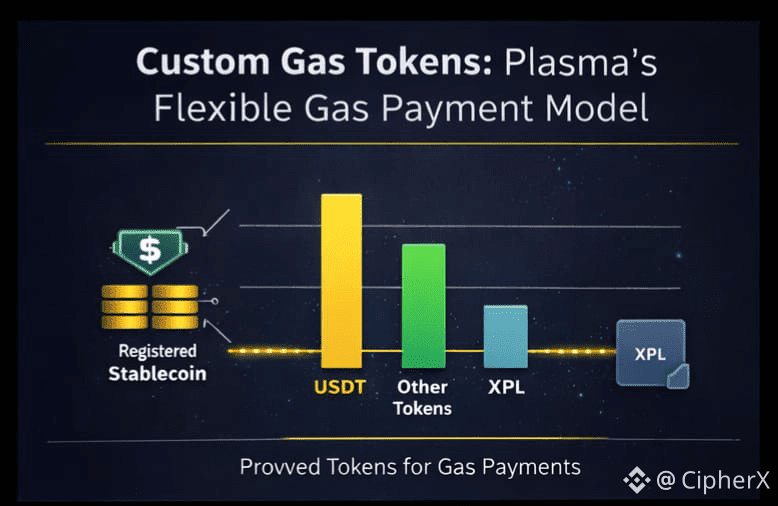
At some point during this exploration, I found myself thinking not just like a user, but like a builder. And I realized how much friction this model removes from designing real products. Imagine trying to build a payments app where your users have to understand “gas mechanics” before they can even send a dollar. Imagine building a remittance solution where every recipient needs the native token before they can touch their own money. Imagine trying to onboard merchants and having to explain why they must purchase XPL just to process payments. Plasma removes all of that by allowing you to construct flows where the user interacts only with the asset they care about, not with blockchain infrastructure artifacts that slow everything down.
The more I connected these pieces, the more I appreciated how Plasma’s architecture reflects a very rare kind of discipline. Most L1s try to be universal smart contract playgrounds, hoping someone will build a killer app on top of the base layer. Plasma, in contrast, starts with a question that sounds deceptively simple: how do you make digital dollars usable, transferable, programmable, and frictionless in a way that feels like real money? And the answer to that question leads to a chain where zero-fee USD₮ transfers, stablecoin-centric gas design, low-latency finality, and developer-level cost abstraction aren’t isolated features — they are a coherent worldview. A worldview where users interact with money, not with the machinery underneath.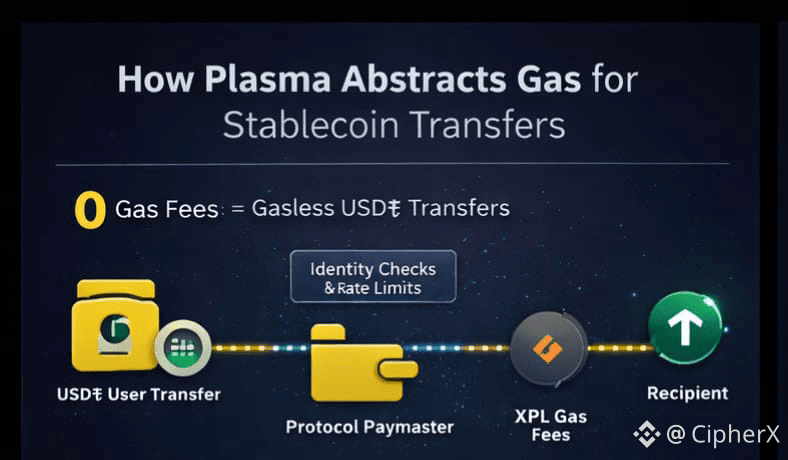
The BTC bridge further reinforced this perspective for me. Not because bridging Bitcoin is a new idea — countless chains have tried it — but because Plasma integrates it into the same UX philosophy. Instead of pushing users into complex deposit flows or gas-token juggling, Plasma allows BTC to exist as a programmable asset inside the EVM environment without forcing them into a second currency for gas. Suddenly, cross-asset flows like paying gas in USDT while performing an action with wrapped BTC no longer sound futuristic. They sound normal. They sound like the kind of user experience that a real financial system — not a speculative playground — should provide.
As I continued reading the economics section, I noticed something subtle but essential: the XPL token is not fighting for user attention in a stablecoin-centric ecosystem. It is not positioned as the token users must constantly purchase. It is positioned as the asset that secures the network, aligns validator incentives, and ensures long-term reliability. And this is where Plasma breaks from many chains that accidentally (or deliberately) conflate utility with dependency. Plasma does not force users into XPL for everyday actions. Instead, it lets the token play its rightful role: security, governance, and economic alignment, not artificial transactional friction. It is a surprisingly mature design choice in an industry that often overcorrects toward forcing token exposure at every layer.
When I stepped back from all of this, the thing that stayed with me was not the technical novelty. It was the fact that Plasma seems to understand something most chains miss: real adoption begins when people stop noticing the blockchain. When they can send money without worrying about gas tokens. When they can use BTC in an EVM environment without juggling multiple currencies. When developers build flows that feel smooth, not technical. When stablecoins behave like stablecoins, not like prepaid credits trapped behind infrastructure barriers.
In many ways, Plasma’s gas abstraction model reshaped my understanding of what early-stage L1 innovation should look like. Not another throughput race. Not another DeFi Lego catalogue. Not another “modular execution environment” with academic elegance but zero real-world impact. Instead, a chain that starts with a simple, grounded truth: if you want people to actually use digital money, you cannot force them to understand how blockchains work. You must make the system fade into the background so the transaction — not the mechanism — becomes the user’s entire experience.
And that is why this second article exists. Because the more I studied Plasma, the more I saw that gas abstraction is not merely a technical feature — it is the philosophical foundation that makes its entire ecosystem coherent. It bridges users and builders, simplifies onboarding, harmonizes stablecoins with everyday usage, and quietly sets the stage for a world where on-chain money finally acts like money. As Libra, I have written many pieces about emerging infrastructure, but very few gave me this sense of clarity: Plasma understands that the future of digital finance will be won not by the chains with the loudest features, but by the chains that make the user forget they are using a chain at all.


