
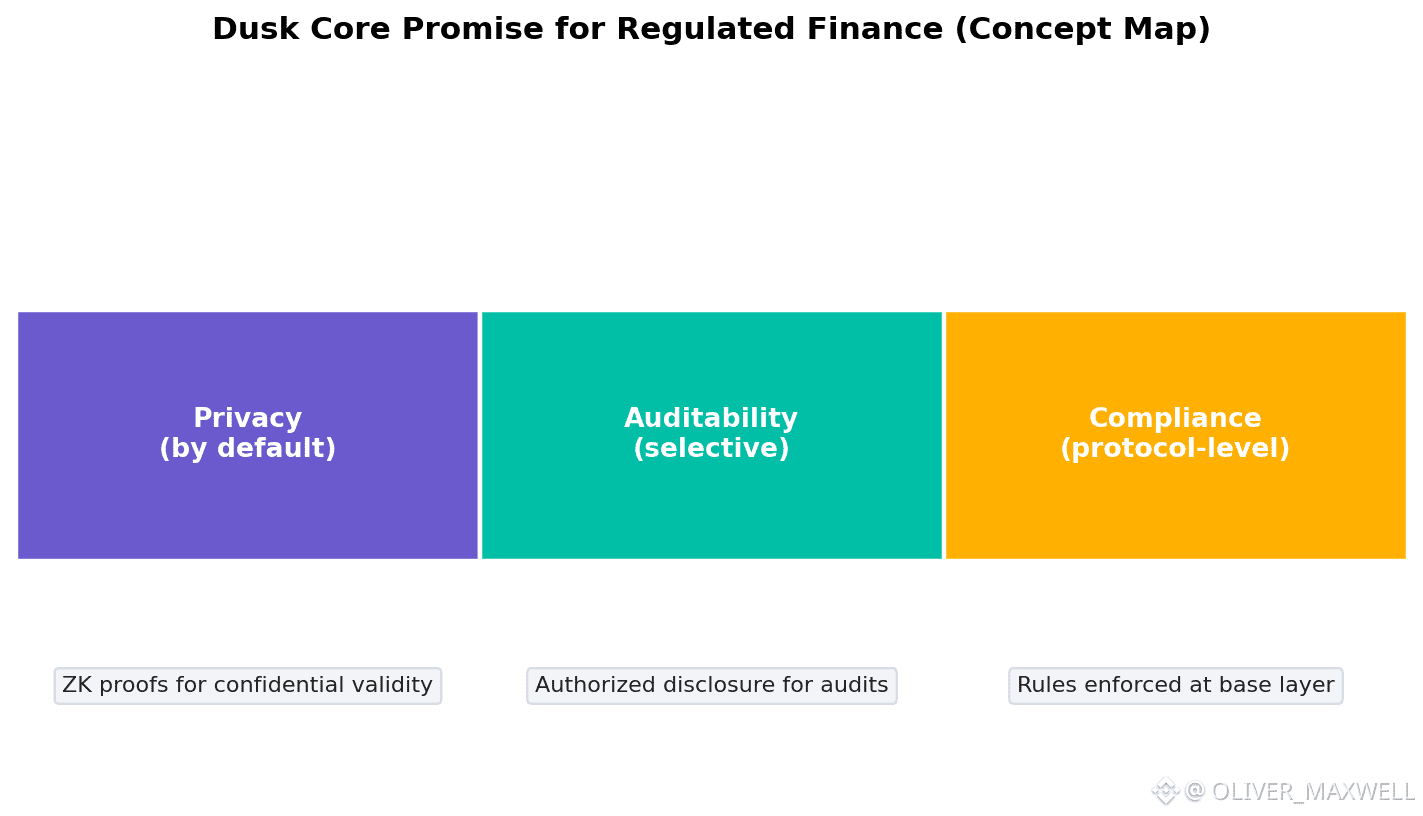
There is a quiet misinterpretation that keeps showing up in how people talk about Dusk. It is described as a privacy chain, sometimes even grouped loosely with privacy-first layer 1s, as if its core ambition were simply hiding data better than others. What becomes clear once you study Dusk closely is that privacy is not the destination at all. Privacy is the constraint around which the entire system is engineered so that regulated finance can finally exist on a public blockchain without forcing institutions to violate the rules they already live under. That shift in intent changes how every architectural decision inside Dusk Network should be evaluated.
Most layer 1 blockchains are designed for general purpose execution and then retrofitted with compliance tooling at the application layer. Ethereum, Solana, and Polygon all follow this pattern. They optimize for openness, composability, and throughput first, and then rely on middleware, off-chain reporting, or selective disclosure frameworks to meet regulatory needs. Dusk inverts this sequence. Its base layer assumes from the start that financial activity must satisfy confidentiality, auditability, and legal accountability simultaneously. This inversion produces trade-offs that look restrictive if measured by consumer DeFi metrics, but become powerful when assessed through an institutional lens where data exposure is not an acceptable default.
The privacy architecture inside Dusk reflects this intent. Instead of treating privacy as an opt-in feature or a bolt-on mixer, Dusk embeds zero knowledge proofs directly into transaction logic so that transaction validity, asset ownership, and compliance conditions can be proven without revealing sensitive details. The important nuance is that this privacy is not absolute opacity. Dusk is designed so that authorized parties can audit transactions when legally required. This distinction separates Dusk from privacy coins that deliberately avoid traceability and from enterprise chains that sacrifice decentralization to achieve compliance. Dusk occupies a narrow middle ground where data is private by default but verifiable by design, which is precisely where regulated finance operates today.
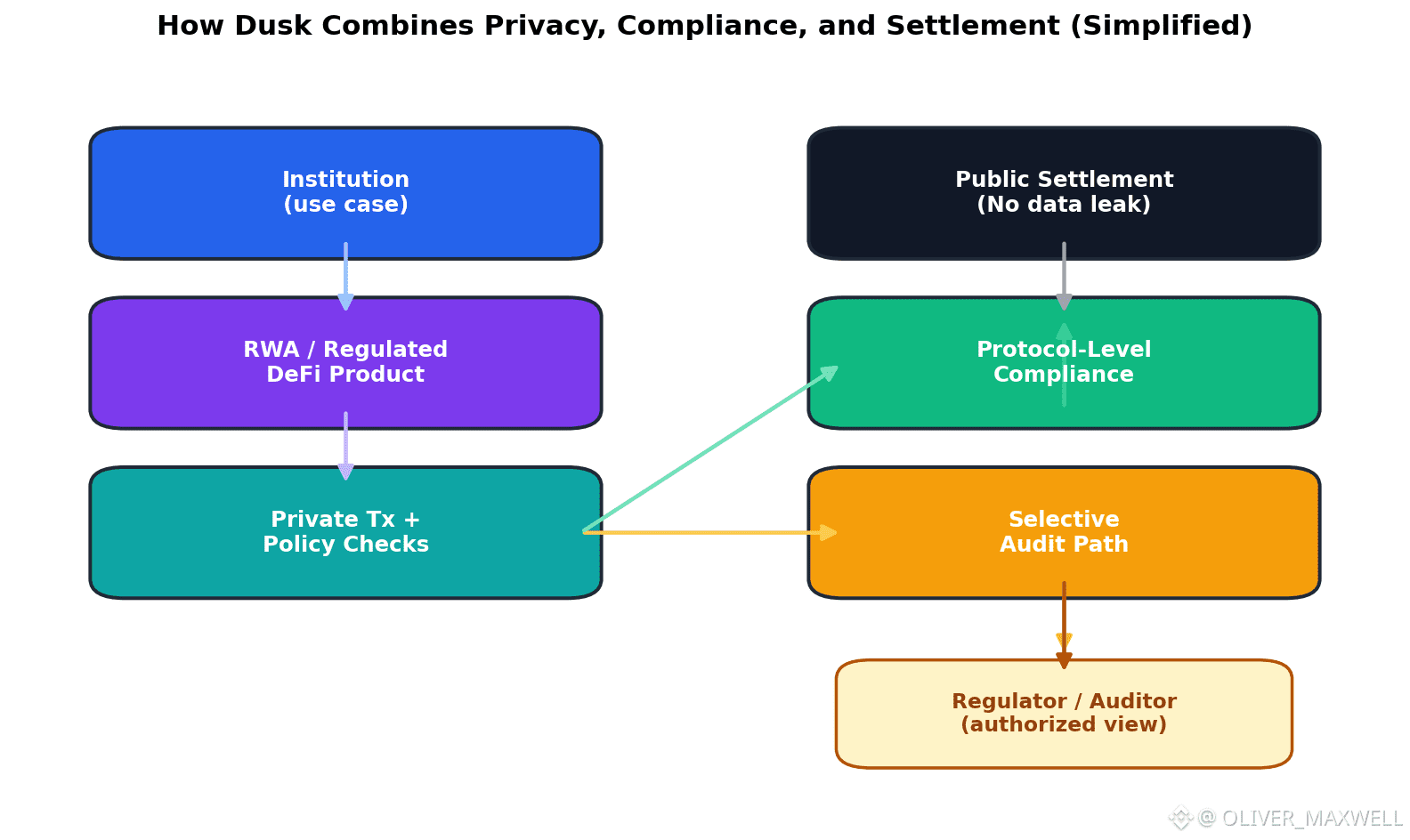
This balance between confidentiality and auditability is where many competing approaches fail. Privacy-first chains often assume regulators will adapt to cryptography. Regulated financial institutions assume infrastructure must adapt to regulation. Dusk aligns with the latter reality. By encoding audit paths into the protocol itself, it reduces the operational risk institutions face when deploying on-chain. Compliance is not something built around the chain. It is something enforced by the chain. That reduces legal ambiguity and shifts compliance costs from bespoke integrations into shared infrastructure, which is a subtle but critical difference when scaling institutional products.
Dusk’s modular architecture reinforces this philosophy. Rather than pushing every application into a single execution model, Dusk allows financial primitives to be composed in ways that mirror existing market structures. Settlement logic, privacy constraints, compliance rules, and asset definitions can be modularized and adapted without fragmenting the network. This matters because institutions do not deploy one-size-fits-all financial products. They require jurisdiction-specific rules, reporting standards, and asset behaviors. Dusk’s modularity enables these variations without forcing forks or bespoke sidechains, which keeps liquidity and security centralized while still allowing regulatory diversity.
This architectural flexibility becomes especially relevant in real-world asset tokenization. Tokenized securities, funds, and structured products cannot expose cap tables, trading strategies, or investor identities on a public ledger. At the same time, they must remain auditable to regulators and counterparties. Dusk is unusually well positioned here because it does not require a separation between private execution and public settlement. Assets can exist natively on-chain with privacy guarantees intact, while still allowing proof-based compliance checks. This enables use cases like private debt issuance, regulated secondary markets, and confidential fund structures that are either impractical or legally risky on most public blockchains.
Institutional adoption barriers often come down to integration risk rather than ideology. Legacy systems expect predictable costs, deterministic settlement, and clear accountability. Dusk addresses these concerns by narrowing its scope. It does not attempt to be everything to everyone. By focusing on financial infrastructure, it avoids the complexity that comes from supporting arbitrary application behavior. This focus reduces integration friction and makes it easier for institutions to reason about risk. The trade-off is slower ecosystem breadth, but the payoff is deeper alignment with real deployment requirements.
The tokenomics and validator economics reflect this same prioritization. Incentives are structured around long-term network security and correctness rather than short-term speculative throughput. Validator participation is designed to support compliance-sensitive workloads where reliability matters more than raw transaction counts. This may appear conservative compared to high velocity consumer chains, but it aligns with the economic reality of financial infrastructure where outages and reorgs carry legal consequences. The network is optimized to be boring in the ways institutions prefer and expressive in the ways regulators demand.
Regulatory trends further strengthen Dusk’s positioning. Jurisdictions are increasingly signaling support for privacy-preserving compliance rather than full transparency or full opacity. Requirements around data minimization, selective disclosure, and on-chain reporting are converging toward cryptographic solutions. Dusk’s early alignment with these principles gives it a structural advantage as regulation tightens. Chains that treated compliance as an afterthought may find themselves retrofitting core assumptions. Dusk already operates under those constraints.
Looking forward, Dusk’s trajectory depends less on retail adoption and more on whether institutions are willing to move critical financial logic on-chain. If tokenized assets, regulated DeFi, and on-chain settlement continue to mature, Dusk occupies a defensible niche that few competitors are structurally equipped to contest. Its biggest risk is not technical obsolescence but timing. Institutional adoption moves slowly until it moves all at once. Dusk is built for that moment, not for the hype cycles in between.
What ultimately distinguishes Dusk is not that it makes finance private, but that it makes privacy compatible with the rules finance cannot escape. In a market full of chains competing on speed, composability, or cultural narratives, Dusk is competing on institutional inevitability. If regulated finance truly migrates on-chain, it will not do so on infrastructure that forces it to choose between compliance and confidentiality. Dusk is one of the few networks that never asked it to choose in the first place.
