

Dusk Network aims to power confidential financial applications, so it needs a consensus layer that’s fast, secure, and tough to manipulate. Most blockchains struggle to hit all of these marks at once. That’s why Dusk developed the Succinct Attestation Protocol SAP for short a consensus system that pulls together efficiency, cryptographic security, and real accountability for validators.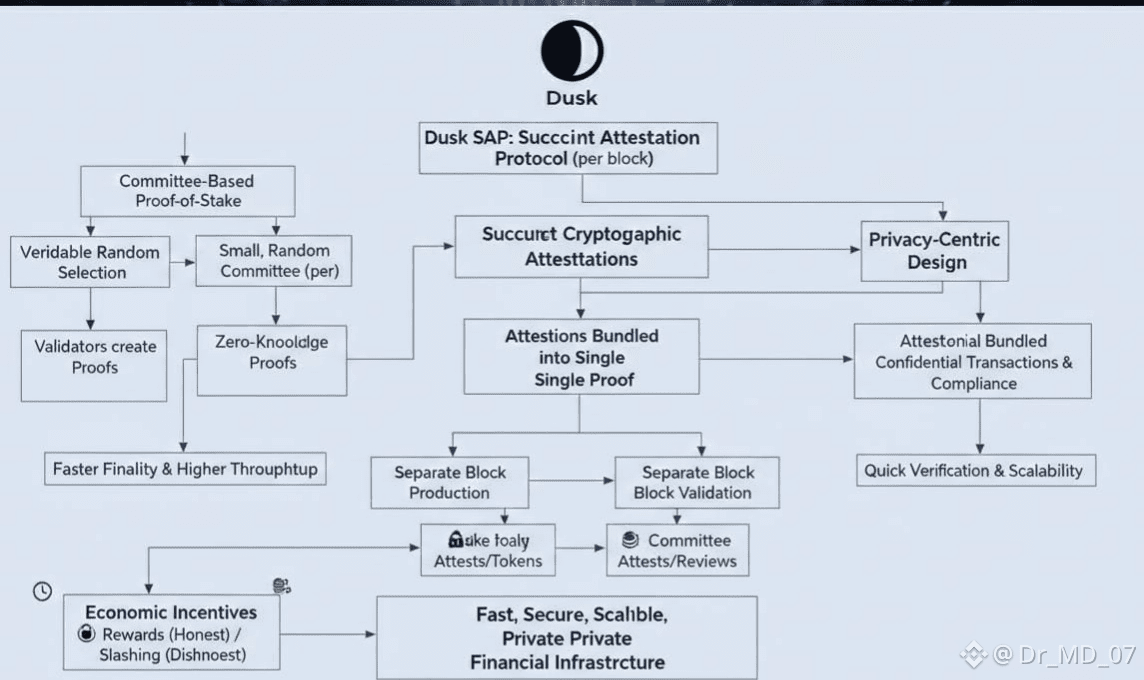
SAP uses a committee based proof of stake design. Rather than dragging every validator into every block decision, Dusk picks a small, random group to form a committee for each block. This makes everything lighter: less chatter across the network, quicker block finalization, better throughput. And it doesn’t give up on decentralization. The selection process uses verifiable randomness, which keeps things unpredictable and stops attackers from gaming the system or forming cliques.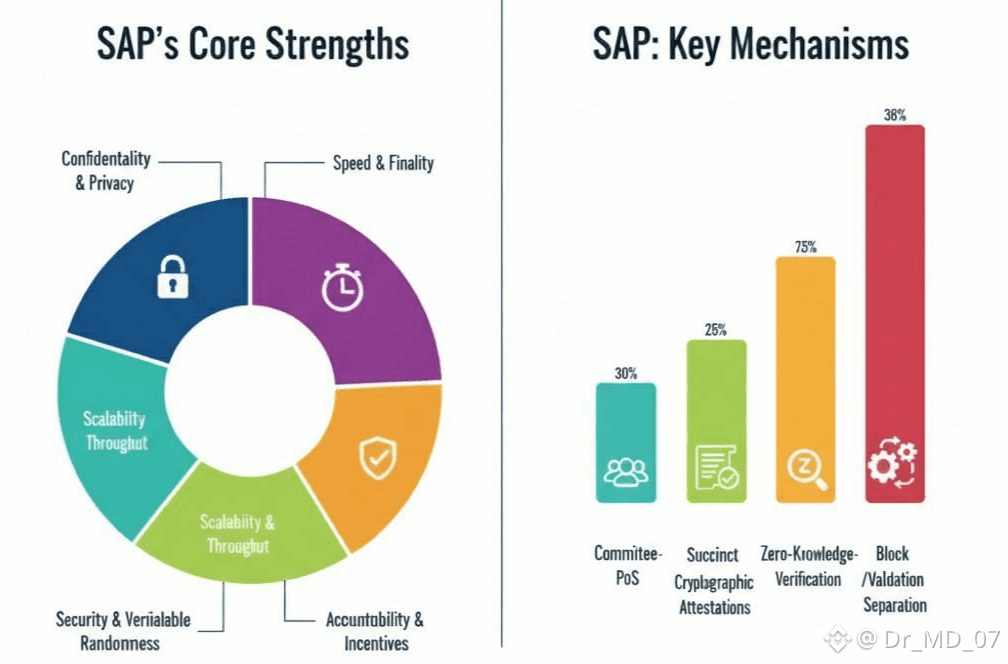
One thing that sets SAP apart is its use of succinct cryptographic attestations. Committee members who validate a block create digital attestations these are cryptographic proofs showing the transactions are sound and the block structure holds up. The network then bundles these attestations into a single, compact proof, which everyone else can quickly check. This keeps data lean and bandwidth low, so the network can scale up without watering down security.
Privacy sits at the heart of SAP’s design. Dusk is built for financial use cases where you need both transaction confidentiality and compliance. SAP backs this up by letting validators confirm state changes without exposing sensitive transaction details. It leans on zero-knowledge-friendly verification and encrypted data handling. As a result, validators can prove transactions are valid without ever revealing private info a must-have for institutions that need secrecy but still want transparent settlement.
SAP also draws a hard line between block production and validation. A chosen leader, or a tiny subset, puts forward blocks. The wider committee reviews and attests to each proposal. That separation cuts down on single-point manipulation and boosts fault tolerance. Even if some validators misbehave or drop offline, as long as enough valid attestations come in, the network keeps moving.
Economic incentives are baked into SAP’s stability. Validators have to stake DUSK tokens to take part. Honest actors earn block rewards and transaction fees. Dishonest or disruptive behavior? That hits their stake. This setup keeps validators motivated to stick around and act right. The bigger the participating validator set, the stronger the security.
Finality under SAP is fast and certain. Once a block collects enough valid attestations, it’s finalized for good no waiting around, no risk of reversal. That speed is critical for financial apps, where delays can mean risk and wasted resources. SAP’s rapid settlement means Dusk can handle real-time transactions and high-frequency trading.
Scalability is another strong suit. Only a subset of validators get involved in each round, so the protocol dodges the heavy communication burden that slows down other systems. This keeps hardware demands in check and opens the door for more people to join as validators, which helps spread out network control.
In short, the Succinct Attestation Protocol is purpose-built for Dusk’s vision: confidential, high-speed financial infrastructure. With its committee-based design, aggregated cryptographic attestations, smart incentives, and privacy-first approach, SAP strikes a balance between speed, security, and scalability. It’s the backbone that lets Dusk meet the real-world demands of modern blockchain finance.
