

When people talk about blockchain vision, it often sounds abstract or overly ambitious. What stands out about Dusk is that its vision is grounded in a very specific question: how do digital assets truly fit into the global economy, not just as speculative tokens, but as regulated financial instruments and representations of real-world value,Dusk’s long-term direction is not about disrupting finance for the sake of it, but about redesigning the underlying infrastructure so it works better, costs less, and respects both decentralization and law.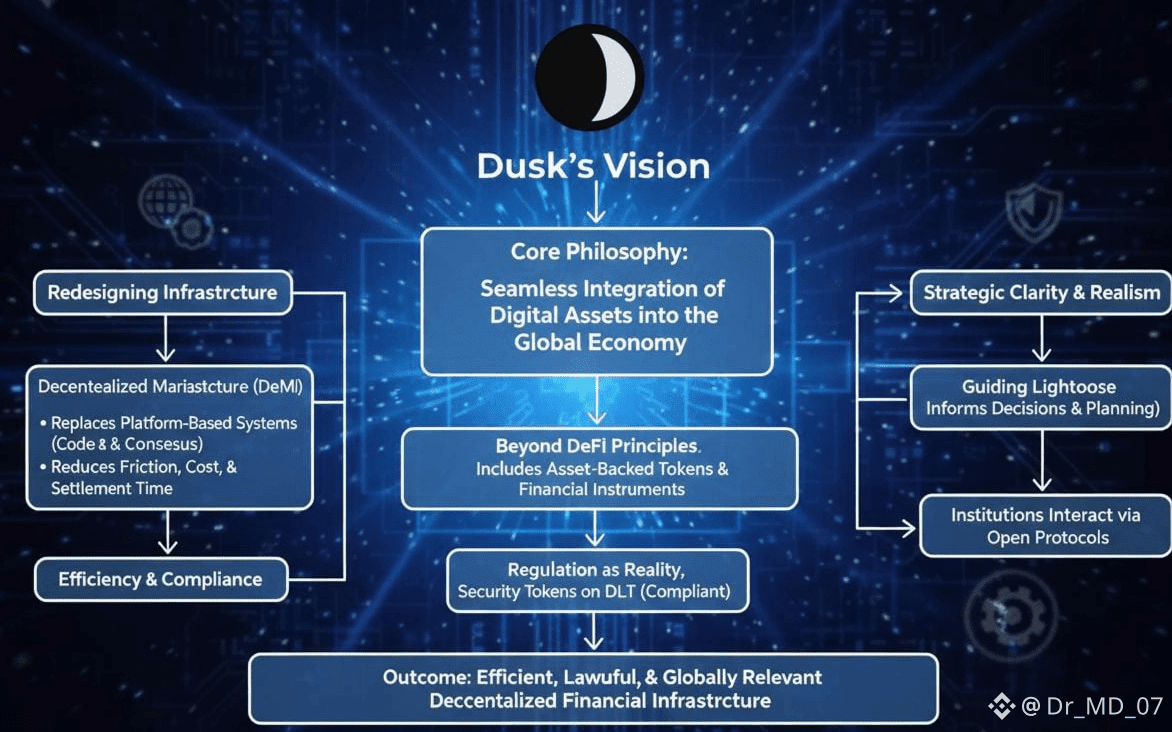
At the center of Dusk’s vision is the idea that digital assets should be seamlessly integrated into the decentralized global economy. That word “seamlessly” matters here in a practical sense, not as a buzzword. It reflects an environment where issuing, transferring, and settling digital assets does not require friction-heavy intermediaries, fragmented platforms, or opaque processes. Instead, the blockchain itself becomes the foundation for how assets move and are governed.
One important way Dusk’s vision differs from traditional DeFi narratives is how it expands the scope of what decentralized finance actually means. For years, DeFi has largely focused on utility tokens that exist only within crypto-native ecosystems. These assets rarely overlap with traditional finance and usually operate outside established legal frameworks. Dusk intentionally moves beyond that narrow focus. Its vision extends DeFi principles to the entire spectrum of digital assets, including asset-backed tokens that represent real-world goods or financial instruments.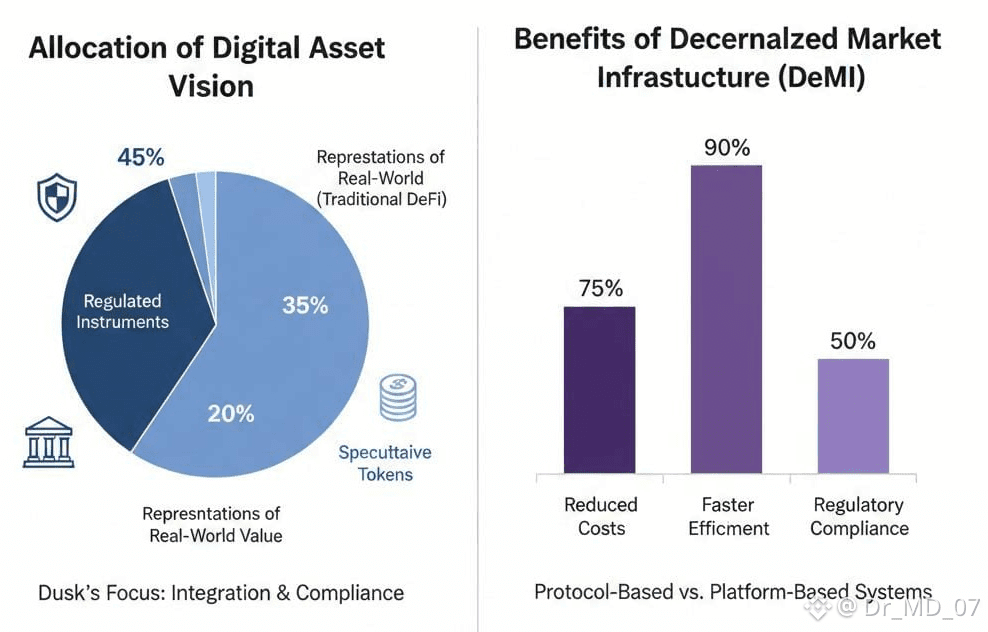
This is where regulated assets come into the picture. Dusk treats regulation not as an obstacle, but as a reality of global finance. Securities, for example, are among the most important asset classes in the world, yet traditional systems for issuing and managing them rely on complex, centralized infrastructure. Dusk envisions security tokens as the digital representation of these instruments on distributed ledger technology, allowing them to exist on-chain while remaining compliant with the law.
To support this broader vision, Dusk introduces the concept of Decentralized Market Infrastructure, or DeMI. This is a foundational shift in how financial markets can be organized. Today’s markets depend heavily on centralized platforms such as Central Securities Depositories. These entities act as trusted intermediaries but come with high costs, slow settlement times, and operational inefficiencies. DeMI replaces platform-based systems with protocol-based infrastructure, where rules are enforced by code and consensus rather than by a single controlling institution.
The practical benefit of this approach is efficiency. By leveraging distributed ledger technologies, DeMI reduces the need for reconciliation between multiple parties, shortens settlement cycles, and lowers operational costs. For regulated markets, this is not a small improvement. It has the potential to change how capital moves, how ownership is recorded, and how compliance is handled across borders.
What makes Dusk’s vision compelling from a professional perspective is its realism. It does not assume that traditional finance will disappear, nor does it expect regulators to step aside. Instead, it imagines a future where decentralized protocols provide the underlying rails for regulated financial activity. In this model, institutions interact with blockchain not through closed platforms, but through open, standardized protocols that anyone can verify.
Another key aspect of the vision is strategic clarity. Dusk frames its vision as a guiding lighthouse, not a distant dream. It is meant to inform day to day decisions, technical development, and long-term planning. That focus on constant reassessment is important in a fast-evolving industry. Rather than chasing trends, the project uses its vision as a filter to decide what belongs in its ecosystem and what does not.
From my point of view, this approach reflects a mature understanding of where blockchain can add the most value. Speculative cycles come and go, but infrastructure lasts. By targeting the backbone of financial markets rather than surface-level applications, Dusk positions itself in a space where progress may be slower, but impact is deeper. Building systems that institutions and regulators can trust takes time, but it also creates stronger foundations.
Dusk’s vision ultimately revolves around integration, not isolation. Digital assets are not treated as a parallel economy detached from reality, but as a natural extension of existing financial systems, improved through decentralization. By extending DeFi principles to regulated assets and redefining market infrastructure through DeMI, Dusk outlines a future where blockchain is not just innovative, but essential.
This vision does not promise instant transformation. Instead, it offers a structured path toward a decentralized financial infrastructure that is efficient, lawful, and globally relevant. In a space often dominated by short-term thinking, that long-term clarity is what gives Dusk’s vision real weight.
