Walrus reframes data storage as an active programmable layer rather than a passive commodity
Instead of treating files as offchain objects Walrus turns every uploaded blob into an onchain controlled asset
Ownership permissions and lifecycle rules can be enforced directly by smart contracts
This transforms storage from a background service into a composable primitive for decentralized applications
How Proof of Availability actually works
When data is uploaded it is first processed through an advanced erasure encoding system called Red Stuff
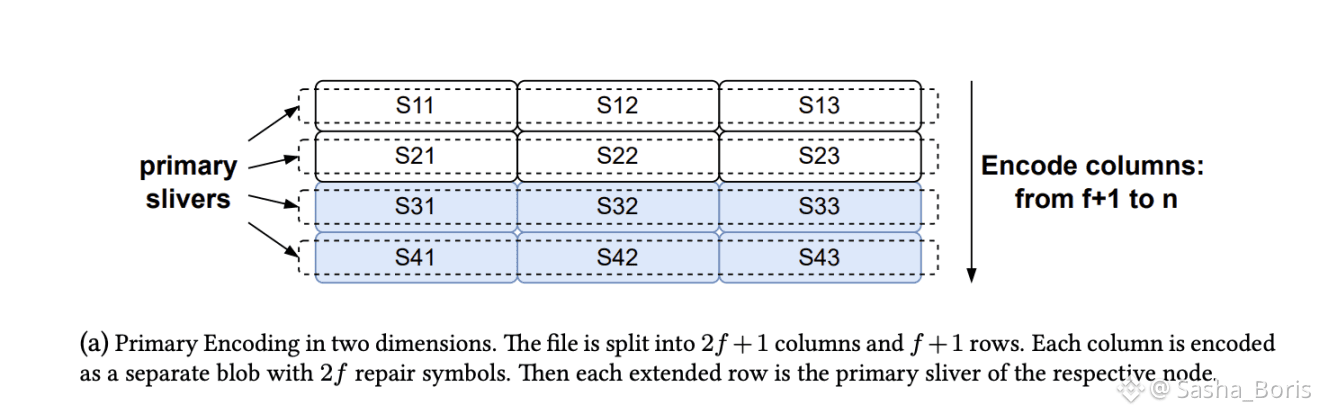
The blob is split into a two dimensional grid of slivers with cryptographic commitments assigned to each piece
Storage nodes independently verify these commitments and sign acknowledgements once they confirm custody
A quorum of these signatures is aggregated and recorded onchain forming the Proof of Availability certificate
This certificate proves that real data is being held by real nodes at a specific point in time
Why this model is different from traditional storage proofs
Most decentralized storage systems rely on periodic challenges to prove data existence later
Walrus focuses on guaranteeing availability at write time which is when applications actually depend on the data
If a write certificate is produced the network can mathematically guarantee that the blob can be reconstructed
This shifts trust from long term promises to immediate cryptographic certainty
Red Stuff and cost efficiency
Red Stuff is designed to tolerate failures malicious behavior and network instability without full replication
Instead of storing many full copies Walrus stores intelligently distributed fragments
Only a subset of slivers is required for full recovery which significantly reduces cost
This makes Walrus viable for large datasets such as AI model weights video archives and analytics logs
The economic layer behind availability
Storage nodes stake WAL to participate in committees
Stake aligns incentives so nodes risk capital if they behave dishonestly or fail repeatedly
Pricing is determined through stake weighted mechanisms that reduce manipulation
As usage grows storage payments contribute to token demand while inefficient operators are gradually filtered out
What evolved recently and why it matters
Walrus mainnet introduced several production grade features that expand its real world usability
Seal enables encrypted storage with programmable access rights
This allows private datasets to live on decentralized infrastructure without exposing sensitive information
Quilt solves the inefficiency of storing many small files by bundling them into optimized units
This dramatically improves developer experience for consumer and enterprise applications
Upload Relay improves reliability for mobile and web clients by handling unstable network conditions during writes
Together these upgrades move Walrus from experimental storage into practical infrastructure
Programmable storage as an application layer
Because blobs are represented as onchain objects applications can trade lease or revoke access dynamically
Smart contracts can control who can read modify or monetize stored data
This enables new design space including data marketplaces dynamic NFTs and AI coordination layers
AI and agent native use cases
Walrus is particularly suited for AI systems that require large files and verifiable integrity
Model checkpoints training datasets and inference artifacts can be stored with cryptographic guarantees
With encrypted access controls AI agents can collaborate without leaking proprietary data
This enables decentralized fine tuning shared research and auditable AI pipelines
Cross ecosystem positioning
While Sui acts as the coordination and settlement layer the data plane itself remains chain agnostic
Applications from other ecosystems can use Walrus purely as storage without migrating execution logic
This separation allows Walrus to function as neutral infrastructure rather than a single chain dependency
Cost and performance tradeoffs
Walrus balances availability guarantees with realistic pricing
Erasure encoding reduces storage overhead while still preserving strong recovery guarantees
For builders this creates a middle ground between centralized cloud storage and heavy replication based networks
Things builders should plan for
Design retrieval logic with awareness of shard distribution
Monitor epoch transitions since committees rotate over time
Integrate encryption early if compliance or privacy is required
Test Upload Relay for consumer facing applications where connections are unreliable
Open challenges to watch
Economic tuning such as slashing thresholds and reward curves must avoid centralization pressure
As usage grows network bandwidth and retrieval latency optimization will become increasingly important
Cross chain developer tooling will largely determine adoption outside the Sui ecosystem
The bigger picture
Walrus is not trying to replace cloud storage directly
It is building a new category where data becomes verifiable programmable and economically aligned
Instead of trusting storage providers users rely on math incentives and onchain guarantees
Final takeaway
Walrus turns data into an owned and provable digital resource
Proof of Availability ensures that when applications depend on data it truly exists and can be recovered
As decentralized applications expand into AI finance and real world data workflows this model becomes increasingly critical