
I didn’t start thinking about digital currencies because of crypto. I started thinking about them because of friction.
The kind of friction that still exists in payments, even after decades of innovation. Delayed settlements. Cross-border transfers that take days. Layers of intermediaries quietly adding cost, risk, and complexity. When stablecoins entered the conversation, they felt like relief—money that could move as fast as the internet. But as adoption grew, it became clear that speed alone wasn’t enough. The real challenge wasn’t moving money. It was settling it properly.
That realization deepened when central banks began discussing digital currencies. The Digital Euro, in particular, changed the tone of the conversation. This wasn’t an experiment or a startup product. It was money itself entering a new form. And money, especially at that level, demands structure, accountability, and trust.
That’s where Dusk quietly enters the picture.
Not as a flashy payment app. Not as a speculative chain. But as something more fundamental—a settlement layer designed for regulated digital money.
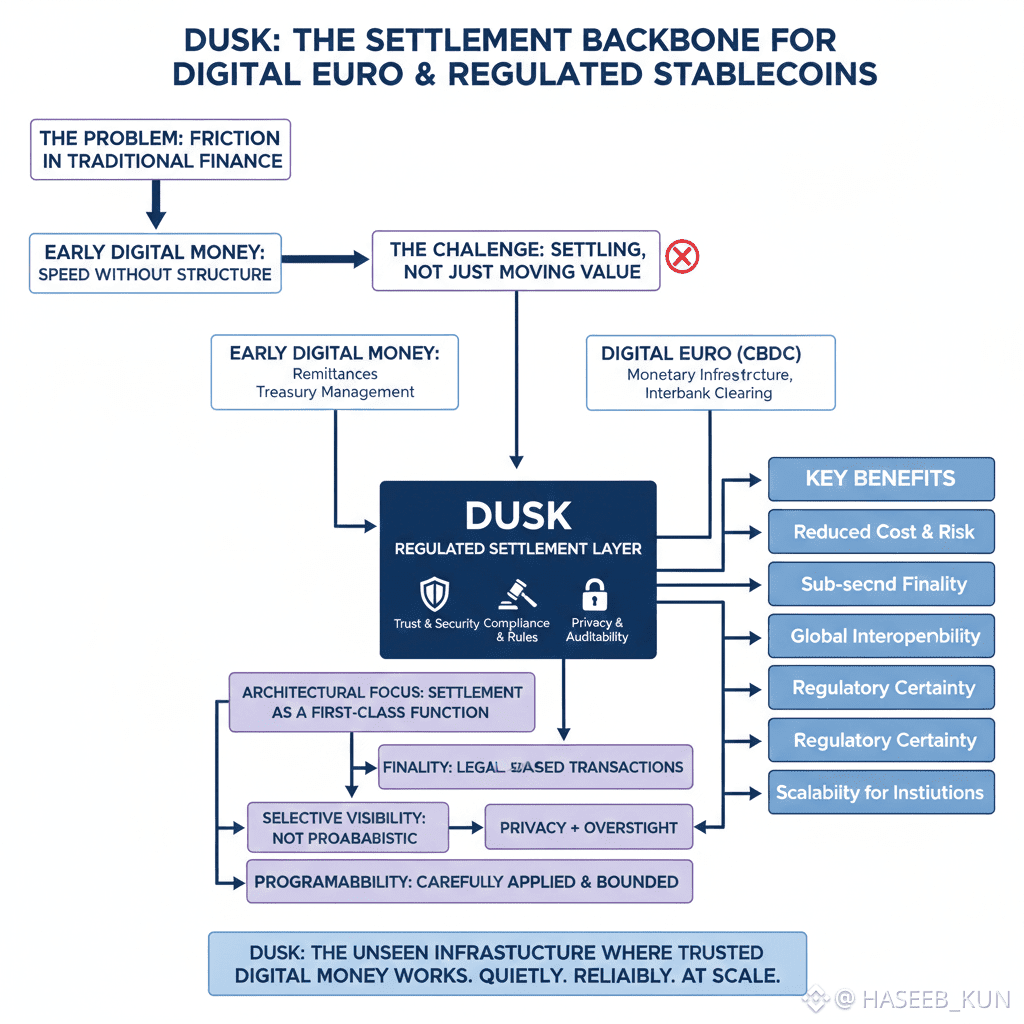
Why Settlement Is the Real Battleground
Most people talk about payments as if they end when value moves from one wallet to another. In regulated finance, that’s only half the story. What matters just as much is what happens after the transfer: finality, reconciliation, auditability, and legal certainty.
Settlement is where financial systems either hold together—or fall apart.
Traditional banking systems are slow because they prioritize settlement integrity. Many blockchains are fast because they ignore it. Stablecoins and CBDCs sit right in the middle. They need speed, but they cannot sacrifice control, compliance, or trust.
Dusk was built for this exact tension.
Its architecture treats settlement as a first-class function. Not something layered on later. Not something handled off-chain. Settlement logic lives inside the system, shaped by rules that regulators, institutions, and issuers can rely on.
This is why Dusk makes sense as a settlement layer for regulated stablecoins and the Digital Euro.
When Stablecoins Stop Being “Crypto”
Stablecoins used to feel like a bridge—useful, but temporary. Today, they feel more like infrastructure.
They are used for payroll, treasury management, remittances, and institutional liquidity. As their role expands, so does scrutiny. Issuers are expected to prove reserves. Transactions must be traceable. Compliance isn’t optional anymore.
Most blockchains struggle here because they were never designed for regulated money. Transparency is either too broad or too limited. Controls are either rigid or nonexistent.
Dusk approaches this differently.
As a settlement layer, it allows stablecoins to operate under clear, enforceable rules. Transfers settle with defined finality. Compliance logic can be embedded directly into settlement processes. Audit trails exist without exposing sensitive data publicly.
This balance is what regulated stablecoins actually need—not permissionless chaos, and not centralized black boxes.
The Digital Euro Changes the Stakes
The Digital Euro isn’t about replacing cash or competing with private payment apps. It’s about modernizing monetary infrastructure while preserving trust.
That means privacy for citizens, oversight for regulators, and reliability for institutions. It also means that the underlying settlement layer cannot behave like a speculative network. It must feel boring in the best way possible.
Predictable. Auditable. Stable.
Dusk fits this role naturally.
Rather than positioning itself as a consumer-facing currency layer, Dusk acts underneath—handling settlement between institutions, clearing obligations, and enforcing monetary rules. For a CBDC like the Digital Euro, this separation is essential. It allows innovation without destabilizing the system.
Dusk doesn’t replace central banks. It supports them.
Privacy Without Losing Oversight
Privacy is one of the most sensitive aspects of digital currencies. Citizens fear surveillance. Institutions fear leaks. Regulators fear blind spots.
Most systems force a tradeoff.
Dusk avoids that trap.
Its settlement model allows selective visibility. Transactions can remain private where appropriate, while still being auditable under defined conditions. Regulators can enforce rules without monitoring every movement. Institutions can report without exposing clients.
For the Digital Euro and regulated stablecoins, this is not a nice-to-have. It’s a requirement.
Privacy on Dusk isn’t about hiding. It’s about respecting boundaries.
Finality That Feels Like Finance, Not Probability
In traditional finance, settlement finality is legal, not statistical. Once something is settled, it’s settled. There’s no “high probability” or “likely final.”
Many blockchains rely on probabilistic finality. That works for open networks, but it doesn’t work for regulated money.
Dusk treats finality as a rule, not a guess.
Settlement on Dusk happens within clearly defined conditions. Once those conditions are met, finality is absolute. This aligns with how banks, clearing houses, and central banks already think about money.
For CBDCs and stablecoins, that alignment is everything.
Why Institutions Think in Layers
Institutions don’t want to manage dozens of blockchains. They want a single, reliable settlement backbone that different systems can plug into.
That’s where Dusk positions itself.
Payment interfaces can evolve. Wallets can change. User experiences can improve. But underneath, settlement must remain consistent.
Dusk provides that consistency.
Stablecoin issuers can settle issuance and redemption securely. Banks can clear interbank transfers. Central banks can oversee digital currency flows without micromanaging them.
The system stays quiet. The value moves correctly.
Cross-Border Settlement Without Breaking Rules
Cross-border payments are one of the biggest promises of digital currencies—and one of the hardest problems to solve.
Different jurisdictions. Different regulations. Different reporting requirements.
Dusk’s settlement-focused design allows rules to be enforced at the protocol level. Compliance logic can travel with the transaction. Settlement conditions can adapt to jurisdictional needs.
For a Digital Euro interacting with global stablecoins, this matters more than raw speed. Without structured settlement, cross-border digital money becomes fragile.
Dusk adds structure where it’s needed most.
Programmable Money, Carefully Applied
Programmability is powerful, but uncontrolled programmability is risky—especially for sovereign and regulated currencies.
Dusk treats programmability as a tool, not a toy.
Settlement logic can automate payments, enforce conditions, and reduce operational overhead, but always within predefined boundaries. This allows innovation without undermining stability.
For the Digital Euro, this means smart features that respect monetary policy, legal frameworks, and systemic risk.
Progress without recklessness.
Why Dusk Feels Like Infrastructure
Some blockchains feel like products trying to find users. Others feel like experiments chasing narratives.
Dusk feels like infrastructure.
It doesn’t ask for attention. It earns trust by solving unglamorous problems well. Settlement, compliance, privacy, finality—these aren’t exciting topics, but they are the ones that matter when real money moves.
That’s why Dusk aligns so naturally with regulated stablecoins and CBDCs. These systems don’t need hype. They need reliability.
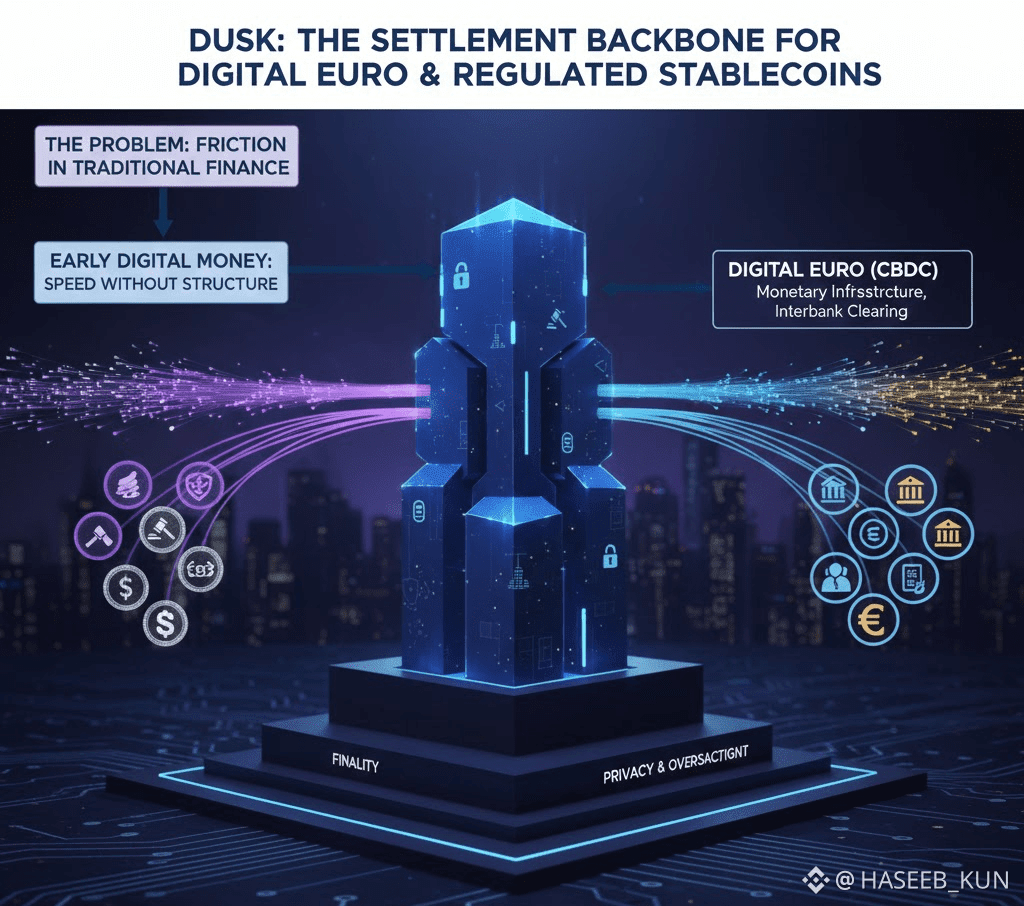
The Quiet Role That Shapes the Future
If the Digital Euro succeeds, most people will never think about how it settles. And that’s exactly the point.
Settlement layers aren’t meant to be noticed. They’re meant to work.
Dusk is building for that future—a future where regulated digital money moves efficiently, settles correctly, and earns trust by behaving predictably.
Not loudly.
Not aggressively.
But reliably.
Closing Thought
As digital currencies mature, the conversation will shift. Away from speed. Away from novelty. Toward settlement, structure, and trust.
Dusk is already there.
By positioning itself as a settlement layer for regulated stablecoins and the Digital Euro, Dusk isn’t chasing the future. It’s preparing for it—quietly, carefully, and with intent.
Because when money changes form, settlement is what keeps it real.
