

Decentralized storage has long been treated as a philosophical extension of blockchains rather than a piece of real infrastructure. While blockchains excel at settlement, ownership, and coordination, they consistently fail at holding the actual substance of digital systems: images, documents, datasets, models, and media. This gap becomes obvious the moment a project attempts to move anything non‑trivial on‑chain and discovers that most decentralized storage solutions either feel experimental, fragile, or economically impractical. Walrus enters this gap not as a manifesto, but as an attempt to turn decentralized storage into something predictable, durable, and usable at scale.
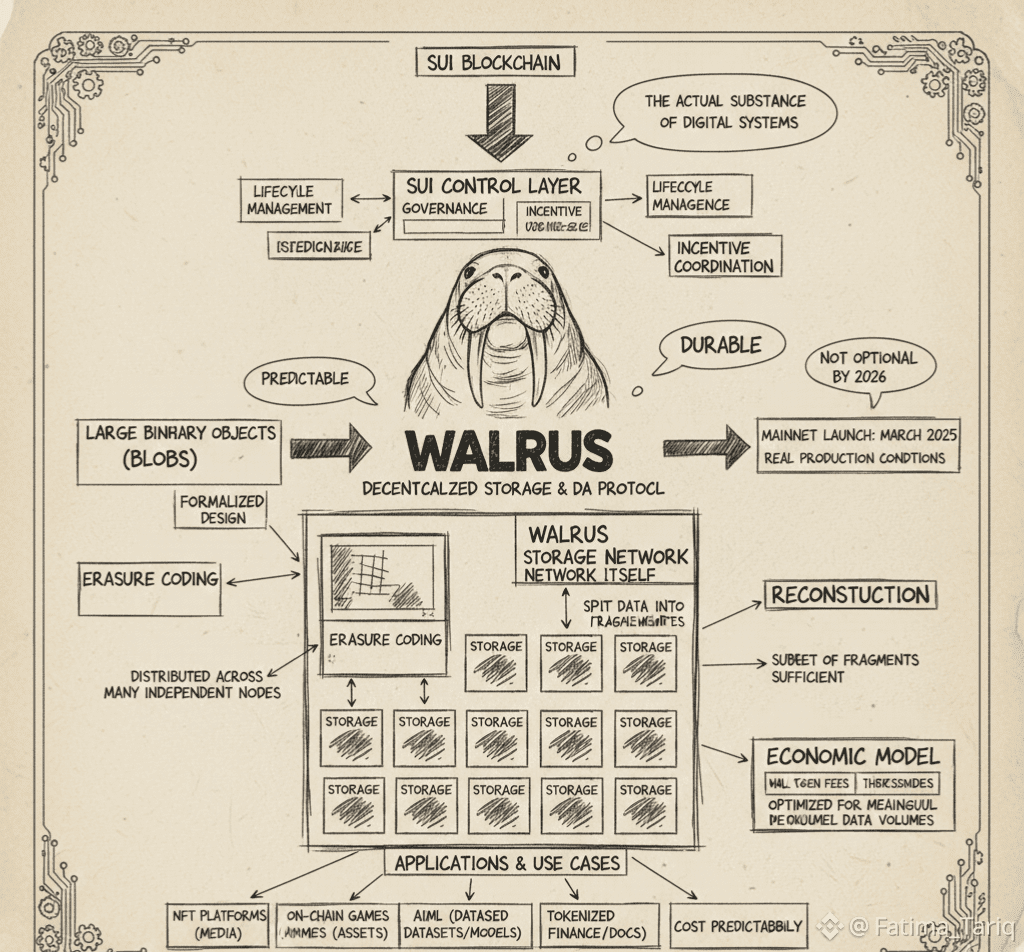
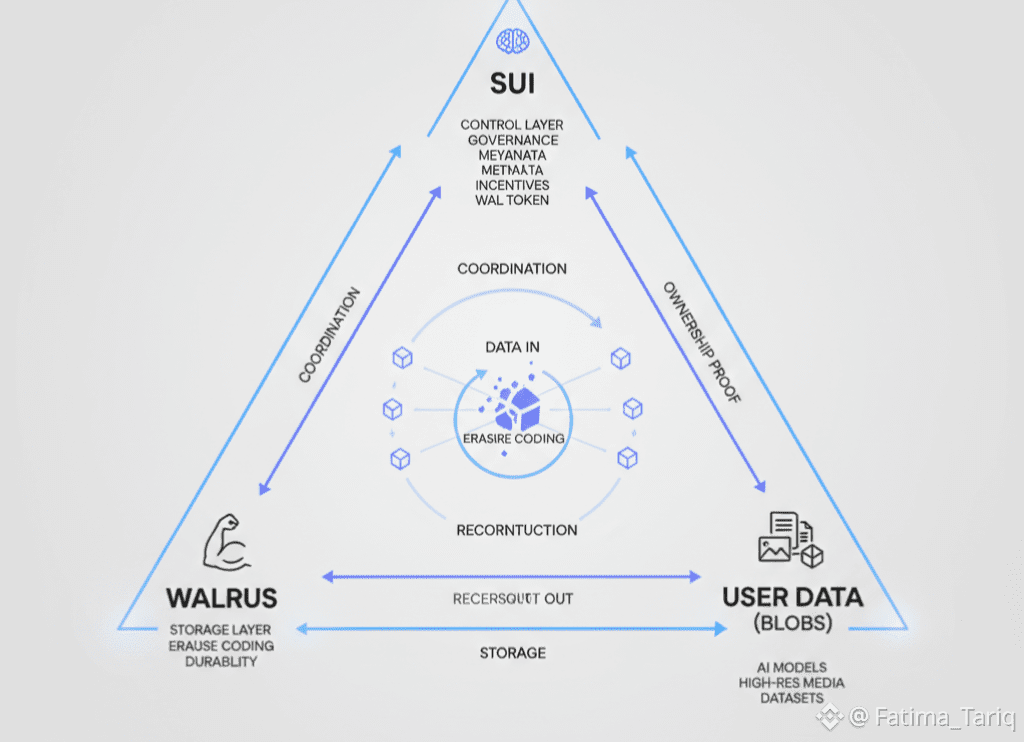
Walrus was introduced publicly by Mysten Labs in mid‑2024 as a decentralized storage and data availability protocol purpose‑built for large binary objects, or “blobs.” Rather than creating a new blockchain to coordinate storage behavior, Walrus uses Sui as its control layer, relying on Sui for lifecycle management, governance, and incentive coordination while focusing engineering effort on the storage network itself. This architectural separation is significant because it treats storage as a specialized system rather than forcing it to inherit the constraints of a general‑purpose execution layer.
The technical foundation of Walrus was formalized through a whitepaper released in September 2024, followed by expanded research publications in 2025. At the core of the design is erasure coding, a technique that splits data into fragments distributed across many independent storage nodes. Unlike full replication, which stores entire copies everywhere and quickly becomes expensive, erasure coding allows the original data to be reconstructed as long as a sufficient subset of fragments remains available. This approach is intended to balance durability and cost efficiency at a scale of hundreds of nodes, aligning Walrus more closely with infrastructure economics than experimental storage networks.
These design choices became materially meaningful when Walrus launched on mainnet on March 27, 2025. This transition marked the point where storage claims could be evaluated under real production conditions rather than theoretical guarantees. Mainnet deployment exposed Walrus to real‑world variables such as node availability, retrieval latency, operational costs, and developer experience, shifting the conversation from ideology to performance. In decentralized infrastructure, shipping a live system is often more informative than any whitepaper, because it reveals which tradeoffs survive contact with reality.
From a practical standpoint, Walrus is engineered around the needs of applications that cannot tolerate data loss or unpredictable availability. NFT platforms require permanent media storage, on‑chain games depend on asset persistence, AI applications rely on large datasets and model artifacts, and tokenized finance increasingly depends on document integrity and audit trails. In each of these cases, storage must be reliable enough that developers stop designing contingency systems around failure. Walrus’s emphasis on durability, availability thresholds, and cost predictability reflects an attempt to meet those expectations rather than merely gesture toward decentralization.
However, the system does not hide its complexity. Walrus documentation acknowledges that writing and reading blobs involves a significant number of requests, reflecting the distributed work required to fragment, distribute, certify, and reconstruct data across nodes. Writing a blob can involve thousands of requests, while reads require hundreds, depending on access patterns. This is not presented as a flaw, but as an honest reflection of the work performed beneath the surface. It also highlights that tooling, SDKs, and developer abstractions are as important as cryptographic design for real adoption.
Walrus’s economic model further reinforces its infrastructure orientation. Storage operations involve WAL token fees combined with SUI gas fees for on‑chain coordination, and costs behave differently depending on blob size. Documentation notes that small blobs can be disproportionately expensive due to fixed metadata overhead, with more efficient cost behavior emerging at larger sizes. This transparency forces developers to design realistically rather than assume storage is infinitely cheap, and it signals that Walrus is optimized for meaningful data volumes rather than micro‑payloads.
The timing of Walrus’s emergence also matters. By 2026, decentralized storage is no longer optional for applications that claim to be resilient or censorship‑resistant. AI systems require verifiable data availability, social platforms require durable media hosting, and financial applications require long‑term record integrity. Centralized storage undermines these claims the moment an outage, policy change, or legal intervention occurs. Walrus positions itself as a response to this inevitability, offering storage that behaves more like infrastructure than an ideological experiment.
From an investment and ecosystem perspective, Walrus is notable for what it does not promise. It does not claim instant mass adoption, zero‑cost storage, or perfect decentralization. Instead, it exposes constraints, publishes cost models, and ships production systems. This posture makes it easier to evaluate as infrastructure rather than narrative. The value proposition is not speculative excitement, but the slow accumulation of usage by builders who need storage to work reliably without negotiating exceptions.
Ultimately, Walrus matters because it attempts to make decentralized storage boring in the best sense of the word. When storage becomes predictable, programmable, and durable, developers stop debating whether it is viable and start treating it as a standard component. At that point, value is driven by usage rather than attention. Walrus is not competing for hype cycles; it is competing to become part of the invisible foundation that digital systems quietly depend on. And in infrastructure, permanence is often the most defensible advantage.
#Walrus #LearnWithFatima $WAL @Walrus 🦭/acc #BinanceSquareTalks #BinanceSquareFamily #creatorpad

