
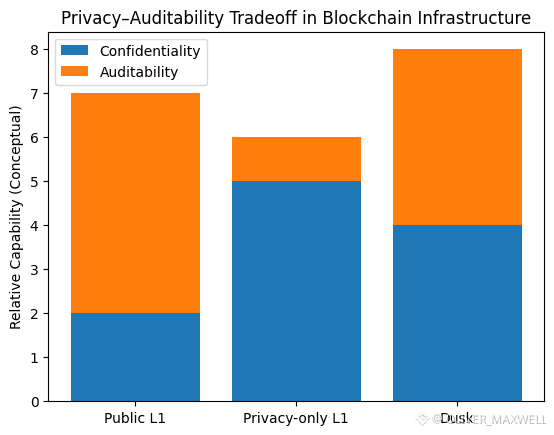
Most blockchains treat regulation like a wrapper. Add identity checks at the edge, publish everything on-chain anyway, and hope institutions accept the trade. Dusk starts from the opposite assumption. In regulated finance, the real constraint is not the rulebook. It is the information leakage that the rulebook forces you to manage. A bank can satisfy reporting obligations today, but it cannot casually expose balances, counterparties, inventory, and client flows to the entire internet without creating new risks that regulators never asked for in the first place. Dusk matters because it reframes privacy as the missing operational control in on-chain finance, not as an ideological preference.
That framing explains why Dusk’s design choices feel closer to market infrastructure thinking than to typical crypto architecture. The project was founded in 2018 with a clear thesis around regulated financial use cases, and its mainnet arrived through a phased rollout that culminated in the first immutable block in early January 2025. The timing is important because it means Dusk has been building through a period where tokenization moved from experiments to production planning inside established institutions, and the requirements hardened. In that world, “decentralization” is not the sales pitch. Deterministic settlement, controllable disclosure, and audit-readiness are. Dusk positions itself as a chain where those expectations are native rather than bolted on.
The most underappreciated part of Dusk is the way modularity is used as a compliance tactic, not just a scalability tactic. Dusk has been evolving into a layered stack where the settlement and data layer is intentionally separated from the execution layer, with an additional privacy-focused layer planned in the architecture roadmap. In institutional terms, that separation reduces audit scope. You can stabilize the settlement guarantees and data availability assumptions, then iterate on application behavior without constantly re-litigating the base ledger’s security model. In practice, this is how regulated systems are upgraded. The core rails change slowly. The products on top evolve faster. Dusk is one of the few chains that seems to internalize that governance reality in its technical roadmap.
Privacy on Dusk is also not a single feature. It is a portfolio of privacy mechanisms designed to map onto different financial confidentiality problems. At the transaction model level, Dusk has built Phoenix, a privacy-preserving model designed for confidential transfers and programmable use, and it has been treated as a first-class component of the protocol’s design. What matters here is not the buzzword of zero knowledge. It is the operational outcome. Institutions need confidentiality for balances and flows, but they also need the ability to prove correctness when disputes, audits, or supervisory reviews occur. Dusk’s public framing consistently emphasizes that dual objective, confidentiality in normal operation and verifiability when properly authorized.
This is where Dusk’s newer work around confidential execution becomes strategically interesting. In its modular evolution, Dusk introduced a privacy engine for its execution environment that combines homomorphic encryption with zero-knowledge proofs to enable confidential activity that can still be made auditable under the right conditions. That combination is not an academic flex. It is aimed at a very specific pain point in regulated markets. If you want on-chain order books, inventory management, or position reporting for regulated instruments, you cannot run them fully transparent without creating front-running, signaling, and client confidentiality issues. But if you run them fully opaque without a disclosure path, you create supervisory dead ends. Dusk is explicitly designing for that middle zone where privacy and auditability are both engineered outcomes rather than competing values.
Real-world asset tokenization is often discussed as if the hard part is putting an asset on-chain. In reality, the hard part is lifecycle management under legal constraints. Issuance is only the beginning. You need transfer restrictions, investor eligibility logic, corporate actions, record dates, redemptions, and reporting. Dusk’s approach here is to treat tokenized securities as a specialized contract standard. Its Confidential Security Contract standard is positioned as the on-chain container for regulated issuance and trading flows, with privacy characteristics aligned to how investor and position data must be handled. Dusk has described this as a way to keep the asset management lifecycle synchronized on-chain while maintaining end-user privacy, which is exactly the requirement set that breaks most generic token models.
A useful way to see the difference is to focus on who bears the compliance cost. In many tokenization models, the chain is neutral and the issuer takes on the full burden. Every downstream market participant must integrate their own policy stack, and the system becomes fragmented quickly. Dusk is aiming for something closer to shared infrastructure. The network provides primitives that allow compliance logic and controlled disclosure to be standardized, so the issuer is not building a bespoke compliance engine for every venue and every integration. That does not eliminate regulatory complexity, but it changes the economics of adoption. The cheapest path becomes the compliant path, which is the only path that scales in institutional settings.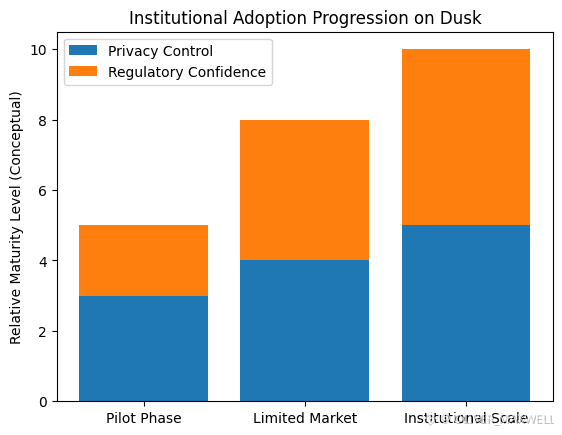
This adoption mechanic is where Dusk’s story becomes more concrete than most analyses admit. Traditional institutions do not adopt blockchains in a single leap. They adopt them in regulatory safe slices. First, closed or permissioned participant sets. Then limited product scope. Then gradual widening of market access as operational confidence grows. Dusk’s privacy and auditability posture supports that staged rollout because it allows early deployments to protect sensitive market data while still producing evidence for internal risk teams and external supervisors. In other words, Dusk is not just offering privacy. It is offering a way to run pilots without accidentally publishing your entire business model to the world.
Tokenomics and governance matter here because they define whether the chain can credibly serve as financial infrastructure rather than a short-lived experiment. Dusk’s documentation describes a capped maximum supply constructed from an initial supply plus a long emission schedule, with 500 million DUSK emitted over 36 years and a maximum supply of 1 billion. For institutions, the key implication is predictability. Long-horizon market infrastructure cannot depend on monetary policy surprises or incentive cliffs. A multi-decade emission schedule signals an intent to fund security and participation over the timeframe that regulated market adoption actually takes, not the timeframe that crypto narratives usually run on.
What I find most compelling, and still under-discussed, is the strategic bet Dusk is making about where compliance friction will concentrate over the next cycle. Many assume the constraint will be whether regulators allow tokenization. A more realistic constraint is that large institutions will only tokenize at scale when they can preserve confidentiality while producing proofs of correctness on demand. That is a narrower technical target, but it is the target that decides whether tokenization becomes a production market or remains a set of disconnected pilots. Dusk is building directly into that target with a modular stack, privacy-first transaction models, and mechanisms designed for auditable confidentiality.
The forward-looking view is therefore not about whether Dusk can add more applications. It is about whether Dusk can become the default compliance-compatible privacy layer for on-chain market infrastructure, where privacy is treated as a regulated control and not as a black box. If the project succeeds, the most important outcome will not be a headline feature. It will be a subtle shift in how regulated institutions talk about blockchains. Instead of asking, “Can we use this chain without violating rules,” they start asking, “Can we operate on-chain without leaking market structure and client data.” Dusk’s entire design is an answer to that second question.
