
At the start of year 2026, I’ve started thinking about Dusk less as a blockchain and more as a personality type. It isn’t loud. It isn’t trying to impress. It doesn’t compete to be “the fastest” or “the most composable.” Instead, it seems preoccupied with a quieter, more uncomfortable question: what if a ledger’s real responsibility isn’t to expose everything, but to know precisely when to stay silent?
Most blockchains are raised in an environment where transparency is treated as a moral absolute. Every balance is visible. Every transaction is linkable. The implicit assumption is that anything hidden must be suspicious. That worldview works well for grassroots coordination and open-source experimentation. It breaks almost immediately when you try to run serious financial infrastructure on top of it. In regulated finance, discretion isn’t a loophole—it’s often a legal requirement. At the same time, discretion without accountability is meaningless. Dusk operates deliberately in that narrow, awkward middle space.
What distinguishes Dusk is that it doesn’t pretend this tension can be resolved later. From the base layer, it accepts that some activity must be visible and some must not—and it grants both equal legitimacy. Transparent transactions and zero-knowledge transactions aren’t auxiliary features or marketing toggles. They are two native ways of interacting with the same ledger. That design choice matters because it reflects how institutions actually function. Payroll is private. Treasury disclosures are public. Client relationships are confidential. Regulatory proofs are mandatory. Forcing all of this into a single visibility model is where many blockchain-finance narratives quietly unravel.
Dusk is not chasing anonymity. It is pursuing discretion. The Phoenix transaction model, with its zero-knowledge structure and selective disclosure, feels less like hiding and more like controlled revelation. It resembles how auditors and accountants operate in practice: you don’t publish an entire company’s books to the world, but when the appropriate party asks the appropriate question, you can prove the numbers are correct. That philosophy is fundamentally different from the “trust me, it’s private” posture that has repeatedly failed this industry.
The technical architecture reinforces that mindset. The settlement layer is intentionally conservative, and execution environments are layered on top rather than rewriting core assumptions. Adding an EVM-compatible environment isn’t novel in itself, but the motivation behind it is revealing. The goal doesn’t seem to be attracting every developer indiscriminately; it’s about reducing friction for teams already fluent in Ethereum tooling who want different guarantees underneath. In that sense, Dusk appears more concerned with who builds on it than with announcing that builders have arrived.
What recently stood out to me wasn’t a partnership announcement or a token price movement, but a node software update 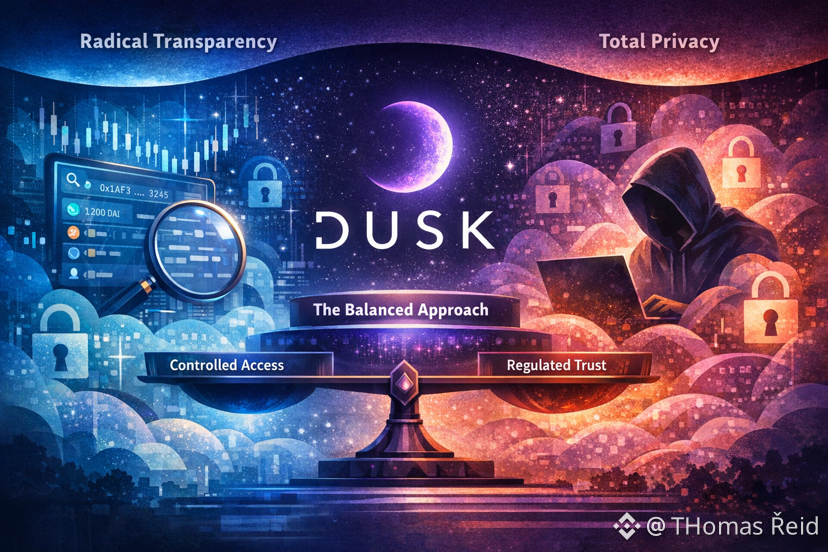 the kind most people scroll past. New endpoints for transaction counts. Better pagination. Clearer contract metadata. Faster transaction inclusion. This is unglamorous work, but it’s the kind you do when you expect operators, analysts, and compliance teams to rely on the system daily. It signals a shift from demonstration toward durability.
The DUSK token itself becomes easier to understand when viewed as infrastructure fuel rather than a speculative chip. Staking is framed as participation in network security, not as a casino. The long emission schedule implies patience rather than urgency, as if the system is designed with decades in mind rather than cycles. Whether that expectation is ultimately justified remains to be seen, but the design doesn’t read as extractive. It reads as sustainable.
That said, not everything feels resolved. The migration path from ERC-20 or BEP-20 representations into native DUSK is a reminder that bridges remain trust chokepoints, regardless of how elegant the core protocol is. Whenever value moves between systems, someone is relaying, reissuing, or mediating. For institutions, that isn’t a footnote—it’s a central risk factor. Dusk will eventually be judged not only on the privacy and auditability of its ledger, but on how cleanly and credibly value enters and exits it.
Where the narrative becomes more concrete is in ecosystem direction. The emergence of regulated instruments such as MiCAR aligned digital euro initiatives is not exciting in the way speculative assets are, but that’s precisely the point. If Dusk succeeds, it won’t be because it captured attention; it will be because it became usable. The emphasis on data infrastructure and exchange grade integrations suggests a worldview where blockchains are expected to plug into existing financial reality, not replace it overnight.
Stripped of jargon, Dusk feels like a ledger designed by people who have sat in rooms where “just make it public” is not an acceptable answer. A system built with the expectation that someone, somewhere, will eventually ask for proof and that when they do, you won’t want to expose everything else just to satisfy them. Whether Dusk ultimately earns a permanent place in financial infrastructure will depend on adoption, trust, and execution. But as an idea, it is refreshingly honest about the world it is trying to serve.
