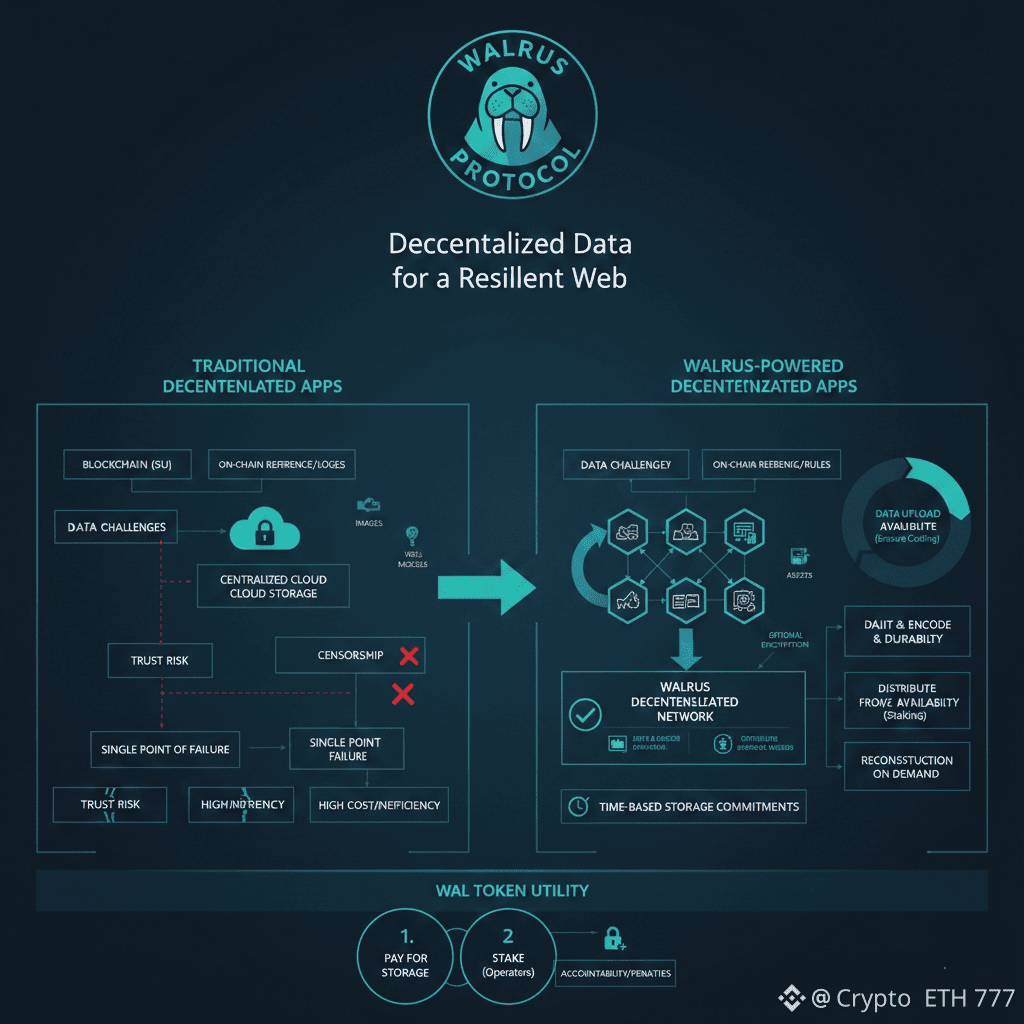
Walrus is often misunderstood at first glance because people try to fit it into the same box as typical DeFi projects, but its real purpose sits much deeper in the blockchain stack. Walrus exists because blockchains, despite all their strengths, are fundamentally bad at handling large amounts of data.
They excel at coordination, ownership, and rules, yet the moment you introduce images, videos, datasets, AI models, game assets, or user files, the system breaks down. Storing that kind of data directly on-chain is expensive, inefficient, and sometimes impossible.
So most decentralized applications quietly fall back on centralized cloud storage, which reintroduces trust, censorship risk, and single points of failure.
Walrus was created to remove that contradiction and make decentralized applications whole again.
At its core, Walrus is a decentralized data storage and availability protocol designed to work closely with the Sui ecosystem.
Instead of forcing heavy data onto the blockchain, Walrus separates responsibilities in a very deliberate way.
The blockchain handles what it is good at: coordination, payments, staking, ownership, and governance. Walrus handles what blockchains struggle with: storing and serving large blobs of data reliably over time.
Applications store references, rules, and logic on-chain, while the actual data lives across a distributed network of independent storage operators. This design keeps the chain efficient while allowing applications to scale to real-world use cases.
When data is uploaded to Walrus, it is not simply copied again and again across the network. Instead, Walrus uses erasure coding, a technique that mathematically splits data into fragments and encodes them so that only a portion of those fragments is needed to reconstruct the original file.
These fragments are spread across many nodes. The result is a system that can tolerate outages, churn, and even malicious actors without losing data.
Even if a large percentage of nodes go offline, the data remains recoverable. This approach significantly reduces storage overhead compared to full replication while still offering strong guarantees around availability and durability.
What makes this design especially important is that it is built for real-world conditions, not ideal ones. Networks fail. Nodes disconnect. Incentives fluctuate. Walrus assumes this chaos and designs around it rather than pretending it won’t happen.
Storage providers are continuously challenged to prove they still hold the data they are responsible for, and rewards are tied to long-term performance, not just one-time uploads. This turns storage into an ongoing commitment rather than a static promise.
Walrus also introduces a time-based model for storage, which feels much closer to how people think about data in practice. Users pay to store data for a defined period, and operators are rewarded over time for keeping that data available.
This creates clarity for both sides. Applications can plan renewals and lifecycles, and storage providers know exactly what they are being paid to maintain. Data does not disappear unexpectedly, but it also is not assumed to live forever without cost. This balance is critical for sustainability.
Privacy is often mentioned alongside Walrus, and it is important to be precise. Walrus itself is not a privacy coin and does not automatically encrypt user data. Instead, it provides the infrastructure that privacy-preserving systems can build on. Because data is fragmented and distributed, no single operator usually holds a complete file. More importantly, users can encrypt their data before uploading it.
In this setup, Walrus guarantees availability and censorship resistance, while encryption ensures confidentiality. This separation avoids forcing rigid assumptions and gives developers flexibility to design for different threat models.
The WAL token ties the entire system together economically. It is used to pay for storage services, to stake as a storage operator, and to participate in governance. Operators are required to put value at risk, which creates accountability.
If they fail to meet availability or integrity requirements, they can be penalized. Token holders can delegate stake to reliable operators, aligning incentives across the network. Governance allows the protocol to evolve over time, adjusting parameters like pricing, rewards, and network rules as conditions change.
From a distribution and ecosystem perspective, Walrus emphasizes community participation and long-term growth rather than short-term speculation.
A large portion of the token supply is allocated to community incentives, development, and ecosystem expansion. This reflects a simple reality: a storage network only becomes valuable if it is widely used. Tokens alone do not create utility. Actual demand for storage does.
Where Walrus truly starts to matter is in the types of applications it enables. AI systems need access to large datasets that must remain available and verifiable. Games need assets that do not vanish when a server shuts down. NFT platforms need media storage that matches the permanence promised by on-chain ownership.
Identity systems need durable data without handing control to a single company. Walrus positions itself as a shared, decentralized data layer that all of these applications can rely on instead of each building fragile, centralized storage solutions.
Developer experience is another area where Walrus shows a clear understanding of reality. Storage is programmable. Smart contracts can reference blobs, manage their lifecycle, and build logic around them.
With caching and aggregation layers, data retrieval can feel much closer to traditional web performance rather than raw peer-to-peer systems. This matters because decentralization only wins when it feels invisible to the end user.
None of this means Walrus is without risk. Decentralized storage is hard. Incentive systems can break if poorly tuned. Performance must stay competitive with centralized alternatives.
Governance must avoid concentration of power. Adoption takes time and usually happens quietly. Walrus still needs to prove itself under stress, during market downturns, and at real scale. Those tests cannot be rushed.
The most honest way to think about Walrus is as infrastructure, not hype. If it succeeds, most users will never think about it at all. Their applications will simply work. Their data will simply be there.
In that future, WAL gains value not because of narratives or speculation, but because it secures and powers something people rely on every day. In a space that often chases attention, Walrus is focused on something far more difficult and far more important: making decentralized data storage actually usable.