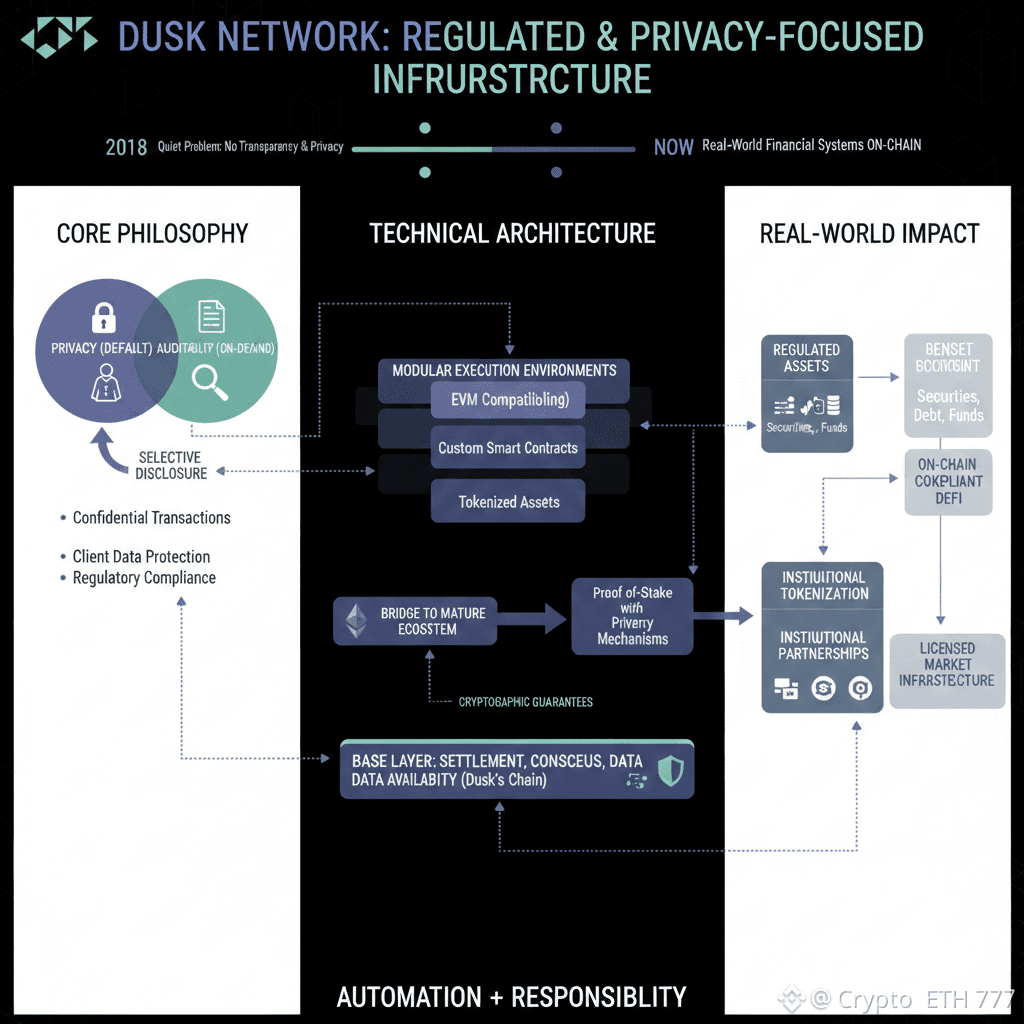
Dusk began in 2018 not as a reaction to hype, but as a response to a quiet problem that builders, institutions, and regulators were all facing at the same time.
Blockchains were proving that value could move without intermediaries, but they were also proving something else: complete transparency is not compatible with how real financial systems operate.
In the real world, privacy is not optional. Companies protect sensitive positions, institutions safeguard client data, and regulators enforce rules without demanding that every detail be publicly exposed. Dusk was created to sit exactly in that reality, not to escape it.
From the start, the vision behind Dusk Network was simple in wording but complex in execution: build a Layer 1 blockchain that regulated finance could actually use. That meant accepting constraints rather than pretending they don’t exist.
Financial markets are governed, audited, and supervised. They rely on confidentiality, yet they also rely on trust and verification. Dusk does not try to choose between privacy and transparency.
Instead, it treats privacy as the default state and auditability as a capability that can be invoked when required. This mirrors how finance already works off-chain, but replaces slow paperwork and fragmented systems with cryptographic guarantees.
The idea of “regulated and privacy-focused infrastructure” only makes sense if the chain itself is designed around those needs. Dusk’s architecture has gradually evolved toward a modular structure, where the base layer focuses on settlement, consensus, and data availability, while execution environments can be adapted to different use cases.
This matters because settlement is where financial finality lives. Institutions need that layer to be stable, predictable, and defensible from a risk perspective.
At the same time, developers need flexibility. Tooling changes, standards evolve, and applications need room to grow. Modularity allows Dusk to protect the core while still remaining adaptable at the edges.
A major expression of this approach is Dusk’s Ethereum-compatible execution environment. Rather than forcing developers to abandon familiar tools, Dusk embraces the reality that most smart contract development today is built around the EVM. Solidity, existing audit practices, and Ethereum-style tooling are deeply ingrained in the ecosystem.
By supporting EVM execution while anchoring settlement to Dusk’s privacy-focused base layer, the network creates a bridge between two worlds: the mature developer ecosystem of Ethereum and the compliance-aware design that institutions need. This is not about chasing popularity. It’s about reducing friction so real applications can be built and deployed without unnecessary barriers.
Security and consensus are treated with the same practical mindset. In regulated finance, a system does not earn trust by being fast alone. It earns trust by being resilient under stress and understandable to those who rely on it. Dusk’s consensus design emphasizes Proof-of-Stake with privacy-aware mechanisms that reduce the exposure of sensitive validator information.
When too much information about stake distribution or leader selection is visible, it can be exploited. By limiting what attackers can see and predict, the network aims to reduce manipulation risks. This kind of design choice rarely goes viral, but it matters deeply when real value and real obligations are involved.
Privacy, however, only has value if it remains compatible with accountability. Dusk’s approach is not about hiding activity indefinitely. It is about selective disclosure. Transactions can remain confidential to the public while still being provably valid and compliant.
When regulators, auditors, or authorized parties need assurance, cryptographic proofs can provide it without exposing everything else. This is closer to how trust actually works in financial systems, where access is controlled and evidence is shared on a need-to-know basis. In this sense, Dusk is less radical than many blockchains. It is intentionally conservative about how information flows.
This philosophy becomes especially important when talking about tokenized real-world assets. These assets are not theoretical. They represent securities, debt instruments, funds, and other regulated products that already exist within legal frameworks. They come with rules about who can own them, how they can trade, and how oversight is enforced.
A blockchain that wants to host these assets cannot ignore those realities without breaking the system. Dusk’s focus on compliant DeFi and tokenized assets is grounded in the belief that automation should simplify processes without erasing responsibility. Smart contracts should enforce rules, not bypass them.
In recent developments, Dusk’s direction has become even clearer through its focus on regulation-aligned partnerships. Instead of prioritizing short-term visibility, the network has emphasized relationships that connect it to licensed market infrastructure. These kinds of partnerships are not flashy, but they are meaningful.
They create pathways for real issuance, real trading, and real settlement under existing regulatory frameworks. This signals that Dusk is aiming to become infrastructure that institutions rely on quietly, rather than a platform driven by constant speculation.
The economic design of the network reflects the same long-term thinking. Staking is not framed as a quick incentive but as a security mechanism that aligns behavior over time. Emissions are spread across long horizons, reinforcing the idea that Dusk is built for durability rather than cycles.
For institutions and serious builders, this matters. Infrastructure decisions are not made for months; they are made for years.
When you strip away technical jargon, the story of Dusk is very human. It is built on the understanding that finance is complex, regulated, and imperfect, and that technology should work with those realities instead of denying them.
Dusk is not trying to replace the financial system overnight. It is trying to give it better rails, where privacy is respected, rules are enforceable, and trust is established through verifiable computation rather than blind faith.
The real measure of Dusk’s success will not be slogans or announcements. It will be whether real assets move through the network, whether compliant markets operate on-chain, and whether privacy features work smoothly in practice without sacrificing usability.
If that happens, Dusk becomes more than an idea. It becomes infrastructure. And infrastructure, when it works, rarely draws attention. It simply enables everything built on top of it to function better.
This content is for educational purposes only and does not constitute financial advice. Blockchain technology involves technical, regulatory, and market risks, and all information should be verified through official sources before making decisions.