

I’ve been watching infrastructure plays for a long time, the quiet, grinding upgrades that actually change how money and data move, and Walrus is one of those projects that kept pulling my attention. Built by Mysten Labs, the same team behind Sui, Walrus moved from an early developer preview in mid-2024 to a full public mainnet launch on March 27, 2025. That transition matters. It’s the difference between theory and something people can rely on in production. When a network goes live with real incentives, real costs, and real users, the conversation changes.
Walrus is a decentralized storage and data availability protocol. It’s designed for large files, not just small bits of metadata. Think videos, images, datasets, AI training data, and long-term archives. Instead of trusting a single cloud provider, Walrus splits files into many pieces and spreads them across independent storage nodes. No single operator holds the full file. This reduces the risk of censorship, data loss, or quiet manipulation. It also means the system can prove that data is still available without revealing the data itself. This isn’t new in theory, but applying it cleanly at blockchain scale, with economic incentives and cryptographic verification, is where things get interesting.
The phrase “where privacy meets regulation” gets thrown around a lot in crypto, often without substance. Walrus is notable because it doesn’t treat privacy as secrecy and regulation as an enemy. Instead, it treats both as design constraints. Storage commitments and availability proofs are managed by smart contracts on Sui. Payments and access rules can be automated. At the same time, data doesn’t have to be globally visible to everyone. Developers can design systems where access is controlled, auditable when required, and private by default. That balance is what regulated industries actually want.
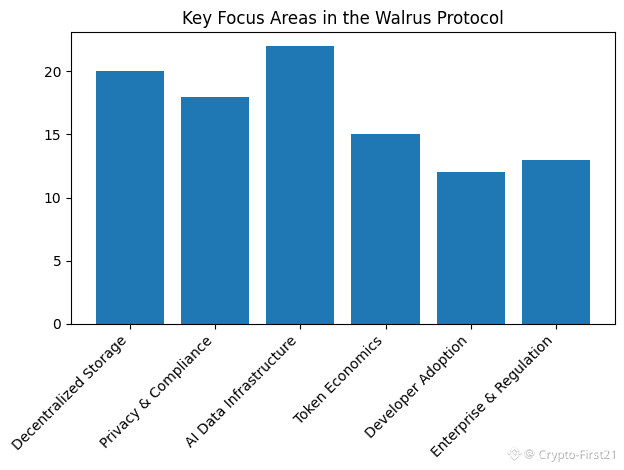
This matters because real businesses don’t operate in a vacuum. Media platforms have copyright obligations. AI teams deal with sensitive datasets. Enterprises must respect data protection rules. Traditional blockchains were never designed to handle large private data responsibly, so developers ended up bolting centralized storage onto decentralized apps. Walrus tries to close that gap by making storage a native, programmable layer rather than an afterthought.
The WAL token isn’t meant to be abstract. It’s tied directly to usage. Users pay WAL to store data. Operators earn WAL for keeping data available and proving they are doing their job correctly. Token holders can stake and, over time, participate in governance. As of late March 2025, circulating supply figures were in the low billions, with market capitalization in the hundreds of millions of dollars range. Numbers like these matter less than behavior, but they show that the market sees Walrus as more than a research experiment.
Training data and model outputs aren’t optional; they’re core assets. Another factor is regulatory reality. Companies are increasingly cautious about where data lives and who controls it. A decentralized system that still allows auditability and access control is suddenly appealing. Finally, Sui’s performance helps. Fast transactions and low fees make it practical to manage storage logic on-chain without crippling costs.
I always separate narrative from execution. The narrative around decentralized storage is compelling, but execution is hard. You need nodes to stay online. You need predictable pricing. You need tooling developers actually want to use. Walrus has approached this methodically. Developer tools were released early. Testnets focused on failure recovery and cost modeling. The mainnet launch came after months of public testing. That slow approach doesn’t generate hype overnight, but it reduces the risk of catastrophic failure later.
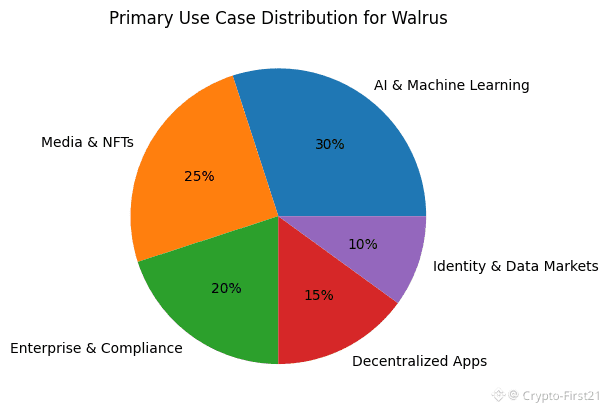
There are still challenges. Competing directly with centralized cloud providers on raw cost and latency is difficult. Centralized players benefit from massive scale and optimized infrastructure. Walrus isn’t trying to win that fight head-on. Its value proposition is different. It offers verifiable, programmable storage that can be embedded directly into on-chain workflows. For applications where trust, longevity, and control matter more than shaving off a few milliseconds, that trade-off can make sense.
Another open question is long-term node participation. Incentives must be strong enough to keep operators engaged even during market downturns. Token design, staking requirements, and slashing mechanisms will be tested over time. This is where watching real metrics becomes important. Storage usage, node uptime, and payment flows say more than whitepapers ever will.
Stepping back, Walrus feels like an infrastructure bet rather than a short-term trade. It’s trying to solve a boring but critical problem: how to store data reliably in a decentralized world that still needs rules. That’s not glamorous, but it’s necessary. The March 2025 mainnet launch marked the point where Walrus moved from promise to production. Adoption is the next chapter, and it won’t be linear.
Systems that solve real, recurring problems tend to compound value slowly. If Walrus can become the default storage layer for AI workflows, media platforms, and regulated applications on Sui and beyond, its relevance will grow regardless of short-term market noise. For anyone watching the intersection of privacy, regulation, and blockchain infrastructure, Walrus is worth paying attention to, not because it’s loud, but because it’s practical.

