

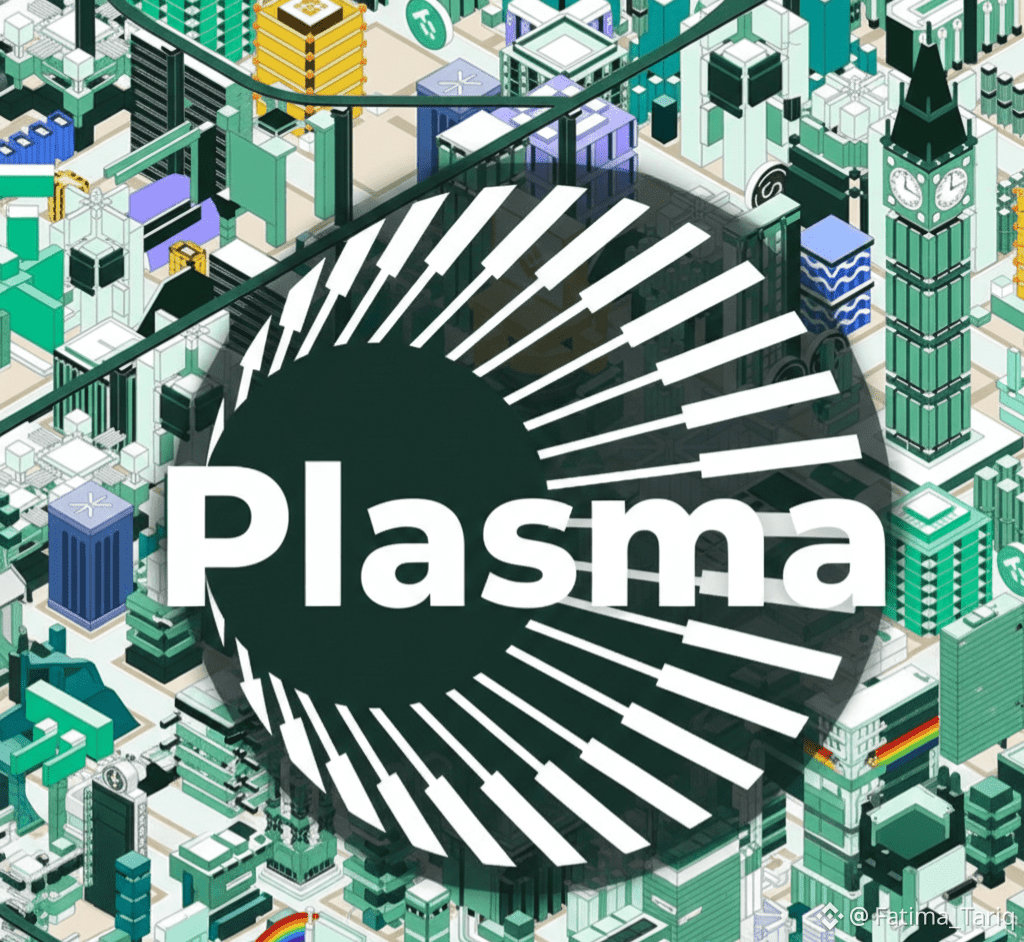
Imagine the internet as a very large city. In this city, Ethereum is like the main capital. It is powerful, trusted, and secure. Important decisions happen there. Big records are kept there. Everyone trusts it. But because everyone trusts Ethereum, everyone wants to use it.
People send money, trade tokens, play games, mint NFTs, store records, and run smart contracts — all on the same roads. Over time, these roads become very crowded. Traffic slows down. Fees become high. Small users feel frustrated because simple actions cost too much and take too long.
Ethereum is not broken. It is simply too popular.
Now imagine city planners looking at this problem. They don’t want to destroy the main city. They want to protect it. So instead of forcing everything to happen in one place, they design a system of smaller cities connected to the capital. These smaller cities can handle daily activity, while the capital focuses on security and final decisions.
This idea is where Plasma begins.
Plasma is a way to move most activity away from Ethereum, without losing Ethereum’s security. It creates what are called child chains. You can think of child chains as smaller cities or side towns connected to the main capital by strong bridges.
People can move their assets from Ethereum into a Plasma chain. Once inside, they can send transactions quickly and cheaply. Games can run smoothly. Trades can happen faster. Fees are low because the roads are not crowded.
But here is the most important part of the story:
Ethereum is still watching.
Even though activity happens in Plasma chains, Ethereum remains the final judge. Plasma regularly sends summaries (called commitments) back to Ethereum. These summaries prove what happened without sending every single detail. Ethereum checks the rules, not the busy work.
Security in Plasma does not come from trust. It comes from choice and protection.
If something goes wrong inside a Plasma chain — for example, if an operator tries to cheat — users are not trapped. They always have an exit door. This exit door lets them return to Ethereum with proof that their funds belong to them. The ability to exit safely keeps Plasma operators honest.
 Think of it like this:
If a bank knows customers can leave at any time with full proof of ownership, the bank behaves better.
Plasma also introduced an important idea: Ethereum should not store everything forever. Storing everything is expensive and slow. Plasma showed that Ethereum can store only what matters most — proofs, commitments, and dispute resolution — while other layers do the heavy work.
This idea changed how people thought about blockchain design.
Before Plasma, many believed everything must happen on-chain to be secure. Plasma proved that security and execution can be separated. You can do work somewhere else, as long as you can prove it to the main chain.
Plasma was not perfect. Exiting could be complex. Users needed to be active to stay safe. Data availability was sometimes difficult. Because of these challenges, Plasma was not adopted everywhere.
But Plasma’s real success was not popularity — it was education.
It taught the crypto world how to think in layers. It inspired later systems like rollups and modern Layer‑2 designs. Even when Plasma itself is not used, its ideas live on inside newer technologies.
Today, Ethereum is no longer just one city. It is a network of layers, systems, and chains working together. Plasma was one of the first blueprints that showed how this could work.
In the long story of blockchain scaling, Plasma is the chapter where developers learned that growth does not mean chaos. With smart design, systems can scale while staying secure, fair, and decentralized.
And that lesson still guides the future of crypto.
#plasma #Plasma $XPL @Plasma #LearnWithFatima #BinanceSquareTalks #BinanceSquareFamily


