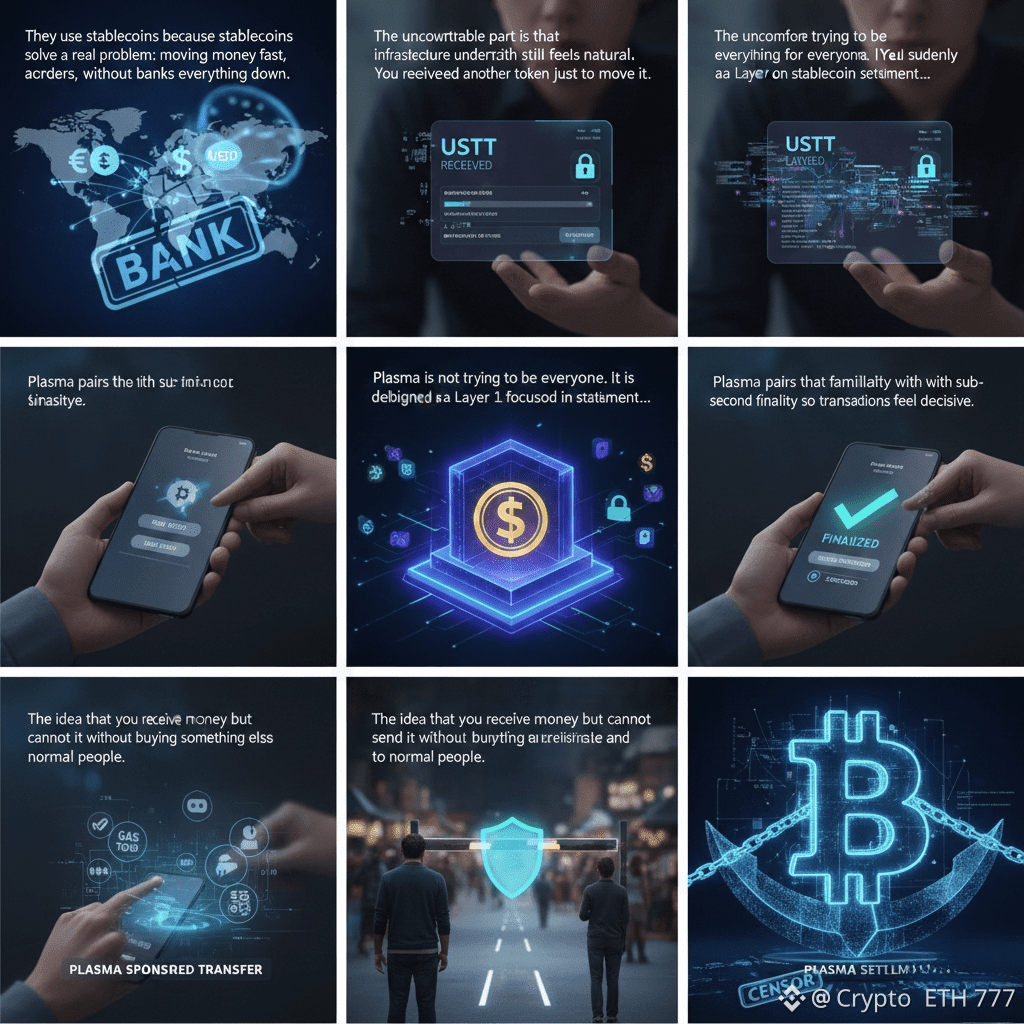
If you watch how people actually use stablecoins in real life, the pattern is very simple. They are not here for ideology, they are not here for tech debates, and they are definitely not here to learn how blockchains work. They use stablecoins because stablecoins solve a real problem: moving money fast, across borders, without banks slowing everything down. But the uncomfortable part is that the infrastructure underneath still feels unnatural. You receive USDT and suddenly you need another token just to move it. Fees change. Transactions feel uncertain. For normal users, that breaks trust instantly. This is exactly the gap Plasma is trying to fix, not by adding more features, but by removing friction where it hurts the most. Plasma is not trying to be everything for everyone. It is deliberately designed as a Layer 1 focused on stablecoin settlement, and that focus shapes every technical and user-facing decision it makes. Instead of treating stablecoins as just another token on a general-purpose chain, Plasma treats them as the main product. That single shift changes everything. The chain is EVM compatible so developers do not have to relearn tools or abandon existing ecosystems. Smart contracts behave in familiar ways, wallets work as expected, and integration costs stay low. This matters because payments infrastructure does not grow through novelty, it grows through reliability and compatibility. Plasma pairs that familiarity with sub-second finality so transactions feel decisive. When someone sends money, they do not want to wait and wonder. They want to know it is done. Fast finality reduces hesitation for users, lowers operational risk for merchants, and makes onchain settlement feel closer to everyday digital payments rather than speculative crypto activity. One of the most human problems Plasma addresses is gas. The idea that you can receive money but cannot send it without buying something else is irrational to normal people. Plasma’s gasless USDT transfers are built around this reality. Basic stablecoin transfers can be sponsored so new users are not blocked at the door. This is not about giving away free transactions forever. It is about making the first experience feel natural. Guardrails, limits, and eligibility checks exist so the system stays sustainable, but the core idea remains simple: if someone has stablecoins, they should be able to use them. Beyond that first step, Plasma introduces stablecoin-first gas so users and businesses can pay fees in the same asset they are already using. Psychologically this is huge. Fees stop feeling like an unpredictable tax in a volatile token and start feeling like a small, understandable cost in dollars. For businesses and institutions, this also simplifies accounting, treasury management, and forecasting. Predictability matters more than cheapness when real money is involved. Plasma’s security model adds another layer to this trust by anchoring parts of its state to Bitcoin. This is not about competing with Bitcoin or turning it into something else. It is about borrowing Bitcoin’s neutrality and long-term security assumptions. For a settlement network that wants to move serious value, credibility matters. Anchoring to Bitcoin strengthens the perception that history is hard to rewrite and censorship is difficult, which is important in a world where stablecoins sit at the intersection of finance, regulation, and geopolitics. Privacy and compliance are treated realistically rather than ideologically. Plasma acknowledges that money is personal and business transactions should not be unnecessarily exposed, while also accepting that stablecoins operate in a regulated environment. The goal is not secrecy for its own sake, but confidentiality that can coexist with compliance. This balance is critical if stablecoin networks want to move beyond niche crypto users and become real financial rails. Liquidity plays a quiet but decisive role in Plasma’s vision. A settlement chain without deep liquidity is just a corridor people pass through. Plasma aims to launch and grow with substantial stablecoin liquidity so users can move, swap, earn, borrow, and settle without constantly leaving the ecosystem. When stablecoins are productive and flexible, users stay. This is also how features like gasless transfers become sustainable, because the network captures value from real economic activity instead of relying purely on subsidies. What makes Plasma feel different is that it treats onboarding as the core product. Most people leave crypto not because it is too slow or expensive, but because the first experience feels broken. Plasma’s design choices are all aimed at making that first interaction feel normal. No gas confusion. No unnecessary waiting. No forced learning curve. For institutions, the appeal is just as practical. Stable fees, fast finality, familiar tooling, and built-in compliance support reduce operational complexity. Plasma is not asking institutions to adapt to crypto quirks. It is adapting crypto infrastructure to institutional reality. None of this guarantees success. Competition is intense, execution matters, and every assumption will be tested under real volume. But the direction is clear and grounded. Plasma is not trying to make users care about blockchains. It is trying to make blockchains disappear into the background so stablecoins can finally behave like money. Risk disclaimer: this content is informational only and not financial advice. Always verify current network details, documentation, and regulatory requirements before using any blockchain for real financial activity.

PLASMA: THE BLOCKCHAIN BUILT TO MAKE STABLECOINS FEEL LIKE REAL MONEY
Zastrzeżenie: zawiera opinie stron trzecich. To nie jest porada finansowa. Może zawierać treści sponsorowane. Zobacz Regulamin

BTC
91,347.42
-1.95%
23