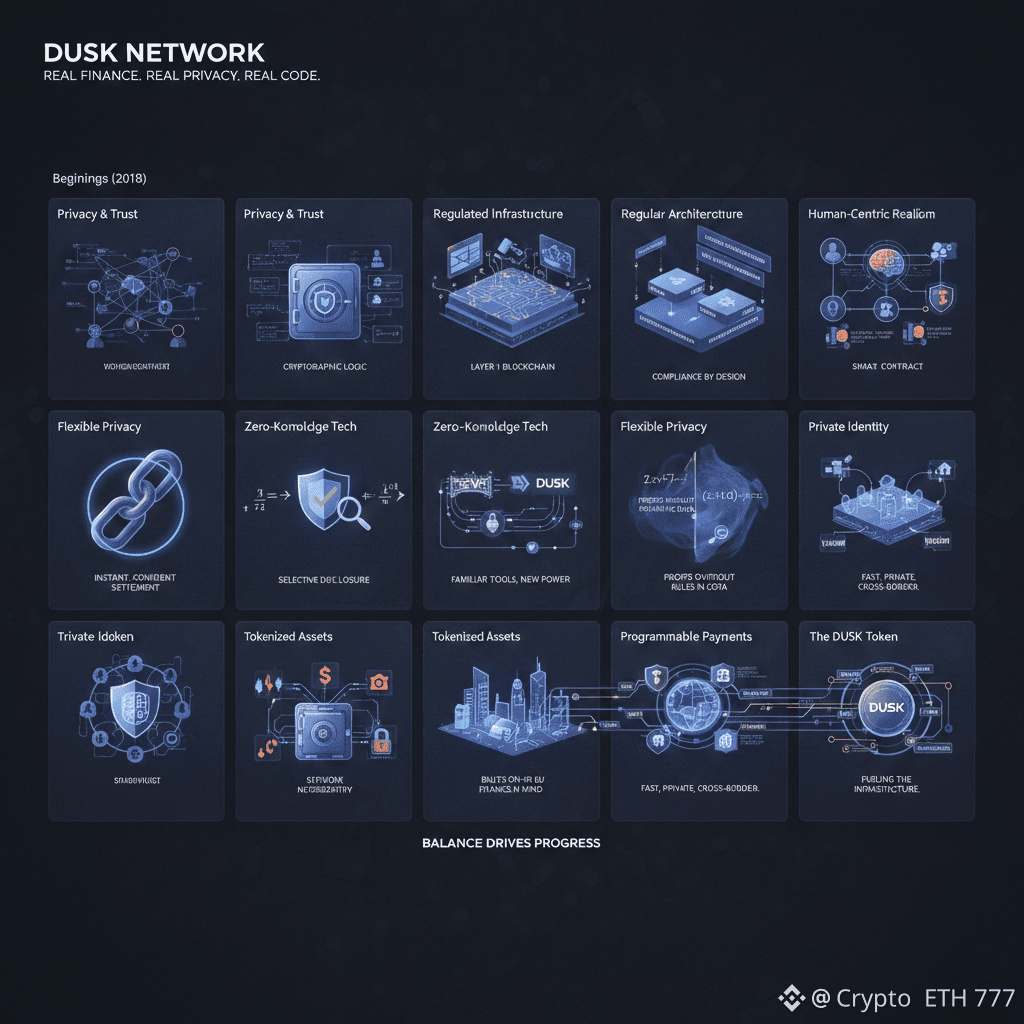
When Dusk Network quietly started in 2018, it was not trying to impress the crypto world with bold slogans or unrealistic promises.
It was responding to a simple truth that many projects preferred to ignore: real financial systems already depend on privacy, rules, and accountability, and any blockchain that wants to replace or upgrade them must respect those foundations instead of fighting them.
Dusk was created for a future where blockchain does not sit outside the law or traditional finance, but works with it in a more efficient and fair way.
In everyday finance, privacy is normal. People do not publish their bank balances, companies do not expose their internal cash flows, and institutions do not reveal their trading strategies.
At the same time, these systems are trusted because they can be audited and regulated. Dusk takes this familiar structure and translates it into cryptographic logic.
Instead of relying on intermediaries and paperwork, it uses mathematics to guarantee that transactions are valid while keeping sensitive information protected. This balance is what makes Dusk feel less like an experiment and more like real infrastructure.
The network is built as a layer 1 blockchain specifically for regulated and privacy-focused financial use cases. That means compliance is not something added later through smart contract tricks or off-chain agreements.
It is part of the protocol itself. Applications built on Dusk can enforce rules automatically, whether those rules relate to who can hold an asset, how it can be transferred, or what information must be disclosed to authorized parties.
This allows developers and institutions to focus on building products instead of constantly worrying about regulatory risk.
One of the most important design choices in Dusk is its modular architecture. Instead of forcing everything into one rigid system, Dusk separates settlement and consensus from execution. The base layer is designed to be stable and predictable, providing strong finality and security.
On top of this foundation, different execution environments can exist and evolve over time. This makes the network adaptable without sacrificing reliability, which is essential for financial markets that cannot afford frequent disruption.
Finality on Dusk is treated with seriousness. In many blockchains, transactions are only probabilistically final, meaning they can technically be reversed under certain conditions.
That uncertainty may be acceptable for casual transfers, but it is unacceptable for securities, funds, and institutional settlement.
Dusk aims for deterministic finality, where once a transaction is confirmed, it is settled with confidence. This aligns much more closely with how real financial systems operate and reduces operational and legal risk.
Privacy on Dusk is flexible rather than extreme. The network supports both transparent and confidential transactions, allowing users and applications to choose what makes sense for each situation. Some operations benefit from openness, while others require discretion.
Dusk does not force a single model on everyone. Instead, it provides the tools to protect financial data when needed while still ensuring that all activity remains verifiable and compliant through cryptographic proofs.
Zero-knowledge technology plays a central role in making this possible.
Transactions can be validated without revealing amounts, balances, or counterparties to the public. At the same time, selective disclosure mechanisms allow authorized auditors or regulators to access necessary information when required.
This reflects how finance actually works in practice, where privacy is preserved but accountability still exists.
For developers, Dusk reduces friction by supporting an EVM-compatible execution environment. This allows builders to use familiar tools and workflows while benefiting from Dusk’s privacy and settlement guarantees.
Instead of asking developers to abandon existing ecosystems, Dusk meets them where they are. Alongside this, a WASM-based environment offers additional flexibility for applications that need deeper control or cryptographic efficiency.
Regulation is not treated as an obstacle but as a constraint to design around intelligently. Dusk is built with existing financial regulations in mind, particularly within Europe, and aims to support compliant issuance, trading, and settlement of digital assets.
This makes it possible for regulated institutions to participate directly on-chain without recreating centralized systems or exposing users to unnecessary surveillance.
Identity within the Dusk ecosystem follows the same philosophy. Users are not forced into universal exposure.
Instead, they can prove eligibility or compliance through privacy-preserving identity mechanisms. This allows services to meet legal requirements while respecting personal data and user control. It avoids the extremes of full anonymity on one side and full transparency on the other.
Tokenization of real-world assets is one of the clearest expressions of Dusk’s vision. Bringing assets like stocks, bonds, and funds on-chain is not just about representation, but about enforcing the rules that govern them. Dusk is designed so these rules can live directly in the system, reducing reliance on off-chain processes and manual enforcement.
This has the potential to make markets faster, more transparent to regulators, and more accessible to users.
Payments also fit naturally into this design. Businesses and institutions need fast settlement without exposing sensitive transaction data.
Dusk supports private, programmable payments that can operate across borders while maintaining confidentiality. This positions the network not only as a platform for investment products, but also as a foundation for real economic activity.
The DUSK token exists to support the network rather than dominate it. It is used for fees, staking, and securing the chain, with a long-term emission model that reflects an infrastructure-first mindset.
Staking is designed to be flexible and programmable, allowing new models to emerge as the ecosystem grows and institutional participation increases.
What ultimately makes Dusk feel human is its realism. It does not promise instant global adoption or pretend that finance can be rebuilt overnight. It acknowledges complexity, regulation, and trust as realities that must be respected.
By working within these boundaries instead of ignoring them, Dusk aims to create a blockchain that serves real people, real businesses, and real markets. In a space often driven by extremes, Dusk chooses balance, and that choice defines its entire approach.