
Crypto is no longer in its early experimental stage. The market has evolved from rapid speculation and untested ideas into an environment where accountability, regulation, and real-world usability matter more than ever. In this context, Dusk feels like a network created specifically for crypto’s more mature phase—a phase where innovation must coexist with responsibility, privacy must align with compliance, and decentralization must serve real economic systems rather than just ideology.
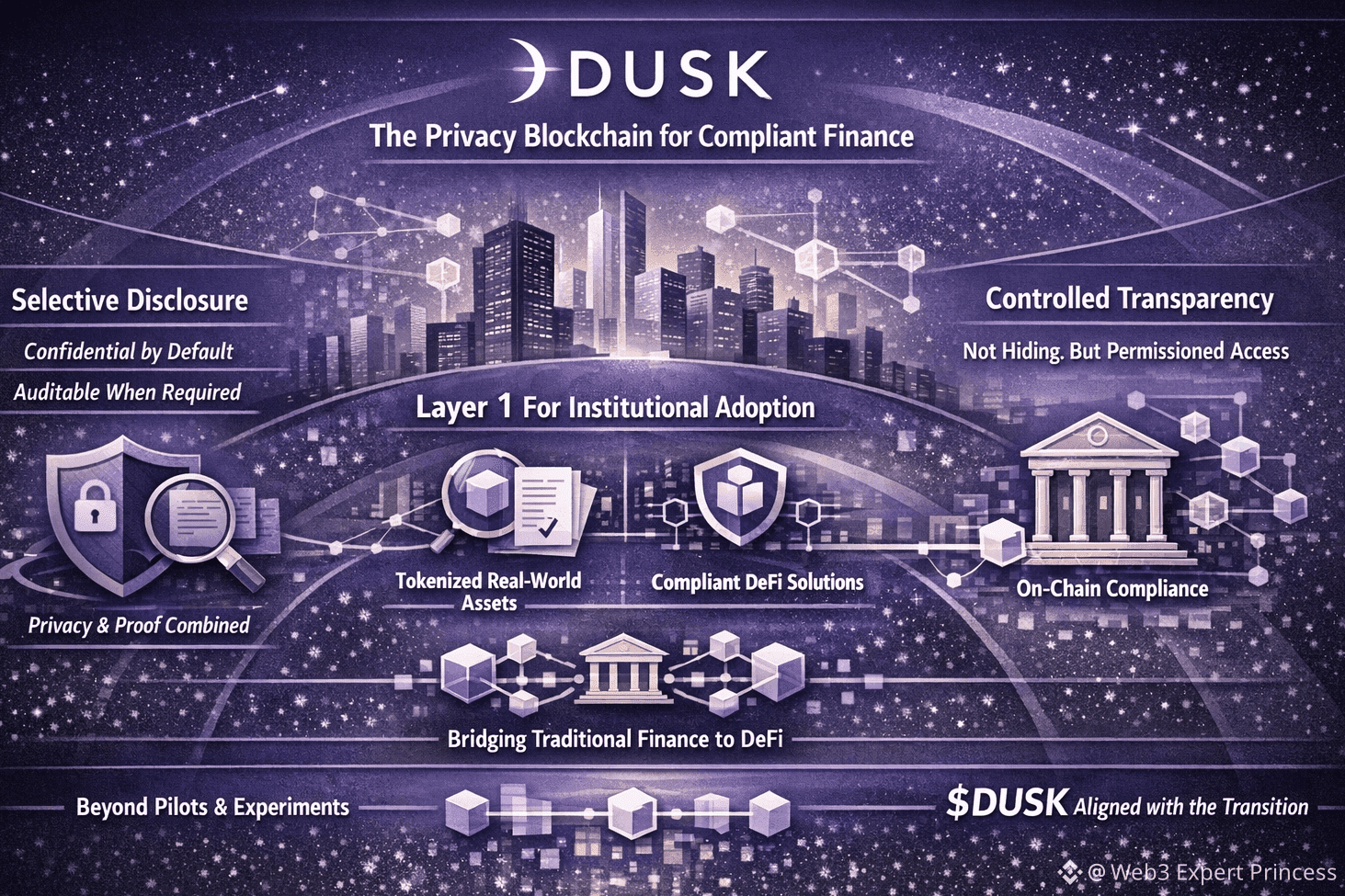
Dusk Network was not designed to chase hype cycles or short-term trends. Instead, it focuses on a long-term vision where blockchain technology integrates seamlessly with regulated financial systems, institutions, and real-world assets. This direction reflects a deeper understanding of where crypto is heading. As governments, enterprises, and traditional finance increasingly interact with blockchain, networks that can balance transparency with confidentiality will define the next era.
One of the clearest signs of crypto’s maturity is the demand for privacy that does not conflict with regulation. Early crypto often treated privacy and compliance as opposites. Dusk challenges that assumption. Its architecture enables confidential transactions while still allowing selective disclosure when legally required. This approach is especially relevant for financial instruments, securities, and enterprise use cases where full transparency can expose sensitive data, yet total opacity is unacceptable.
Dusk’s use of zero-knowledge technology is central to this balance. Rather than hiding activity completely, the network allows verification without revealing underlying data. This is a significant evolution from earlier privacy-focused chains that prioritized anonymity above all else. In a mature crypto environment, privacy is not about evasion—it is about protecting legitimate business information while remaining accountable. Dusk understands this distinction.
Another defining trait of crypto’s mature phase is institutional readiness. Institutions do not adopt technology casually. They require predictable performance, formal governance structures, and legal clarity. Dusk is built with these expectations in mind. Its consensus design and network mechanics aim for stability and efficiency rather than experimental extremes. This makes the network more suitable for long-term deployments, financial products, and regulated markets.
Tokenized securities are a strong example of where Dusk’s philosophy shines. Traditional capital markets are moving toward blockchain-based settlement, but they cannot sacrifice confidentiality or compliance in the process. Dusk positions itself as infrastructure capable of supporting these instruments natively. Instead of forcing legacy finance to adapt to crypto’s limitations, Dusk adapts blockchain technology to meet financial reality.
The idea of maturity also extends to developer experience. Early crypto ecosystems often accepted complexity as the cost of innovation. Dusk takes a more refined approach by providing tools, documentation, and frameworks that reflect years of industry learning. This lowers barriers for developers building serious applications rather than experimental proofs of concept. A mature network attracts builders who think in terms of sustainability, maintenance, and user trust.
From a user perspective, maturity means reliability. Users today expect fast finality, predictable fees, and consistent network behavior. Dusk is designed to deliver these qualities without sacrificing decentralization. Instead of optimizing solely for maximum throughput or minimal costs, the network focuses on balanced performance that can hold up under real economic activity. This trade-off reflects experience rather than idealism.
Governance is another area where Dusk reflects crypto’s evolution. Mature systems require mechanisms for upgrades, security improvements, and protocol changes without fragmenting the community. Dusk emphasizes structured governance that allows the network to evolve responsibly. This reduces the risk of disruptive forks and ensures continuity—something institutions and long-term participants value deeply.
Importantly, Dusk does not position itself against the broader crypto ecosystem. It complements it. While some chains focus on open consumer finance or permissionless experimentation, Dusk targets the layer where blockchain meets law, finance, and enterprise. This specialization is itself a sign of maturity. The crypto industry no longer needs one-size-fits-all solutions; it needs networks optimized for specific roles.
Market cycles also reveal maturity. During speculative booms, attention often shifts toward speed, memes, or aggressive incentives. In quieter periods, fundamentals matter. Dusk’s steady development and clear positioning suggest it is designed to outlast cycles rather than ride them. This long-term mindset aligns with how serious financial infrastructure is built—not for months, but for decades.
In many ways, Dusk represents a philosophical shift. It acknowledges that decentralization does not mean disorder, that privacy does not mean secrecy at all costs, and that innovation must eventually integrate with existing systems to achieve global impact. These ideas resonate strongly as crypto moves beyond its experimental adolescence.
As regulation becomes clearer and adoption broadens, networks like Dusk become increasingly relevant. They offer a blueprint for how blockchain can grow up without losing its core principles. By focusing on compliance-friendly privacy, institutional usability, and long-term stability, Dusk feels less like a speculative experiment and more like foundational infrastructure.
Crypto’s mature phase demands responsibility, design discipline, and respect for real-world constraints. Dusk does not fight these demands—it embraces them. That is why it feels like a network created not just for today, but for the future stage of blockchain where credibility matters as much as innovation.
