
As blockchain adoption accelerates, one challenge continues to stand out as critical infrastructure: storage. While computation and consensus have advanced rapidly, reliable, scalable, and decentralized data storage remains a bottleneck for many Web3 applications. This is where Walrus decentralized storage positions itself as a defining solution—designed not just to store data, but to do so in a way that is resilient, efficient, and aligned with the realities of a decentralized internet.
Walrus approaches storage with a fundamentally different mindset. Instead of relying on simple replication or centralized coordination, it uses advanced data encoding techniques to distribute information across a global network. Data is broken into fragments and encoded in such a way that it can be reconstructed even if parts of the network go offline. This design ensures high availability without the excessive overhead that traditional replication requires.
At the core of Walrus is the idea of self-healing storage. In decentralized environments, node churn is unavoidable. Machines go offline, regions experience outages, and participation fluctuates. Walrus is built to expect this. When fragments of data are lost or become unavailable, the network can automatically regenerate missing pieces using existing encoded data. This creates a living storage layer that actively maintains its own integrity over time, rather than relying on manual intervention.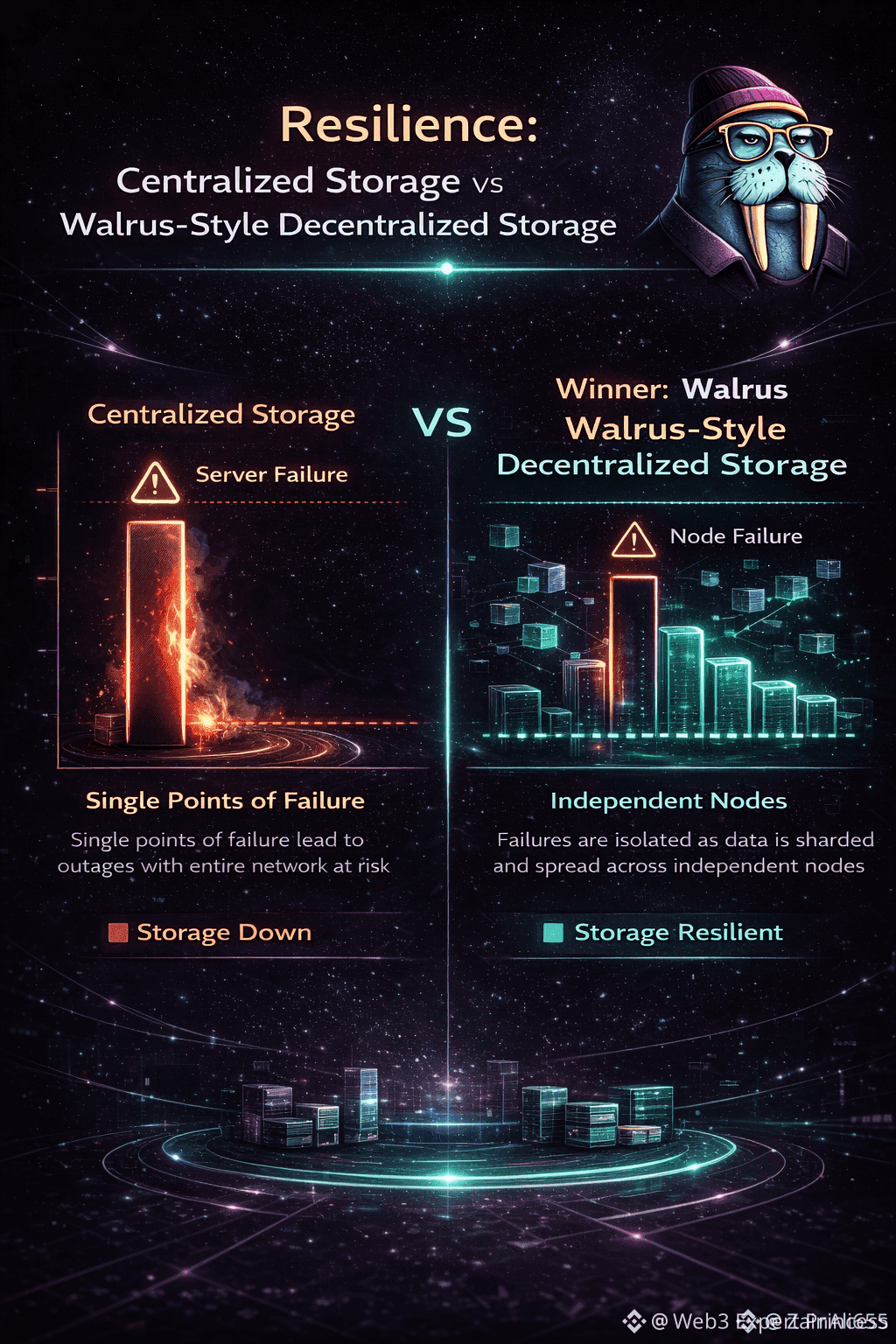
Scalability is another area where Walrus stands out. Many decentralized storage systems struggle as data volumes grow, leading to rising costs or performance degradation. Walrus is designed to operate efficiently at global scale. Its encoding model allows the network to store large datasets without linear increases in redundancy costs. This makes it suitable not only for small files or metadata, but also for large-scale applications such as blockchain state storage, NFTs, media assets, and application data.
Walrus also aligns closely with the needs of modern blockchain ecosystems. As chains become more modular, storage is increasingly separated from execution and consensus. Walrus fits naturally into this architecture by acting as a dedicated data availability and storage layer. It allows blockchains and applications to offload large data while retaining cryptographic guarantees about availability and integrity. This separation improves overall system efficiency and opens the door to more complex on-chain applications.
From a developer perspective, Walrus emphasizes usability without sacrificing decentralization. Developers can store and retrieve data without needing to manage storage nodes themselves. The network abstracts complexity while preserving trust-minimized guarantees. This balance is essential for adoption, especially as Web3 moves beyond experimental apps into production-grade systems used by real users and enterprises.
Security is another defining pillar of Walrus. Data stored on the network is protected through cryptographic proofs and distributed encoding rather than trust in any single operator. No single node holds complete data, reducing the risk of censorship, tampering, or unauthorized access. This model reflects a mature understanding of threat landscapes in decentralized systems.
Importantly, Walrus is not designed as a niche solution. Its architecture supports a wide range of use cases, from decentralized applications and rollups to data-heavy protocols that require high availability guarantees. As demand for on-chain data, off-chain computation, and cross-chain interoperability grows, storage systems like Walrus become foundational rather than optional.
Walrus also reflects a broader shift in Web3 thinking. Early decentralized storage focused primarily on proving that data could be stored without centralized servers. Walrus moves beyond that question and focuses on how storage can be reliable, cost-efficient, and operational at internet scale.

