
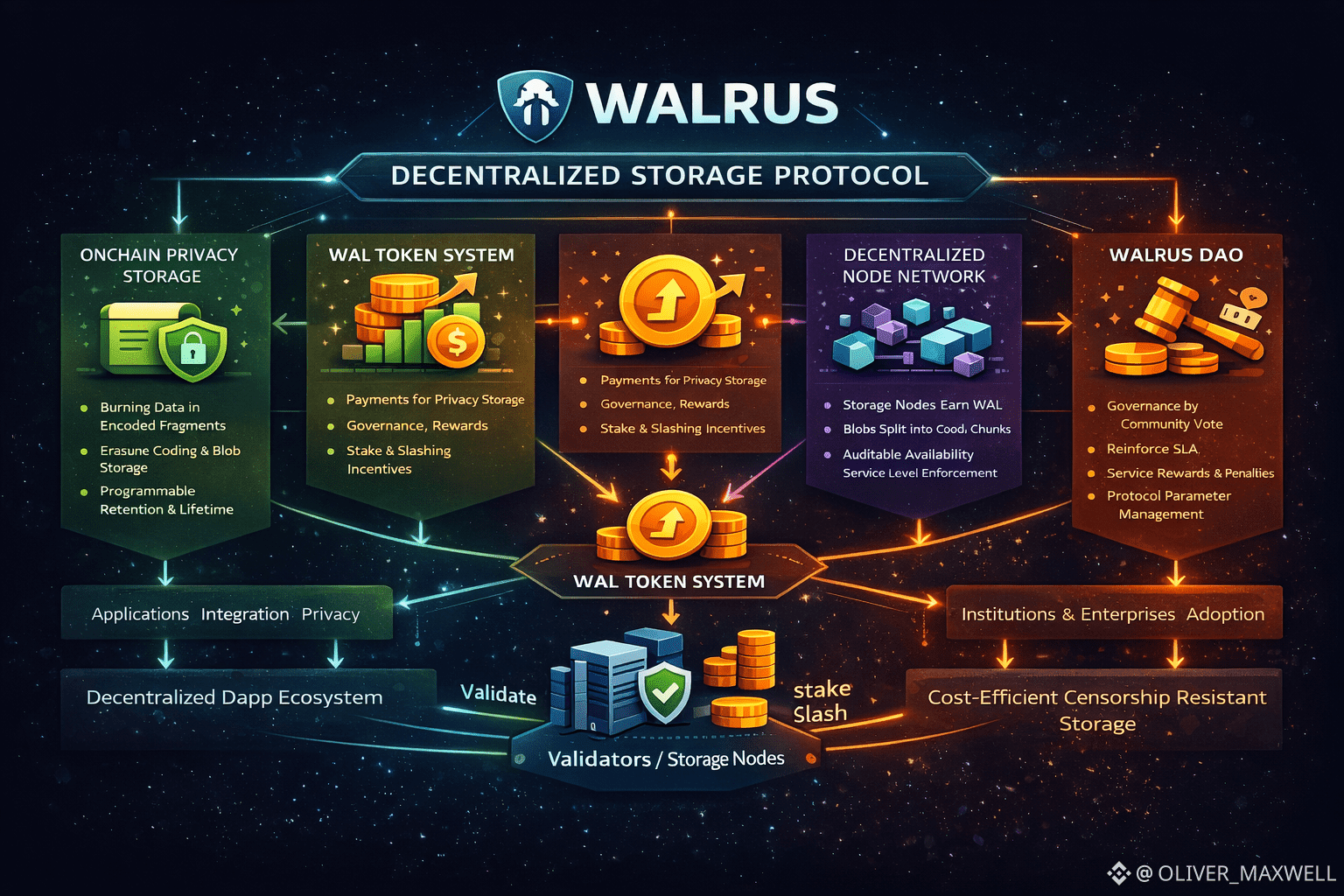
Most storage networks still talk like their product is space. Walrus quietly shifts the unit of value from space to commitments. A blob is not just uploaded and forgotten. It becomes an onchain object with an explicit lifetime, verifiable availability, and rules that smart contracts can reason about. That sounds subtle until you realize it turns storage into something programmable, auditable, and financeable in a way centralized cloud bills never are. This is the real wedge. Walrus is positioning storage as a first class economic primitive inside an application stack, not a peripheral service you stitch on later.
Once you look at Walrus through that lens, the engineering choices stop feeling like a generic decentralization story and start looking like a deliberate attack on the two pain points that block serious adoption. The first is cost predictability at scale. The second is operational risk when you do not control the infrastructure. Walrus addresses both by combining a low replication target with a governance and staking model that makes service quality a measurable outcome rather than a marketing promise. On the cost side, the protocol relies on erasure coding that encodes a blob into many slivers, and it is designed so the original can be reconstructed even when a very large portion of slivers are unavailable. The published design target is a replication factor in the 4x to 5x range, with documentation describing storage costs as roughly five times blob size, which is dramatically different from naive full replication approaches.
That replication target is not just an efficiency flex. It is the economic foundation that makes the rest of the system credible. When storage overhead is bounded, you can build pricing that behaves like a product instead of a speculative asset. Walrus explicitly designs WAL payments to keep storage costs stable in fiat terms and to dampen the effect of long term token price swings. Users pay upfront for a fixed time window, and the protocol distributes that payment over time to the operators and stakers providing the service. This is one of the most underappreciated aspects of Walrus because it mirrors how real procurement works. Enterprises buy retention periods, not raw bytes. Builders want to budget. A time based prepayment stream is closer to a subscription with cryptographic enforcement than it is to the typical pay per request crypto model.
Now connect that to programmability. Walrus represents storage space as an onchain resource that can be owned, split, merged, and transferred, and it represents stored blobs as objects that smart contracts can interrogate for availability and remaining lifetime, extend, or optionally delete. This is where the protocol stops being a backend and starts becoming a composable building block. Data can be made conditional. You can build a contract that extends storage only if revenue clears a threshold. You can escrow a dataset and release access keys on settlement. You can enforce retention policies by construction because the object itself carries time semantics that other modules can read. The blog framing around representing blobs as objects is not a developer convenience feature. It is a new interface between compute and storage where the contract is no longer blind to the state of the data it depends on.
Privacy is another place where Walrus benefits from being pragmatic instead of performative. Many teams equate privacy with heavy cryptography and end up with systems that are correct but unusable. Walrus leans into a layered model. It splits data into encoded fragments distributed across nodes such that no single operator needs to possess a whole file, and it supports encryption for sensitive content. This matters because it reframes confidentiality as an end to end property you can choose based on threat model. Fragmentation reduces the blast radius of any single node compromise, while encryption handles the cases where data sensitivity demands it. At the same time, the network does not pretend metadata disappears. Interactions with a public chain can expose transactional traces, so the privacy story for institutions becomes about minimizing what goes onchain, encrypting what must be stored, and designing access patterns that do not leak business intent. That is a mature privacy posture because it respects how compliance and security teams actually evaluate risk.
Security and liveness are where Walrus makes a trade that is easy to miss if you only skim the high level narrative. The protocol is operated by a committee of storage nodes that evolves across epochs, with delegated stake influencing which nodes are selected, and WAL serving both payments and staking. This structure is not only about decentralization optics. It is a mechanism for continuously rebalancing who is responsible for data, and for tying compensation to observed behavior. The documentation also makes the denomination detail explicit, with WAL subdivided into FROST, which signals that fee precision and accounting granularity were considered early. The most important part, though, is that the system is built to be governable at the parameter level, which is what you need when you run a market for storage quality.
WAL itself is designed to do more than circulate. Distribution is structured with a stated max supply of 5,000,000,000 WAL and an initial circulating supply of 1,250,000,000 WAL, with allocations across a community reserve, user distribution, subsidies, core contributors, and investors. The release schedule details matter because they shape who can influence governance and when. More interesting is the incentive hygiene built into the model. Walrus describes deflationary pressure through burning mechanisms tied to behavior. It plans penalties for short term stake shifts because churn imposes real migration costs on the network, and it links future slashing of low performing nodes to partial burns. That is a rare instance of a protocol admitting that volatility in delegation is not neutral. It is an externality. Walrus is trying to price that externality directly rather than hoping the market behaves.
This is also where institutional adoption barriers become clearer. Enterprises rarely reject decentralized storage because they dislike decentralization. They reject it because the failure modes are unfamiliar. Who is accountable when a dataset is unavailable. How do you audit service levels. How do you map retention requirements to a system that is probabilistic. Walrus addresses these questions by putting more of the operational truth onchain. Availability and lifetime can be checked by contracts. Payments are structured over time. Node membership changes by epochs rather than ad hoc churn. The security roadmap explicitly contemplates cheap challenge and audit mechanisms and service quality options, which is exactly the direction you would go if you wanted to offer something that resembles an enforceable SLA without reverting to a centralized operator model.
For DeFi native builders, the immediate use cases are less about replacing a cloud drive and more about unlocking application designs that were previously awkward. Think about media heavy dApps where user generated content must remain available without a trusted host. Think about liquidity strategies and vaults that need to publish proofs, reports, and datasets in a way that users can verify over time. Think about AI agents that need to store evolving state, prompts, and artifacts with explicit retention and verifiable existence. Blob storage becomes part of the protocol surface area. It stops being an offchain dependency that undermines decentralization at the edges and becomes something you can program against.
For institutions, the highest leverage use case is not public content. It is regulated data workflows that need both confidentiality and auditability. Walrus does not force you to reveal data to the network. It gives you a way to store encrypted blobs where availability can be verified and lifecycle can be automated. That combination can support archival policies, controlled sharing across counterparties, and disaster recovery designs that reduce reliance on any single vendor. The contrarian point is that institutions may adopt Walrus first for resilience and cost control, not ideology. Decentralization is the risk hedge. Programmable lifecycle is the compliance hook. Fiat stable pricing logic is the budget unlock.
The open question, and the one that will define whether WAL becomes a durable asset rather than a transient attention cycle, is whether Walrus can keep stake markets aligned with real service quality as the network scales. Delegated systems can drift toward concentration if delegation follows brand rather than performance. Burning and slashing can help, but only if measurement is credible and enforcement is predictable. The encouraging signal is that the design already treats migration costs, audits, and service quality as first class economic objects, not as afterthoughts.
If Walrus succeeds, it will not be because it stored files cheaply. It will be because it turned storage into a programmable contract with time, accountability, and composability built in. That is the kind of shift that changes where developers place trust and where institutions are willing to place risk. WAL then becomes less like a speculative ticker and more like the unit that coordinates a real market for decentralized availability. The forward looking bet is simple. As applications demand richer data surfaces and stronger guarantees, protocols that make data lifecycle legible to smart contracts will become the default. Walrus is aiming directly at that future, and its design choices suggest it understands that the real competition is not other storage networks. It is the assumption that storage must live outside the onchain economy.

