
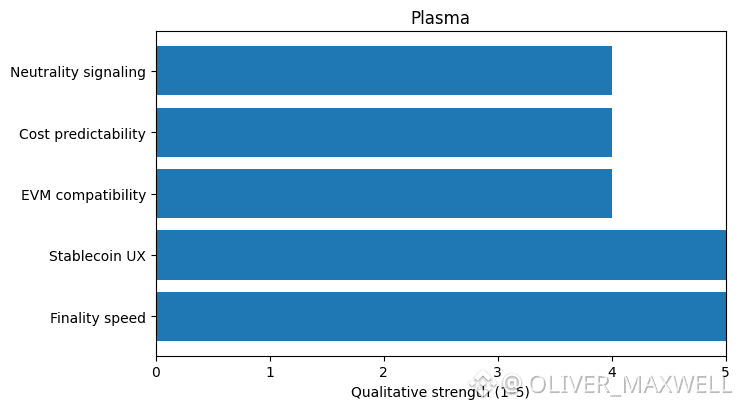
Plasma is best understood as a Layer 1 that treats stablecoin settlement as the product, not as one use case among many. The design choice that shapes everything else is the insistence on fast, deterministic finality paired with an execution environment that feels familiar to Ethereum developers. Plasma is not trying to win by being a universal chain for every kind of application. It is trying to become the place where stablecoins move with the operational certainty institutions actually demand.
Plasma’s core technical posture is straightforward. Full EVM compatibility means existing smart contract tooling and patterns carry over with minimal translation cost. The consensus layer is engineered around sub second style settlement expectations, so finality is not framed as probabilistic comfort but as a commitment the network intends to deliver consistently. For institutional settlement, that difference is not cosmetic. It changes when a payment can be treated as done for reconciliation, treasury controls, fraud workflows, and release of goods or services. The value is latency to certainty, not just throughput.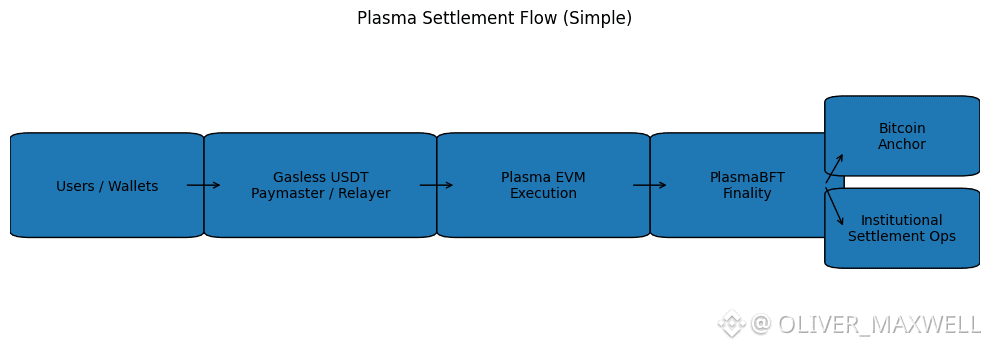
Where Plasma becomes meaningfully distinct is the stablecoin first transaction experience. Gasless USDT transfers and stablecoin oriented fee abstraction remove the most common point of failure in real payments deployments, the requirement that end users and operational teams must acquire and manage a separate volatile token purely to move stablecoins. That single requirement has quietly killed more consumer and fintech integrations than most people admit, because it creates support costs, user confusion, and balance management risk. Plasma attempts to collapse that friction so the default experience of sending stablecoins looks closer to modern payments rails, while still remaining on chain.
The Bitcoin anchored security narrative is also best read as a settlement posture, not a branding flourish. Plasma is positioning itself as neutral infrastructure for stablecoin movement, meaning it wants to look less like a corporate controlled ledger and more like a durable public settlement layer. Bitcoin anchoring, if implemented and maintained as a reliable checkpointing and verification story, is meant to add long horizon credibility to Plasma history in ways that auditors and risk teams can understand. It does not replace the need for robust validator operations and governance discipline. It is meant to strengthen the claim that settlement history should not be casually rewritten.
The real adoption question for Plasma is whether it can translate these technical choices into sustained usage without relying forever on subsidies. Gasless transfers create a compelling on ramp, but the long term system needs a durable path to fund security and operations while keeping costs predictable. That puts pressure on token incentives, validator economics, and the ability to attract stablecoin heavy activity that is real and recurring, not just short lived liquidity chasing. Plasma’s success will be measured by whether it becomes an invisible default rail inside wallets, fintech apps, and institutional settlement flows, because that is where stablecoin demand actually lives.
If Plasma executes, it occupies a defensible niche. Not the fastest chain in abstract benchmarks, but the chain that makes stablecoin settlement feel deterministic, inexpensive, and operationally legible to institutions. Plasma is betting that payments want reliability and cost clarity more than they want maximal generality. In stablecoin settlement, that is a serious bet with a clear product thesis, and it will either compound into real network effects or fail quickly in the only arena that matters, production usage at scale.

