

When I first started experimenting with Plasma, I wasn’t trying to analyze its deeper design patterns. I simply wanted to understand if their claim about “gasless stablecoin transfers” was just another marketing line, or if there was a real architectural shift happening underneath. But the more time I spent navigating the flow of transactions, observing how Plasma abstracts away the entire concept of gas, and watching stablecoins behave like UX-first money instead of blockchain assets, something clicked for me. I realized I wasn’t just interacting with a fast chain — I was experiencing a completely different philosophy of how value should move. Somewhere along the way, Plasma stopped feeling like a blockchain to me and started feeling like an operating system for money where friction—one of the biggest costs in finance—is systematically removed at every layer.
The turning point came when I made my first transfer without needing to worry about holding XPL for gas. It felt almost wrong at first, because every major chain trains you to manage gas balances like you manage fuel in a car. You run low, you refill. You run out, your day stops until you get more. Plasma broke that habit instantly. With protocol-level paymasters covering the gas for USD₮ transfers and enabling stablecoins to act as the fee asset when needed, I felt like a heavy psychological burden was lifted. For the first time, value movement didn’t feel like “using a blockchain”; it felt like sending a message. And because this design is native to the protocol itself instead of relying on dApps or wallets to patch over UX problems, everything is consistent, predictable, and free of hidden complexity.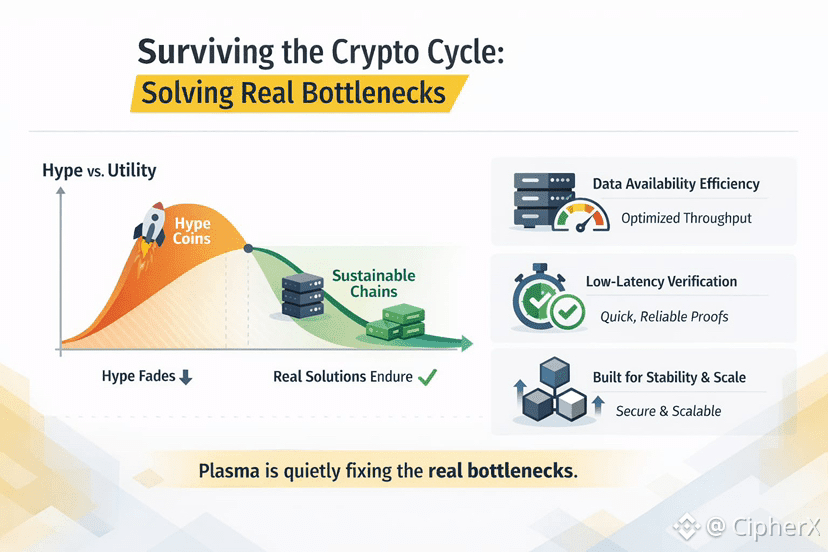
As I studied the architecture behind this, the elegance of the design impressed me even more. Plasma’s paymaster isn’t a bolt-on feature or some custom contract deployed by a third party. It is a protocol-maintained entity, deeply integrated with the chain’s economics, aware of stablecoin balances, and capable of pricing gas in non-native denominations through oracle feeds. The first thing that struck me was how heavily this reduces friction for mainstream users. A person shouldn’t need a tutorial to understand gas. They shouldn’t need to learn what slippage is, or why fees change, or why they have to buy a native asset just to move the asset they already own. Plasma’s model dissolves all that complexity long before the user ever notices it.
The more I thought about it, the more I realized how crucial this approach is for real-world stablecoin adoption. If stablecoins are going to become the universal digital money people constantly talk about, then gas cannot remain a prerequisite. Traditional finance doesn’t force you to buy a special token to access bank transfers; your money is the medium and the fuel. Plasma mirrors that experience in a decentralized environment. By allowing USD₮ to pay for gas, or removing gas entirely for basic transfers, it treats stablecoins like first-class citizens — the way digital dollars deserve to be treated. And that’s when it hit me: this wasn’t an improvement to blockchain UX. This was a redesign of money UX.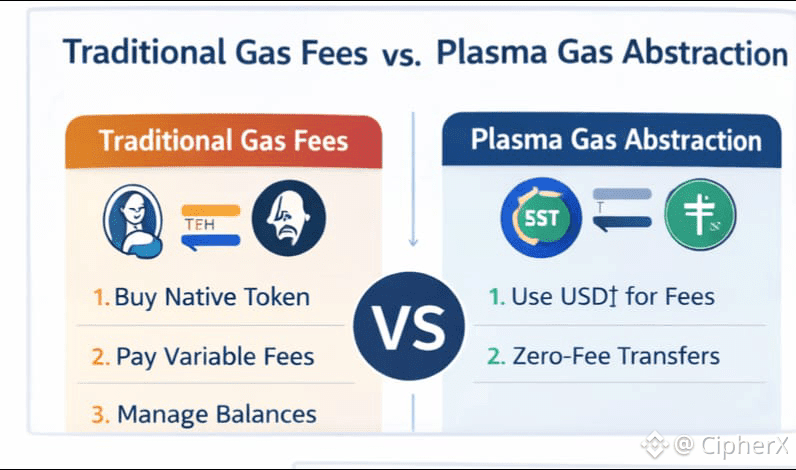
Another realization came when I began comparing transaction flows on Plasma to those on other EVM chains. Every other chain introduces friction at three levels: acquiring gas, calculating gas, and maintaining gas. Even when fees are low, the mental overhead is always there. On Plasma, that overhead disappears. You don’t think about supply and demand for blockspace. You don’t worry about fee spikes. You don’t have to manage multiple tokens. In a world where billions of transactions per day will involve stablecoins, this simplicity is not only powerful — it is necessary. Without it, stablecoins will always remain niche tools instead of mainstream money.
What really deepened my appreciation was how Plasma balances this frictionless UX with robust economic incentives under the hood. The validators are still compensated. The network still processes fees. The economics still function. The difference is that Plasma mediates all of this through the paymaster layer, shielding users from the complexity while keeping incentives intact. It reminded me of how internet protocols hide routing, packet shaping, and congestion management beneath the surface. You never see those mechanisms, but they’re working every second to deliver a seamless experience. Plasma does the same for money movement.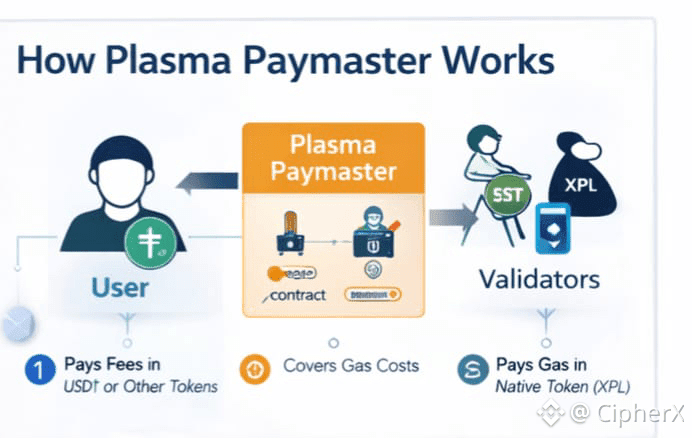
Then I started thinking about the broader implications. If anyone in the world can send stablecoins without worrying about gas, and if enterprises can integrate a chain where the cost model is predictable and stable, then the design space opens up dramatically. Payroll. Subscriptions. Commerce. Cross-border settlement. Payment apps. Merchant flows. Micropayments that would be impossible on Ethereum or Tron suddenly become normal. And because Plasma is EVM-compatible, these use cases don’t require developers to rethink everything from scratch. They simply deploy the same smart contracts they already know, but in an environment built for stablecoin velocity.
The personal moment for me came when I thought about users in emerging markets. Someone sending $20 to a relative shouldn’t lose a meaningful amount to fees. Someone using digital dollars for day-to-day spending shouldn’t have to worry about topping up a native token. Someone running a small business shouldn’t panic during a network surge. Plasma’s gas abstraction model isn’t just about convenience; it’s about access, fairness, and dignity. In many places, financial friction is the barrier between opportunity and stagnation. A system that removes that friction isn’t just a technological upgrade — it’s a social one.
As I dove deeper into Plasma’s roadmap, I saw that this philosophy extends far beyond gas. Every layer is designed to remove friction — consensus tuned for predictable settlement, contract templates built around stablecoin logic, and even the consumer app layer crafted to hide complexity while preserving decentralization. I began noticing a pattern: Plasma isn’t simplifying blockchain; it’s simplifying money. The chain just happens to be the mechanism that enables that simplicity.
Another thing that struck me is how this model aligns with institutional needs. Businesses rely on predictable cost structures. They need to know that a transaction won’t suddenly cost 20x because of network congestion. They need stable, programmable settlement rails. Plasma’s gas abstraction creates that environment. It creates a chain where enterprises don’t have to wonder what their operational expenses will look like next month. That reliability is what separates financial infrastructure from speculative networks.
Eventually I realized that Plasma’s worldview is incredibly consistent: if stablecoins are modern money, then everything about the chain must be designed to make them behave like money. Not like tokens. Not like assets. Not like complex DeFi objects. Just… money. And that includes removing every unnecessary step between intent and settlement. Plasma’s model made me confront a simple truth: most of the friction in digital value transfer isn’t economic — it’s architectural. And Plasma is one of the few systems trying to solve that at the root, not just at the surface.
In hindsight, this was the moment I fully understood what “frictionless money” actually means. It’s not enough for transactions to be cheap. They must be cognitively effortless. Emotionally effortless. Operationally effortless. What Plasma has built is not just a faster chain; it is a chain where the user no longer feels like a participant in a technical system. They feel like someone using money — the way money should always have worked in the digital age.
And that’s why Plasma’s gas abstraction model continues to fascinate me. It’s not a feature; it’s a philosophy. It’s a statement that the future of stablecoins requires simplicity, predictability, and accessibility at a global scale. And once you experience it, you start to see how unnecessary the friction on other chains truly is. Plasma doesn’t just make money move. It makes money feel free.

