
I’ve watched enough “AI chains” launch over the past two years that I’ve developed a reflex. If the pitch starts with throughput numbers and ends with “agents,” I usually stop reading. Most of them are just fast blockchains with an AI wrapper slapped on top, hoping the narrative does the heavy lifting. There’s nothing wrong with that, but it’s not new, and it’s rarely durable.
Vanar Chain didn’t catch my attention because of an announcement or a chart. I ran into it indirectly, late one night, reading a developer thread about persistent memory across AI sessions. Not model context. Not prompt history. Actual semantic memory that could be recalled, reasoned over, and acted on later. On-chain. That sounded ambitious enough to be either very serious or completely impractical.
At first, I assumed the latter.
The thing that made me keep reading wasn’t the claim itself, but how casually it was discussed. No grand promises. No timelines. Just logs, edge cases, and trade-offs. Someone mentioned myNeutron failing to recall context cleanly after a long idle period. Another talked about Kayon reasoning taking longer than expected under load. That’s usually where marketing decks end. Here, it was where the conversation started.
That’s when Vanar Chain began to feel less like a narrative and more like infrastructure.
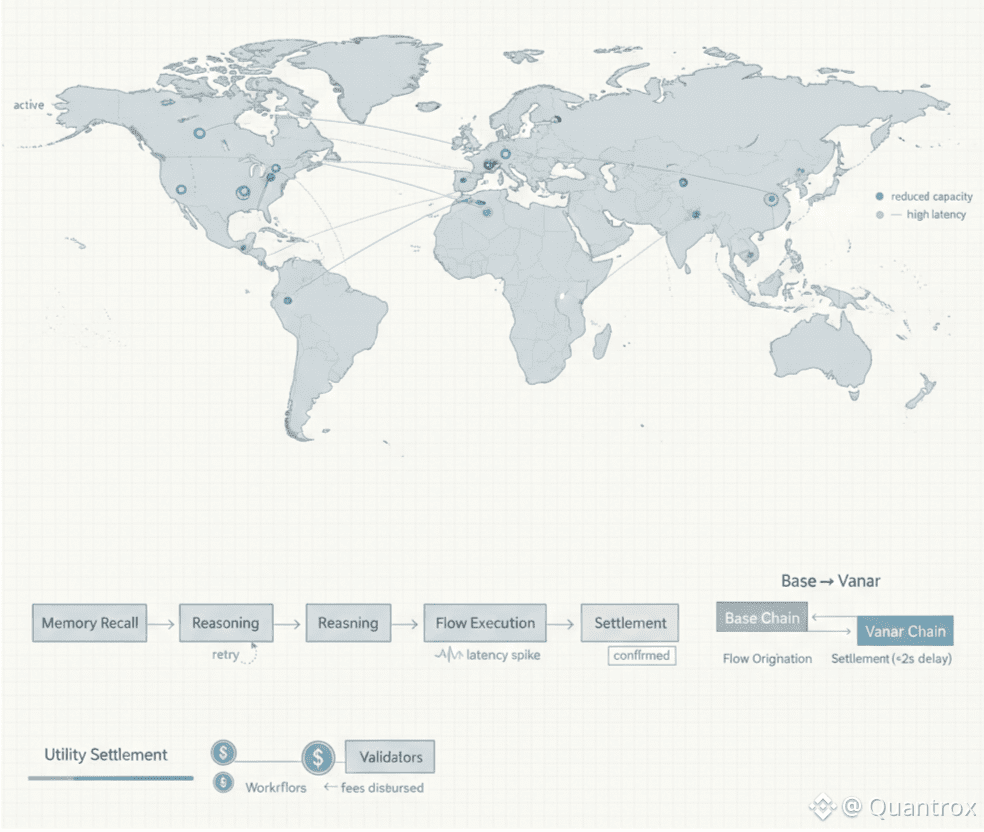
Watching Vanar operate isn’t clean or impressive in the way new L1 demos usually are. Validators are spread across regions, some clearly on modest setups, others on more robust infrastructure. Things occasionally lag. A Flow triggers late. A reasoning sequence has to retry. Nothing catastrophic, just the kind of friction you only see when something is actually being used instead of staged.
What stood out was that the system didn’t collapse under those imperfections. Agents adapted. Developers tweaked parameters. Settlements went through. $VANRY moved, quietly, without fanfare. The token wasn’t there to incentivize speculation. It was there because something had just happened on the network that required settlement.
One developer shared a test they were running across Base. An AI agent had to recall context from a prior session, reason about a changed condition, and execute the next action automatically. The logs weren’t pretty. You could see hesitation points where the network adjusted. But the sequence completed. A Flow executed. Payment settled. No one announced it. No one clipped it for social media. It just worked, eventually.
That distinction matters.
Most chains optimize for things that are easy to measure and easy to market. TPS. Finality. Cost per transaction. Vanar seems to be optimizing for things that are harder to fake: memory persistence, explainable reasoning, safe automation. Those are uncomfortable problems because they introduce complexity. They also introduce failure modes you can’t smooth over with a fast block time.
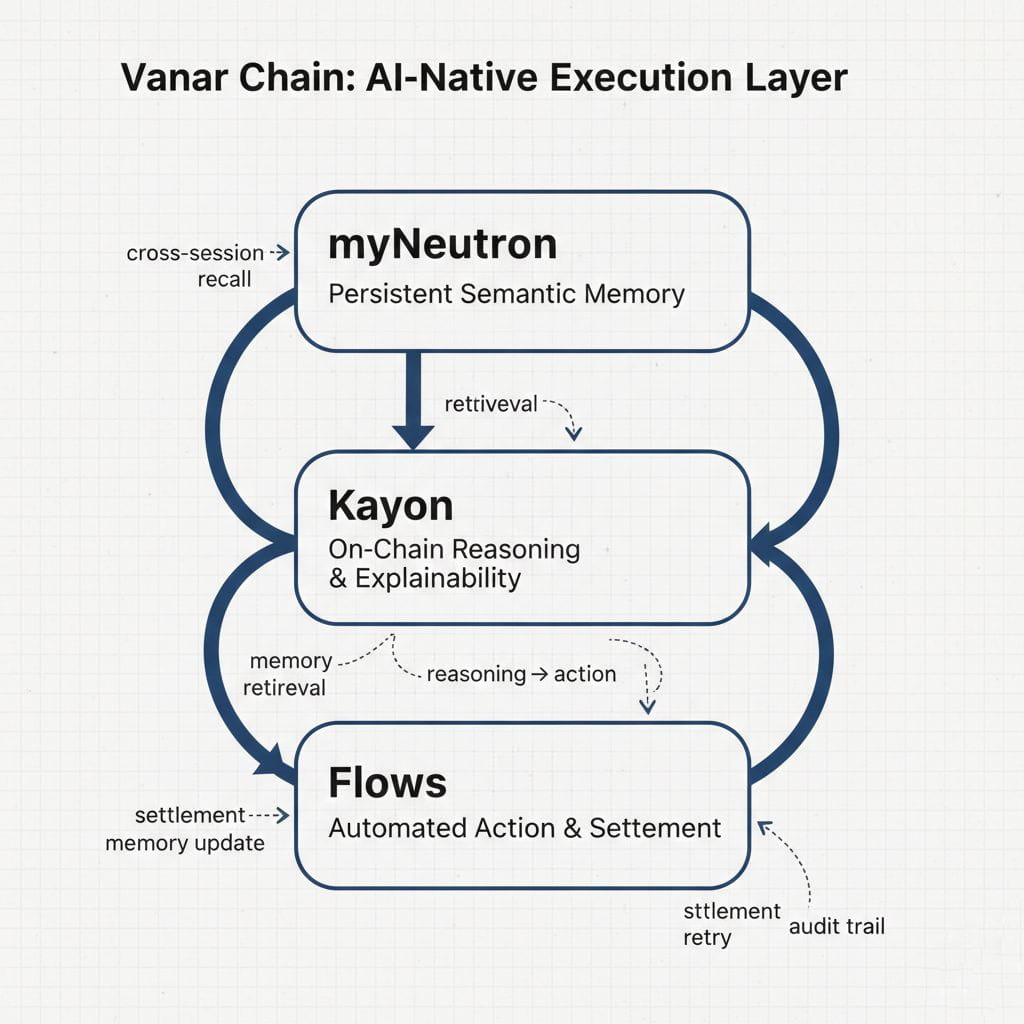
The architecture reflects that discomfort. myNeutron handles persistent semantic memory. Kayon processes reasoning in a way that can be audited after the fact. Flows translate that intelligence into automated action. None of this is lightweight. None of it is cheap to build or maintain. And none of it makes sense unless you genuinely believe AI agents will need these capabilities at the infrastructure level.
That belief is the real bet here.
Over time, patterns start to emerge. Validator deployments aren’t uniform. Some teams deliberately spread infrastructure across locations testing how reasoning behaves under different latency and load conditions. Others focus on reliability even if it means slower iteration. This isn’t the behavior of operators chasing short-term yield. It’s the behavior of people experimenting with a system they expect to be around long enough to justify the effort.
$VANRY plays a quiet but important role in that dynamic. It’s not just a reward token. It’s how work gets priced. When a Flow executes, when memory is accessed, when reasoning completes, settlement happens. If something breaks, value doesn’t magically appear. Someone eats the cost. That creates a feedback loop that’s hard to simulate in a testnet environment and impossible to sustain with pure hype.
Adoption, if you can call it that at this stage, is slow. Builders test. Things fail. They retry. Some ideas get abandoned. From the outside, VANRY price movement might look like noise. But underneath each transfer is a concrete action: an agent completing a task, a reasoning sequence resolving, a piece of memory being recalled and used.
There’s an uncomfortable honesty to that. It means progress isn’t linear. Some days, activity is quiet. Other days, bursts of automated actions fire in quick succession. The token reflects that uneven rhythm. Not cleanly. Not predictably. But accurately enough to tell you this isn’t just idle infrastructure waiting for a narrative to save it.
Cross-chain interactions add another layer of complexity. Actions originating on Vanar now touch Base, which introduces new assumptions and new failure points. That’s where a lot of “AI-first” chains quietly stop. Interoperability makes everything harder. Latency increases. Debugging becomes messier. Vanar didn’t avoid that. It leaned into it, which suggests a longer time horizon than most.
None of this guarantees success. It’s entirely possible that most applications won’t care about on-chain reasoning or persistent memory. They might decide off-chain systems are good enough. Centralized solutions will always be cheaper and easier for the majority of use cases. That’s the same advantage centralized cloud storage has over decentralized alternatives.
But the subset that does care, really care, about autonomy, auditability, and agents that can act without constant human supervision, won’t have many places to go.
What Vanar Chain seems to be building is infrastructure for that subset. Patient, imperfect, occasionally frustrating infrastructure. The kind that doesn’t photograph well but compounds quietly over time. VANRY doesn’t scream for attention. It moves when something real happens and stays quiet when it doesn’t.
That’s not exciting in the short term. It’s also not accidental.
Whether this approach works depends on whether AI agents actually become economic actors instead of demos. If they do, infrastructure like this starts to look less optional. If they don’t, Vanar will join a long list of technically sound ideas that arrived before the market was ready.
For now, the network runs. Agents execute. Memory persists. Payments settle. No one’s promising dominance. No one’s declaring victory. And that restraint, more than any metric, is what makes Vanar Chain worth paying attention to.
