
The crypto industry has reached a stage where infrastructure matters more than narratives. As adoption grows, the focus is shifting toward reliability, settlement certainty, and systems that can support real financial activity. Payments and stablecoins sit at the center of this transition. This is where Plasma enters the picture with a design philosophy that is deliberate, focused, and highly technical in nature.
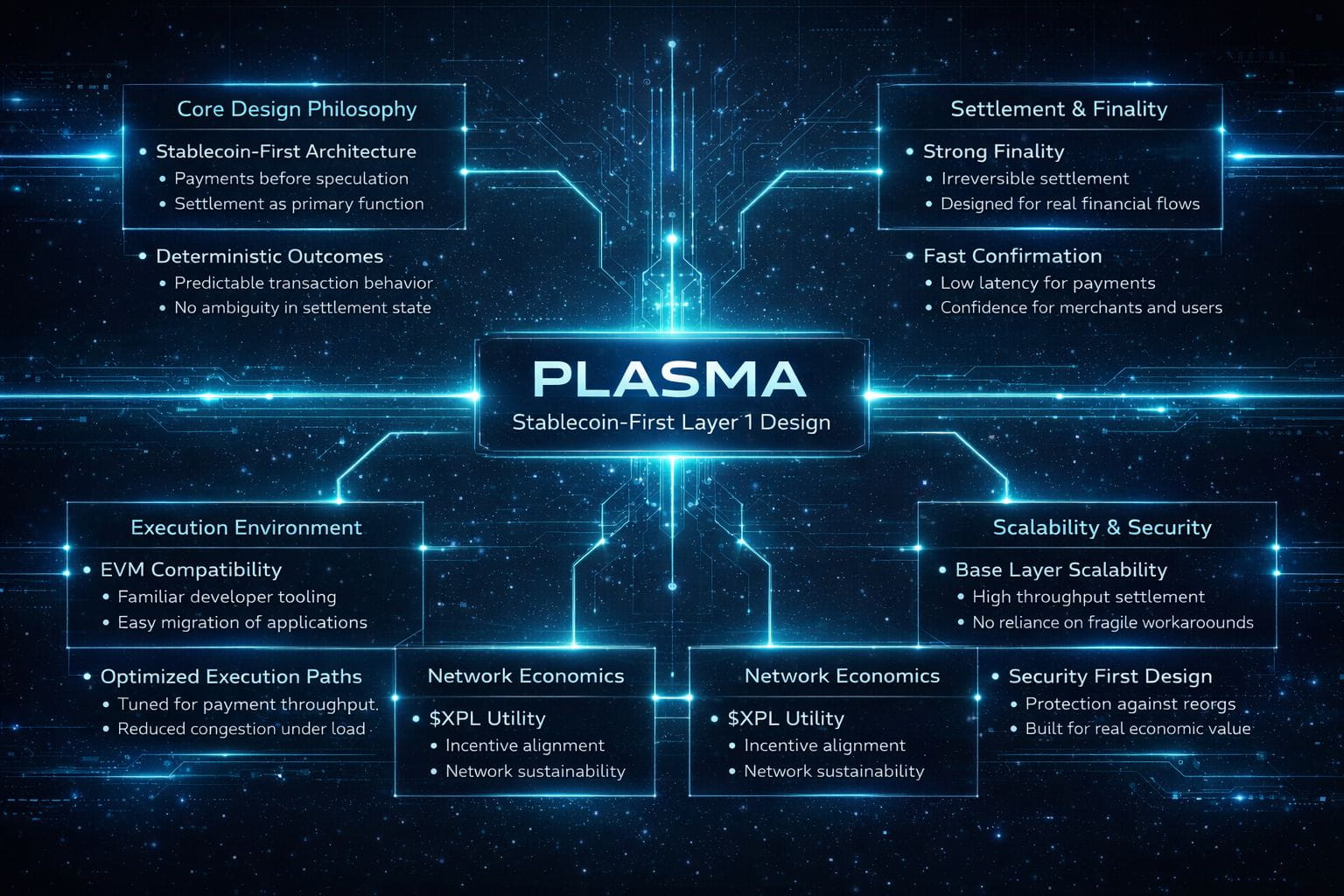
Plasma is a Layer 1 blockchain built specifically around the needs of stablecoin settlement. Instead of trying to optimize for every possible use case, it narrows its focus to the most demanding and realistic requirement in crypto today. Moving value consistently, quickly, and with certainty. This design choice influences every layer of the network, from execution to finality.
Stablecoins are fundamentally different from speculative assets. When someone sends a stablecoin, they expect it to arrive quickly and remain final. There is little tolerance for reorgs, delays, or ambiguous settlement states. Plasma recognizes this and builds its architecture around deterministic outcomes rather than probabilistic ones.
One of the defining elements of Plasma is its emphasis on strong finality. In many blockchains, transactions are considered final after a certain number of confirmations. While this approach works for trading and experimentation, it introduces uncertainty for payments. Plasma aims to reduce this ambiguity by designing finality into the core of the protocol.
Fast finality is not just about speed. It is about confidence. When a transaction is finalized on Plasma, it is designed to be irreversible in a practical sense. This characteristic is essential for payment processors, merchants, and institutions that rely on predictable settlement.
Another important aspect of Plasma’s design is its EVM compatibility. Rather than forcing developers to learn new tooling or rewrite applications, Plasma aligns itself with the existing Ethereum development ecosystem. This lowers the barrier to entry while still allowing Plasma to optimize its base layer for stablecoin use.
By supporting familiar smart contract environments, Plasma enables developers to focus on application logic rather than infrastructure complexity. At the same time, the underlying chain is tuned specifically for payment flows, ensuring that execution and settlement remain efficient even under load.
Plasma’s architecture treats stablecoins as first class citizens. Many blockchains support stablecoins, but they are often an afterthought layered on top of systems optimized for other purposes. Plasma inverts this approach by designing around stablecoin movement from the beginning.
This stablecoin first mindset affects how resources are allocated across the network. Transaction processing, gas behavior, and throughput are all considered through the lens of settlement reliability. This allows Plasma to avoid tradeoffs that often degrade performance during high usage periods.
At the center of Plasma’s ecosystem is the $XPL token. Rather than existing purely as a speculative asset, $XPL is designed to support network operations and align incentives across participants. As usage grows, the role of $XPL becomes increasingly tied to the health and sustainability of the settlement layer.
In payment focused systems, neutrality and predictability matter. Plasma aims to maintain a neutral base layer where transactions are processed consistently regardless of who initiates them. This is particularly important for stablecoin ecosystems that serve global users and institutions.
Scalability is another core consideration in Plasma’s design. Payment networks must handle spikes in demand without degrading user experience. Plasma approaches scalability through protocol level optimizations rather than relying solely on external layers or temporary solutions.
By optimizing for throughput at the base layer, Plasma ensures that settlement remains smooth even as transaction volume increases. This approach reduces reliance on complex workarounds that can introduce new points of failure.
Security is treated as a foundational requirement rather than a feature. Stablecoin settlement involves real economic value, and the cost of failure is high. Plasma’s design prioritizes security mechanisms that protect against double spending, censorship, and network instability.
Unlike experimental chains that iterate rapidly at the cost of reliability, Plasma adopts a more measured approach. Changes to the protocol are evaluated through the lens of long term stability and financial trust.
Another technical strength of Plasma lies in its clarity of purpose. Many blockchains attempt to serve decentralized finance, gaming, NFTs, and payments simultaneously. This often leads to architectural compromises. Plasma avoids this by aligning its design decisions with a single dominant use case.
This focus allows Plasma to fine tune execution paths, optimize block propagation, and maintain predictable performance. In payment systems, predictability is often more valuable than raw flexibility.
Plasma also recognizes the importance of integration with existing financial infrastructure. Stablecoins act as a bridge between traditional finance and blockchain systems. Plasma’s settlement oriented design makes it well suited for this role.
By prioritizing deterministic outcomes and fast confirmation, Plasma can support use cases such as remittances, payroll, merchant payments, and institutional settlement. These applications demand consistency above all else.
From a developer perspective, Plasma offers a familiar yet specialized environment. Developers can deploy EVM based applications while benefiting from a network optimized for payment logic. This balance helps accelerate ecosystem growth without sacrificing technical rigor.
Plasma’s approach also reduces complexity for end users. When transactions behave consistently, user trust increases. This trust is essential for mainstream adoption, especially in regions where stablecoins are used for everyday financial needs.
As the crypto space matures, the importance of infrastructure that works quietly in the background becomes clearer. Not every blockchain needs to be experimental or expressive. Some need to be dependable.
Plasma positions itself in this category. It does not attempt to capture attention through novelty. Instead, it focuses on engineering choices that support long term utility and adoption.
The stablecoin economy continues to grow, and with it comes the need for settlement layers that can handle real demand. Plasma’s design reflects an understanding of this shift and responds with a protocol built for purpose.
By anchoring its architecture around stablecoin settlement, Plasma addresses a real gap in the current blockchain landscape. It provides a foundation where payments can function with the reliability expected of financial infrastructure.
As usage expands, the importance of chains like Plasma will likely become more visible. The success of blockchain adoption depends not only on innovation but also on execution.
Plasma represents a thoughtful step in that direction. With its stablecoin first design, strong finality, EVM compatibility, and focus on settlement reliability, it contributes to the next phase of blockchain infrastructure.
In an ecosystem often driven by trends, Plasma stands out by committing to fundamentals. Its technical design reflects a clear understanding of what real world finance requires from a blockchain.
For those looking beyond speculation and toward practical systems, Plasma offers an example of how purpose built architecture can shape the future of digital payments.

