@Plasma doesn’t announce itself like a revolution. It moves more like infrastructure that already knows it will be blamed later for changing everything. From the outside, it looks like another Layer 1 with familiar promises. From the inside, it’s a calculated response to a problem most crypto markets still refuse to name clearly: stablecoins have already won, but the chains they live on were never designed for how they’re actually used.
The dominant use of stablecoins today is not DeFi yield, not governance, not composability. It is settlement. Boring, relentless, high-velocity settlement across borders, desks, exchanges, OTC rails, and informal payment networks. This activity doesn’t care about narrative. It cares about speed, certainty, and neutrality. Plasma starts from that truth instead of pretending every chain needs to be a world computer.
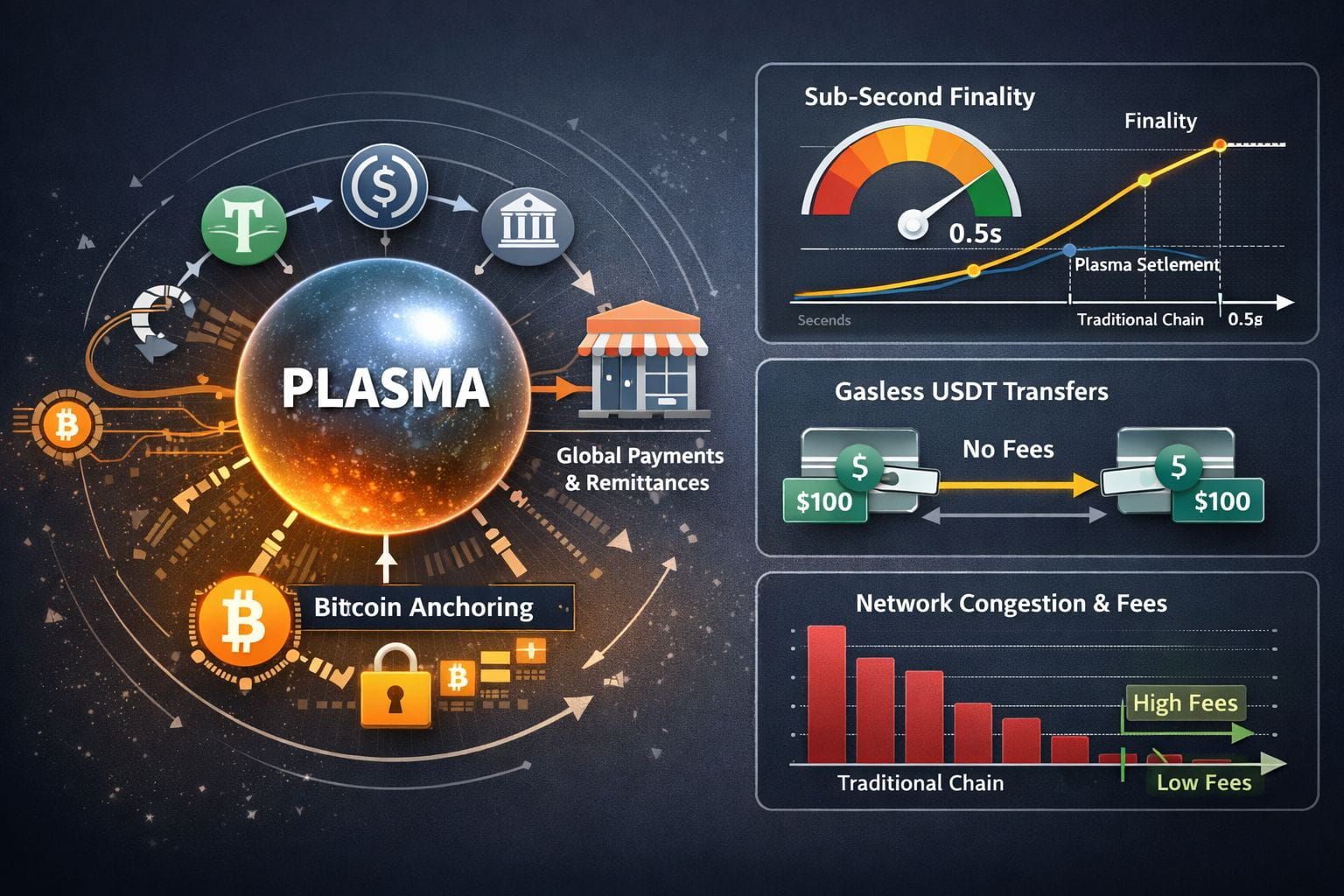
Most Layer 1s optimize for developer expressiveness first and hope payments follow. Plasma flips the order. It treats USDT not as an asset on the chain but as the economic center of gravity around which everything else must bend. Gasless transfers are not a UX gimmick here. They are an admission that, in real payment flows, users do not tolerate meta-economics. If a stablecoin is supposed to behave like digital cash, forcing users to hold a volatile token just to move it is friction masquerading as decentralization.
Under the hood, Plasma’s use of Reth matters less for compatibility and more for behavioral continuity. Traders, market makers, and payment operators already think in EVM terms. Execution risk is not just about bugs; it’s about unfamiliarity. By keeping execution familiar while changing the settlement assumptions, Plasma reduces the cognitive cost of migrating serious capital. That is a form of liquidity engineering most chains underestimate.
PlasmaBFT’s sub-second finality is not about bragging rights on throughput charts. It directly reshapes counterparty risk. When settlement finality approaches human reaction time, the need for trust buffers collapses. This is especially relevant for stablecoin-based credit, where delays translate into margin requirements. Faster finality compresses those margins, which quietly increases capital efficiency across desks that never tweet about it.
The most misunderstood design choice is Bitcoin anchoring. It is not there to borrow Bitcoin’s brand or appease maximalists. It is there because stablecoin settlement is politically sensitive. The more stablecoins resemble global shadow banking rails, the more they attract censorship pressure. Anchoring state to Bitcoin is a strategic hedge against discretionary interference, not a technical flourish. Plasma is implicitly betting that neutrality will become a pricing factor in settlement networks, even if users never articulate it.
What makes Plasma dangerous to incumbents is not that it competes with Ethereum or Solana directly, but that it exposes their hidden tax. On general-purpose chains, stablecoin users subsidize everything else: NFTs, experiments, congestion, narrative cycles. Plasma removes that subsidy. If it succeeds, it forces an uncomfortable question across the ecosystem: why should the most economically productive flows pay for everyone else’s ideas?
Capital flows already hint at this shift. Stablecoin velocity continues to rise while speculative activity fragments. Payment-heavy regions care less about ecosystem breadth and more about reliability under stress. Plasma is clearly positioning itself where remittances blur into institutional settlement, where compliance is negotiated off-chain but execution must remain censorship-resistant on-chain.
The long-term risk for Plasma is not technical failure but success. A chain optimized for settlement becomes systemically important faster than a chain optimized for experimentation. That invites scrutiny, pressure, and attempts at capture. Plasma’s architecture suggests its builders understand this and are preparing for adversarial environments, not just competitive ones.
Plasma is not trying to be loved by crypto. It is trying to be needed by money. That distinction explains almost every design choice, and it is why serious traders should pay attention long before the charts make it obvious.