@Vanarchain enters the Layer-1 arena with an uncomfortable premise that most blockchains avoid admitting: mass adoption has very little to do with decentralization ideals, TPS benchmarks, or whitepaper purity. It has everything to do with whether real users even realize they are touching a blockchain. Vanar is not trying to win crypto Twitter. It is trying to disappear into the background of products people already want to use.
The most misunderstood aspect of Vanar is that it is not a “gaming chain” or a “metaverse chain.” Those labels are lazy shortcuts. Vanar is better understood as a consumer infrastructure chain optimized for behavior, not ideology. Its design choices reflect years of exposure to how games, brands, and entertainment products actually scale users: frictionless onboarding, predictable costs, and emotional engagement. Crypto markets underestimate how rare that experience set is inside L1 teams.
Most blockchains optimize for developers first and hope users arrive later. Vanar inverts this. The chain is structured around predictable execution costs and UX-stable environments because consumer platforms cannot tolerate gas volatility. When transaction fees spike unpredictably, it does not hurt DeFi whales. It kills games, loyalty programs, and branded digital products overnight. Vanar’s economic design implicitly acknowledges that consumer apps demand boring reliability, not financialized chaos.
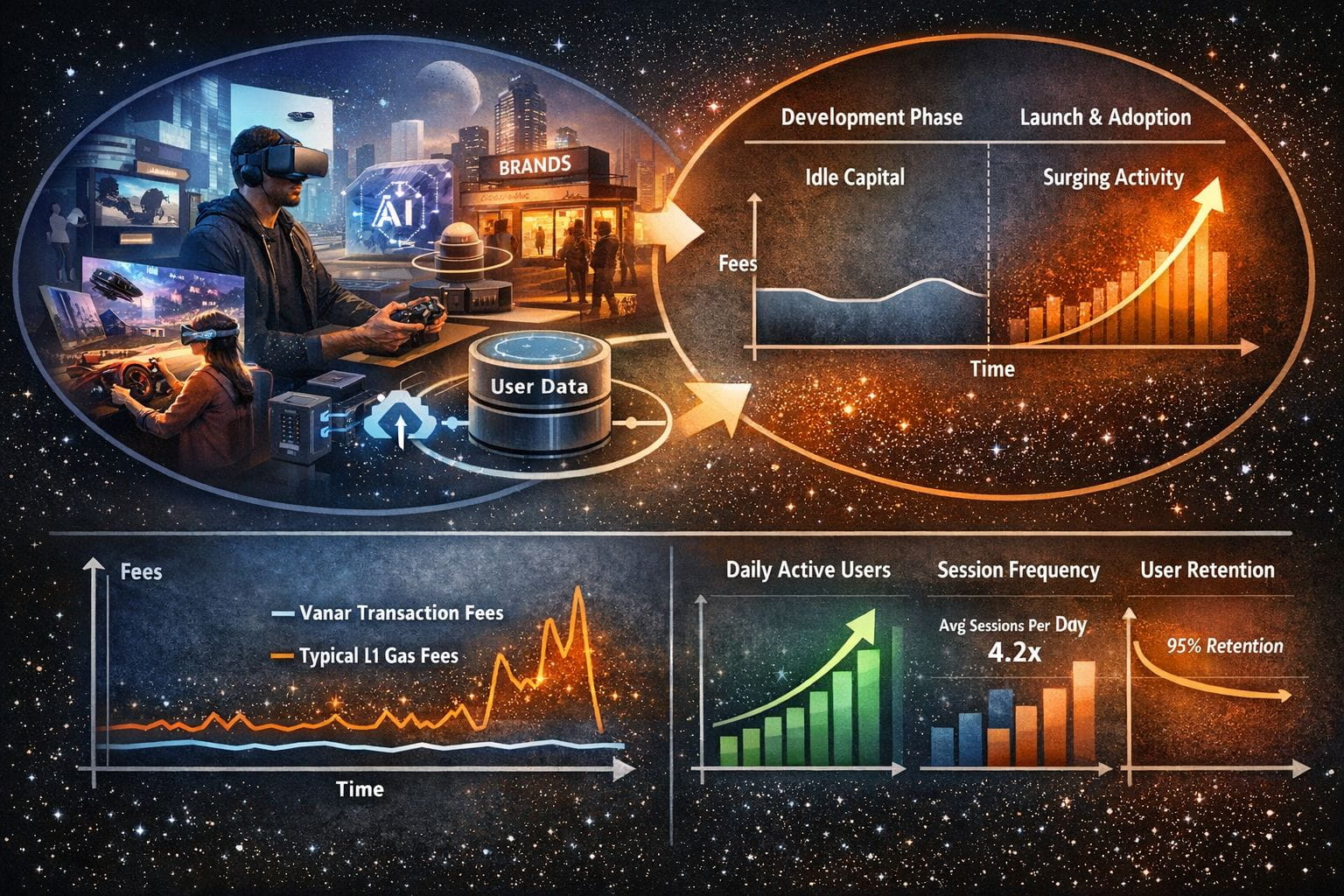
This is where VANRY’s role becomes more interesting than it appears on the surface. VANRY is not positioned to be hyper-velocity money. It is positioned to be quietly consumed by activity. In ecosystems like Virtua or VGN, token velocity is not driven by speculative loops but by repetitive micro-actions. That creates a different supply-demand profile than DeFi-native chains. Charts would show this as flatter fee curves and less reflexive correlation with broader market leverage cycles.
There is also a subtle capital flow insight most traders miss. Capital in gaming and entertainment does not rotate like crypto capital. It arrives early, sits idle during long development cycles, and explodes in usage at launch moments rather than during bull markets. Chains built for DeFi ride narratives. Chains built for products ride release schedules. Vanar’s ecosystem cadence aligns more with traditional tech roadmaps than crypto hype cycles, which means its valuation lag can be structural, not bearish.
Another overlooked dimension is how brands interact with blockchains. Brands do not want composability. They want containment. They need environments where user experience, compliance boundaries, and data flows are controlled. Vanar’s architecture implicitly accepts this tradeoff, even if it makes crypto purists uncomfortable. This is precisely why enterprise and entertainment adoption tends to avoid permissionless chaos and favor curated ecosystems.
The AI narrative around Vanar is also misunderstood. This is not about AI tokens or on-chain inference gimmicks. It is about data persistence and behavior mapping. Consumer platforms generate massive contextual data, and AI systems only become useful when that data is clean, continuous, and economically cheap to store or reference. Vanar’s low-cost execution layer makes AI-driven personalization economically viable at scale, something Ethereum-centric stacks quietly struggle with.
From a market structure perspective, Vanar sits in an awkward but potentially powerful position. It is not competing for DeFi TVL. It is competing for attention time. Metrics that matter here are daily interactions per wallet, session frequency, and retention curves, not just active addresses. Traders watching only volume charts will miss this entirely until usage leaks into token demand months later.
The long-term risk is obvious and real. Consumer chains die if they fail to ship compelling products. Infrastructure alone does nothing. Vanar’s advantage is also its burden: it must continuously deliver experiences, not just upgrades. The upside is that if even one flagship consumer product escapes the crypto bubble, VANRY demand becomes structurally different from most L1 assets on the market.
Vanar is not building a financial playground. It is building a substrate for digital life where blockchain is invisible and value flows quietly underneath. Markets rarely price that correctly early. They usually notice only after users arrive without asking permission.