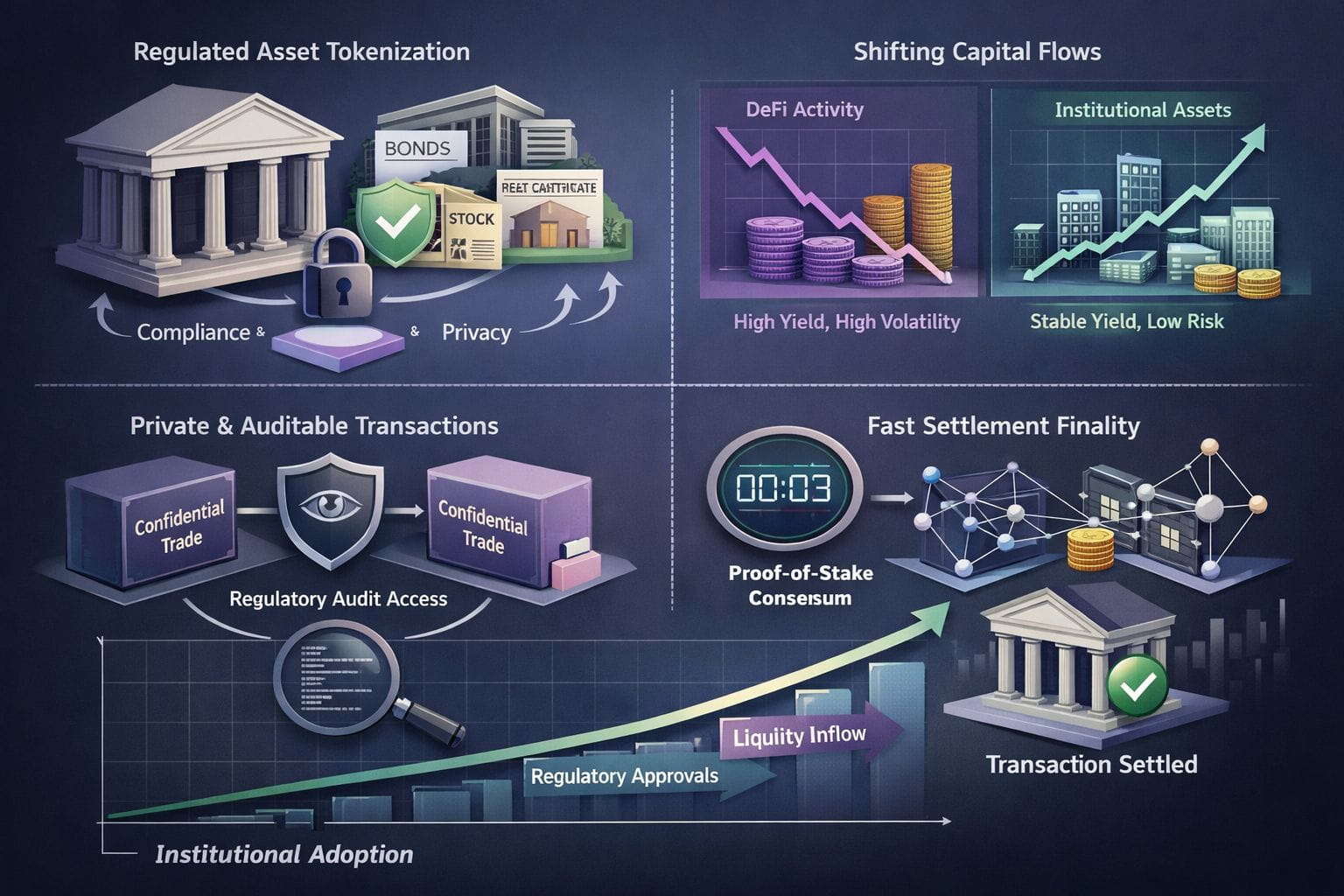
@Dusk begins from a premise most crypto investors still resist: the largest pools of capital in the world will never touch infrastructure that treats regulation as an afterthought. While the industry spent years optimizing for permissionless chaos, Dusk quietly designed a chain for markets that already exist, markets that move slowly, demand guarantees, and punish ambiguity. That choice has kept it out of hype cycles, but it may be the reason it survives the next one.
The uncomfortable truth is that privacy in crypto has mostly been framed as an act of rebellion. Dusk treats privacy as operational necessity. In real financial markets, information asymmetry is not a bug, it is the system. Order books are protected, counterparties are obscured, and disclosures happen selectively, on demand, and under legal constraints. Dusk’s architecture reflects that reality. Its privacy model is not about hiding from the state; it is about allowing institutions to transact without broadcasting strategy, inventory, or exposure to the entire internet. That distinction matters more than most traders realize.
What makes Dusk interesting right now is not its cryptography alone, but how its cryptography is welded to economic intent. Zero-knowledge systems are everywhere in marketing decks, yet few chains design them around settlement finality, compliance proofs, and audit triggers. Dusk’s approach treats privacy and auditability as two sides of the same transaction. A position can remain confidential until a regulator, auditor, or counterparty has a legally justified reason to see it. This is closer to how prime brokerage actually works than anything built for retail DeFi.
Markets are currently obsessed with tokenized real-world assets, but most RWA narratives gloss over the hardest part: post-issuance behavior. Issuing a tokenized bond is easy. Managing transfer restrictions, disclosure rules, jurisdictional access, and secondary market liquidity is where projects quietly die. Dusk’s modular design targets that exact layer. Compliance is not bolted on at the application level; it is enforced at the protocol level, where violations are impossible rather than merely discouraged. That changes risk models for issuers and investors in ways most charts do not yet reflect.
There is also a subtle capital flow dynamic forming that favors chains like Dusk. As yield compresses in retail DeFi, larger players are rotating toward lower-volatility, compliance-friendly on-chain instruments. This is visible in on-chain data as longer holding periods, lower transaction frequency, and higher average position sizes in RWA-adjacent protocols. Dusk is structurally aligned with that shift. It is not optimized for memecoin velocity or NFT churn. It is optimized for slow money that expects contracts to still work five years from now.
Technically, Dusk’s consensus and execution choices signal another underappreciated insight: institutions value predictable finality more than theoretical decentralization metrics. Sub-second settlement is not about bragging rights; it reduces counterparty risk, margin requirements, and capital lock-up. When you model this across large balance sheets, the savings are material. Traders often miss this because it does not show up as explosive on-chain volume. It shows up as capital that quietly stops leaking.
From a trader’s perspective, Dusk occupies an awkward middle ground that the market often misprices. It is not narrative-friendly enough for retail hype cycles, yet it is early for institutional adoption to be visible on public dashboards. This creates valuation gaps driven by impatience rather than fundamentals. If you overlay development milestones with regulatory timelines instead of Bitcoin dominance charts, the roadmap suddenly looks less slow and more synchronized with reality.
There is risk here, and it should not be ignored. Regulation-aligned infrastructure lives and dies by policy interpretation. A shift in regulatory tone can accelerate adoption or freeze it overnight. Dusk’s bet is that compliance demand will increase, not soften. That is a macro call, not a technical one. Traders who treat it like a typical Layer 1 will misunderstand both the risk and the opportunity.
The deeper insight is that Dusk is not competing with Ethereum, Solana, or the next throughput-optimized chain. It is competing with legacy financial plumbing that is decades old and deeply inefficient. That battle will not be loud. It will not trend on social feeds. It will be reflected in custody integrations, pilot programs, and balance sheets that slowly migrate on-chain without asking for permission from crypto Twitter.
If you were to visualize Dusk’s progress on a chart, price would be the least informative metric in the short term. More telling signals would be developer concentration, regulatory partnerships, and the complexity of assets issued on-chain. When those curves start bending upward together, liquidity tends to follow with a delay. That delay is where asymmetric positioning lives.
Dusk feels less like a bet on technology and more like a bet on human behavior under constraint. When markets mature, they do not become freer; they become more structured. Dusk is building for that end state. The question is not whether crypto will need chains like this, but whether traders are willing to hold an asset that grows quietly before it becomes obvious.