
If you are watching the Real-World Assets and compliance narrative, @dusk_foundation is one of the few blockchain projects built specifically for that space. $DUSK is not trying to compete as a meme chain or a general-purpose hype network. Dusk Network focuses on something much more specific and difficult: bringing regulated financial assets on-chain while keeping sensitive data private but still verifiable. This idea is often described as “auditable privacy,” and it sits at the core of what Dusk is building. 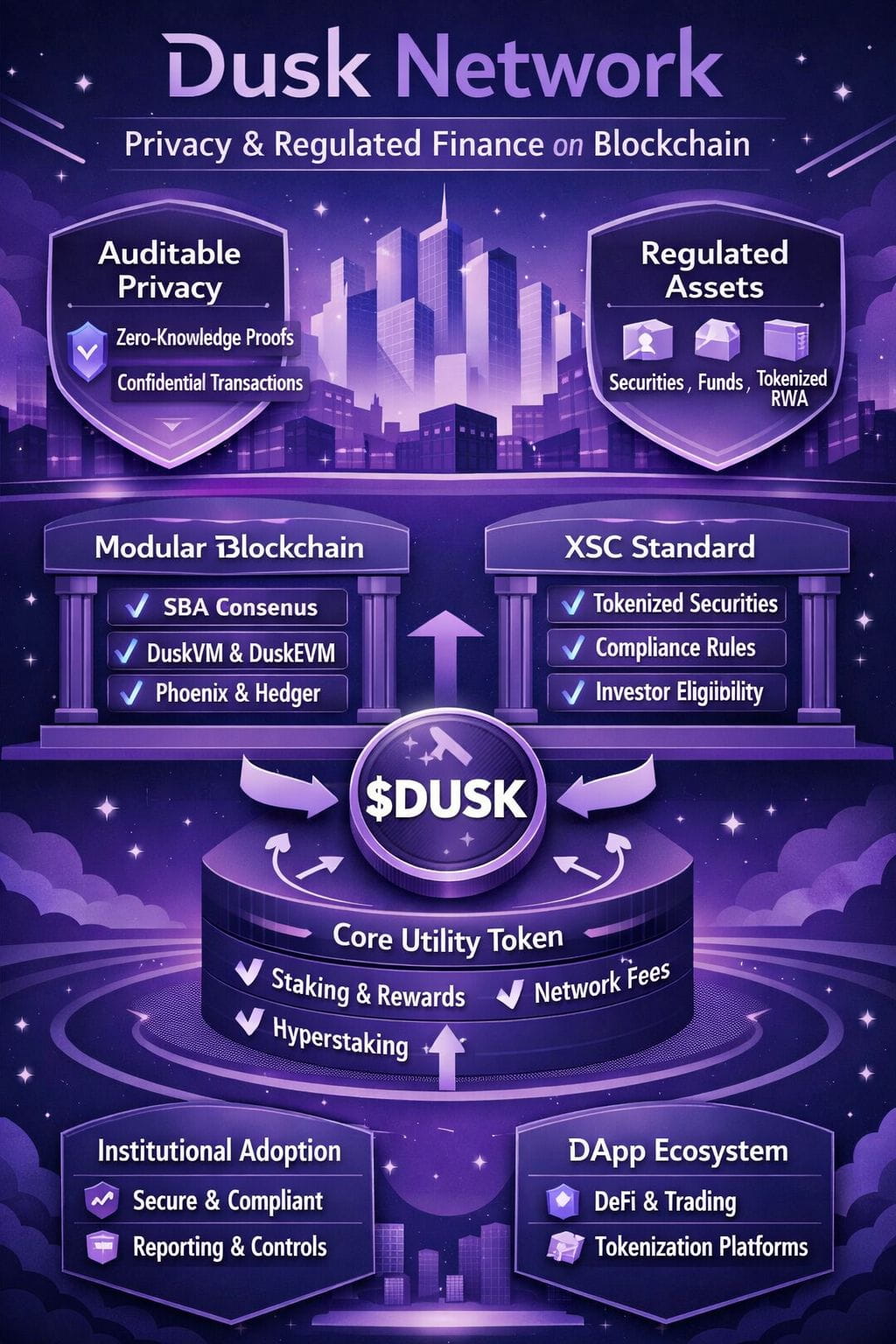
Most blockchains today are fully transparent, which sounds good in theory but creates real problems for finance. In real markets, traders do not want their balances, strategies, counterparties, or order sizes visible to everyone. At the same time, regulators and institutions need proof that rules are being followed. Dusk tries to solve this conflict by allowing transactions and smart contracts to stay confidential while still proving, through cryptography, that everything is valid and compliant. This makes Dusk highly relevant for tokenized securities, funds, and other regulated assets.
Dusk Network is a Layer-1 blockchain that uses zero-knowledge cryptography to prove correctness without exposing private data. Instead of publishing all transaction details on-chain, Dusk publishes cryptographic proofs that confirm balances are sufficient, transfers are valid, and no rules were broken. This means users keep privacy, while auditors and regulators can still verify outcomes when required. This approach is very different from both fully public blockchains and fully private financial systems.
The network runs on a Proof-of-Stake model using a consensus mechanism called Segregated Byzantine Agreement. In simple terms, this separates block creation and validation roles to improve security and efficiency. Validators and provisioners stake to secure the network, earn rewards for honest participation, and face penalties if they act maliciously or go offline. This creates long-term incentives for stability and reliability, which is essential for financial infrastructure.
For developers, Dusk supports both a native virtual machine and an EVM-compatible environment. DuskEVM allows Solidity developers to build using familiar tools, while DuskVM enables deeper privacy features through WebAssembly. This dual approach lowers the barrier for developers while still allowing advanced privacy functionality where it matters most. On top of this, Dusk has introduced privacy systems like Phoenix and Hedger to bring confidential transfers and private smart contract interactions even to EVM-based applications.
A major part of Dusk’s vision is tokenized securities. Through its Confidential Security Contract standard, often referred to as XSC, developers and institutions can issue assets that include built-in compliance rules. These rules can define who is allowed to hold an asset, how it can be transferred, and what disclosures are required. This is critical for real financial products, where regulation is not optional but mandatory.
The $DUSK token plays a central role in the network. It is used to pay transaction fees, secure the network through staking, and reward validators and participants. Dusk follows a defined emission schedule that distributes staking rewards over time while maintaining a maximum supply cap. Slashing is also part of the system, meaning bad behavior results in financial penalties. Dusk has also explored stake abstraction, sometimes called Hyperstaking, which allows smart contracts to participate in staking. This opens the door to automated staking services, pooled staking, and more advanced financial products built on top of the network.
The Dusk ecosystem is built around three layers. At the base is the core network, including nodes, validators, developer tools, and privacy infrastructure. On top of that is asset issuance and settlement, especially for regulated financial products. The final layer is applications, such as compliant trading venues, RWA platforms, and privacy-focused financial tools. This ecosystem design shows that Dusk is not chasing short-term trends but aiming to become infrastructure for serious on-chain finance.
Looking ahead, Dusk’s roadmap focuses on mainnet maturity, security audits, improved developer tooling, and expanding privacy support across smart contracts. The long-term goal is to support real institutions and real financial products at scale. Progress should be measured by network stability, validator participation, developer adoption, and real-world pilots rather than short-term price action.
Dusk also faces real challenges. Privacy technology is complex and harder to explain than simple performance metrics. Competition in the RWA and institutional blockchain space is intense. Regulations vary across regions and can change over time. Most importantly, strong technology alone is not enough — Dusk needs real applications and users to build lasting network effects. These challenges are significant, but they are also the same challenges that define whether a blockchain becomes infrastructure or fades into noise.
Overall, Dusk Network is making a focused bet that the future of blockchain adoption lies in regulated markets that require privacy, compliance, and trust. Instead of trying to be everything, it is trying to solve a real problem that traditional finance actually has. If that vision succeeds, becomes more than just a token — it becomes the backbone of confidential, compliant on-chain finance. @Dusk $DUSK #dusk
