
You know what’s funny about Web3? Everyone talks about apps, DeFi, and on-chain everything but almost nobody talks about where the data actually lives. And when you look closer, a lot of it still ends up on centralized cloud servers. Kind of awkward for a space that’s supposed to be decentralized. That’s why Walrus Protocol has been on my radar lately.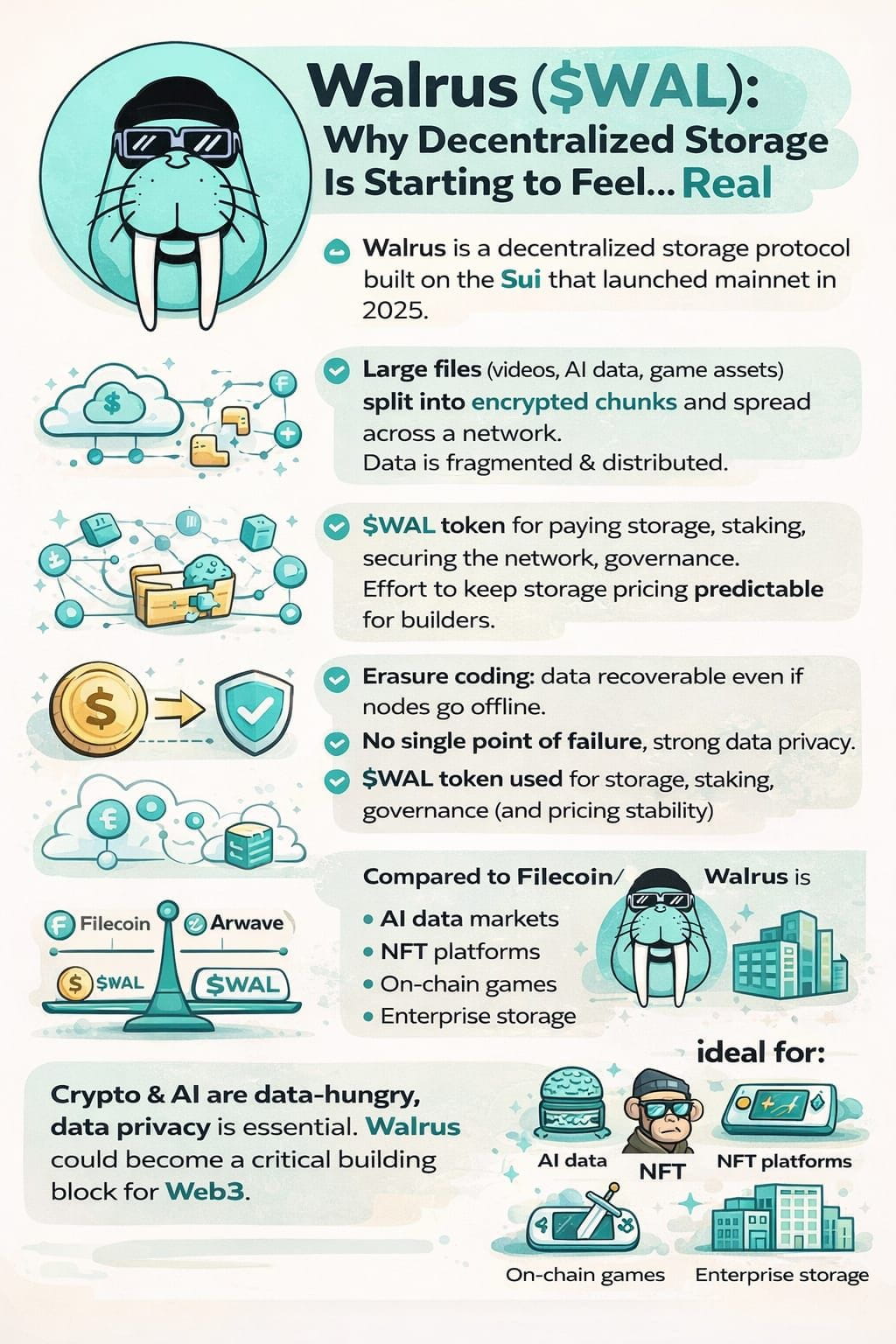
@Walrus 🦭/acc is a decentralized storage and data availability protocol built on the Sui. And importantly, it’s not just an idea anymore. Walrus launched its mainnet in 2025, and people are actually building with it now. That alone puts it ahead of a lot of “future promise” projects. Here’s the simple breakdown. Walrus takes large files videos, images, AI datasets, game assets, whatever breaks them into encrypted chunks, and spreads them across a network of nodes. It uses erasure coding, which basically means the data can still be recovered even if some nodes go offline. No single node ever has the full file. No single point of failure. That’s the whole point.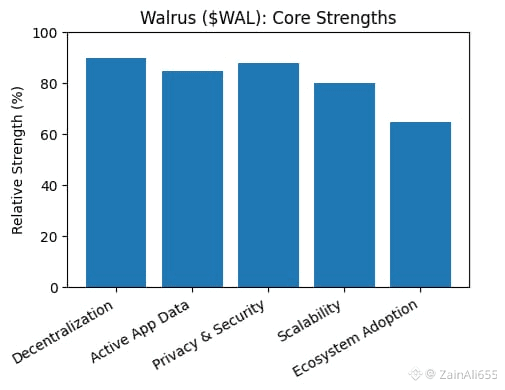
The $WAL token ties into all of this. It’s used to pay for storage, to stake and help secure the network, and to participate in governance. There’s also an effort to keep storage pricing predictable, so builders aren’t constantly guessing what their costs will be if the token price moves around. That matters more than people think. What really clicks for me is who this is for. Walrus isn’t just chasing crypto-native use cases. It’s clearly aiming at data-heavy apps AI data markets, NFT platforms with high-res media, on-chain games, even enterprises testing decentralized data storage. These are areas where centralized storage becomes a real risk, not just a philosophical issue. Compared to older decentralized storage networks like Filecoin or Arweave, Walrus feels more practical. Those protocols were early and important, but they leaned heavily toward long-term or archival storage. Walrus feels designed for active application data, especially with Sui’s fast execution and low latency. Stored data isn’t just sitting there it can actually interact with smart contracts in useful ways.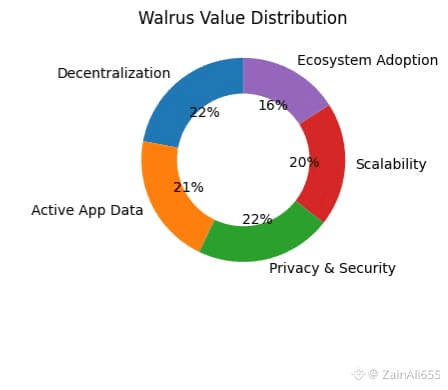
That said, it’s not risk-free. Developers are still used to centralized cloud tools, and habits don’t change overnight. Adoption has to keep growing, and $WAL’s long-term value really depends on whether real storage demand shows up consistently. Competition in decentralized storage isn’t slowing down either. Still, the direction feels obvious. Data privacy is getting regulated. Outages are expensive. AI and on-chain apps are data-hungry. At some point, decentralized storage stops being a “nice idea” and starts being necessary infrastructure. I’m not treating #walrus like a hype play. I’m watching it as one of those quiet building blocks that could end up everywhere if things go right. And in crypto, those boring-looking layers are often the ones that matter most later on.



