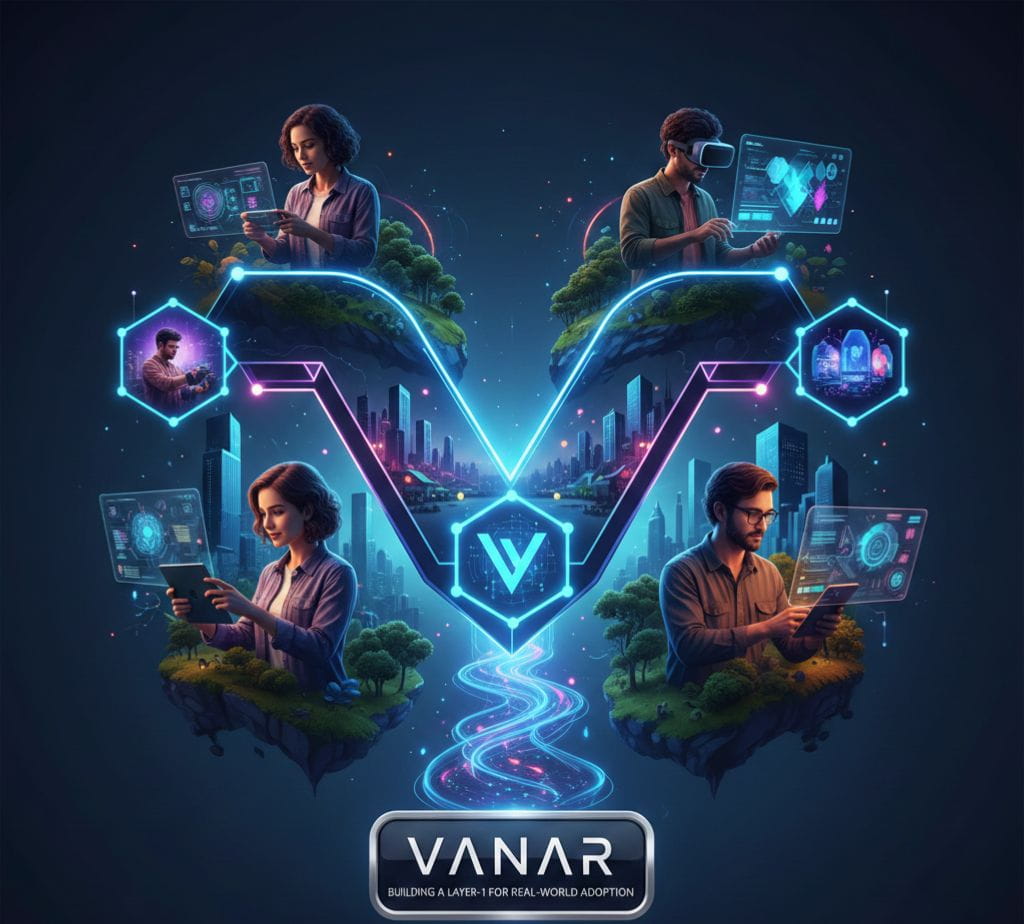
@Vanar was not conceived as a blockchain experiment looking for a problem to solve. It was built around a much simpler question: how would a blockchain look if it were designed for people who do not think about blockchains at all?
Most Layer-1 networks begin with technical ideals such as throughput, decentralization models, or cryptographic elegance, and assume that adoption will follow. Vanar takes the opposite route. Its foundation is shaped by years of hands-on experience in gaming, entertainment, and consumer brands, industries where users expect speed, clarity, and reliability without needing to understand what powers the system underneath. This background informs every design decision behind the network.
As a Layer-1 blockchain, Vanar controls its core infrastructure rather than relying on layered workarounds. That control matters because consumer applications behave very differently from financial protocols or experimental decentralized apps. Games, virtual worlds, and digital media platforms generate frequent interactions, small transactions, and large bursts of activity. A network built for occasional, high-value transfers struggles under those conditions. Vanar’s architecture reflects the realities of consumer software: predictable costs, low friction, and performance that holds up when usage scales.
What truly distinguishes Vanar is its insistence that blockchain should feel invisible to the end user. In most mainstream products, people do not care how data is stored or how servers communicate. They care about whether an experience feels smooth and intuitive. Vanar’s approach treats blockchain the same way, as an enabling layer that quietly handles ownership, coordination, and value transfer without demanding attention.
This philosophy becomes clearer when looking at the products built on Vanar. The Virtua Metaverse is not presented as a technical showcase but as a digital environment where users can explore, collect, and interact with branded and creative content. Ownership and interoperability exist beneath the surface, enhancing the experience rather than defining it. For users, the appeal lies in the world itself; blockchain simply ensures that digital assets behave like real possessions.
The same logic applies to the VGN games network. Blockchain gaming has often struggled because it asks players to tolerate complexity for abstract benefits. Wallets, transaction confirmations, and unfamiliar interfaces create friction where none previously existed. Vanar’s gaming ecosystem attempts to remove those obstacles by designing around developers and players rather than crypto-native expectations. The objective is not to teach users Web3, but to let them enjoy games where digital economies function more transparently and fairly.
Vanar’s scope extends beyond gaming and virtual worlds. Its ecosystem spans areas such as artificial intelligence, environmental initiatives, and brand-focused digital solutions. This breadth is intentional. Mass adoption rarely arrives through a single breakthrough application; it emerges when technology quietly improves many parts of everyday life at once. Blockchain can support this shift, but only if it adapts to different contexts instead of forcing every use case into the same framework.
The VANRY token underpins this ecosystem. Rather than existing purely as a speculative instrument, it functions as the connective tissue of the network, securing the chain, enabling transactions, and aligning incentives among participants. In a healthy ecosystem, a token gains relevance through use, not attention. Vanar’s design reflects that understanding, positioning VANRY as a tool that supports activity rather than a symbol that demands belief.
The ambition to reach the next three billion users is often repeated across the industry, but Vanar grounds this goal in practical considerations. Many potential users live in regions where fees matter, hardware is limited, and trust in digital systems is fragile. For these audiences, blockchain adoption will not happen through ideological arguments. It will happen when products simply work better, feel fairer, or offer opportunities that were previously inaccessible. Vanar’s emphasis on efficiency and usability suggests an awareness of these realities.
This approach also carries broader implications for Web3 as a whole. As the space matures, success is likely to favor platforms that integrate seamlessly with existing digital habits rather than demanding radical behavioral change. The future of blockchain may look less like a parallel internet and more like an upgrade to the one people already use. Vanar positions itself firmly within that future.
None of this guarantees success. Building a Layer-1 network with real consumer traction requires discipline, long-term execution, and the ability to evolve without losing focus. Competition remains intense, and credibility will ultimately be measured by sustained usage rather than narratives. Yet Vanar’s direction is clear and coherent. It treats blockchain as infrastructure, not ideology.
In an industry often driven by abstraction and speculation, Vanar stands out by focusing on the ordinary user. Its bet is that the most powerful technology is the kind people do not have to think about. If Web3 is ever to become part of everyday digital life, it will likely resemble something much closer to Vanar’s vision: quiet, practical, and built for the world as it is, not as technologists wish it to be.