

Hey, have you ever stopped to think about where your data actually lives these days? In a world full of cloud services and centralized servers, it’s easy to feel like your files are just floating around, vulnerable to outages, censorship, or even simple human error. Walrus is trying to change that picture by building a decentralized storage network on the Sui blockchain, one that makes large unstructured data—like images, videos, datasets, documents, and media files—reliable, verifiable, and accessible. At the center of this system sits the $WAL token, which isn’t just another crypto asset but a practical utility that keeps everything running smoothly.
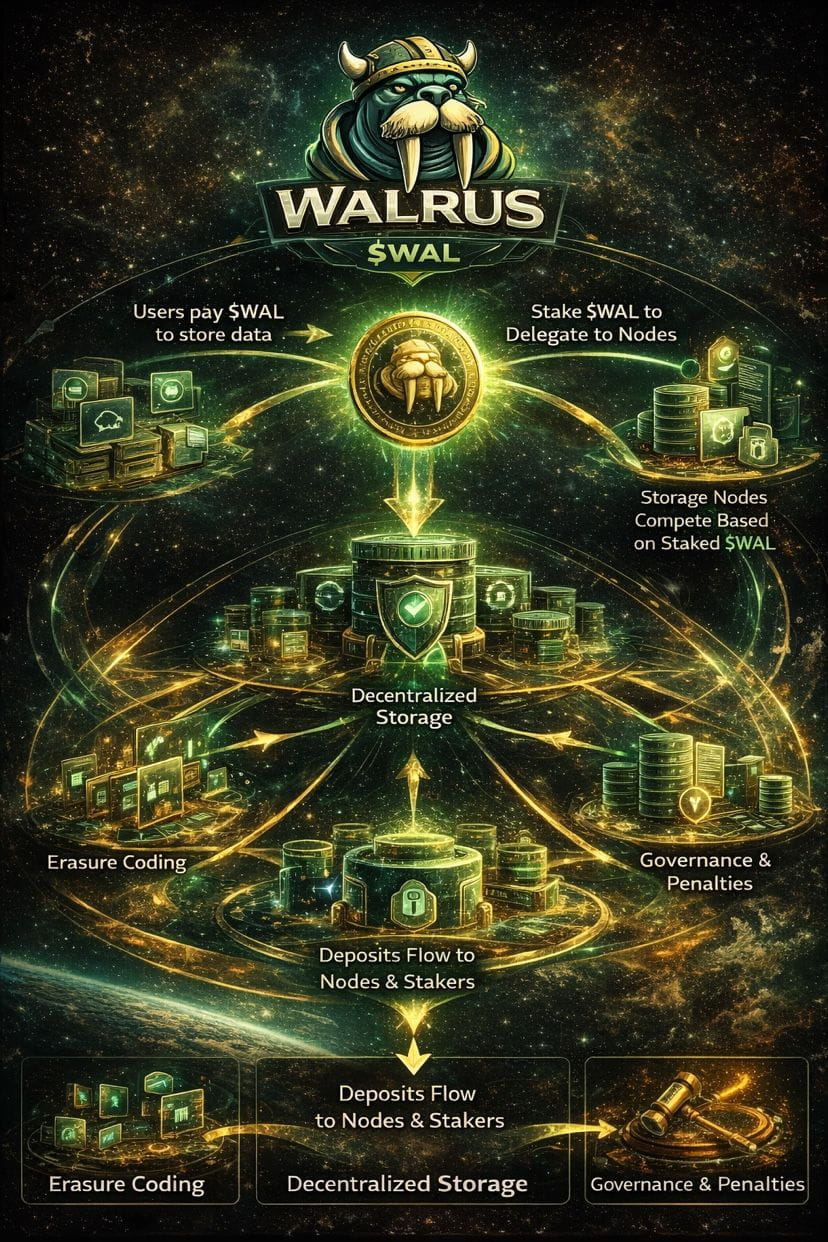
Let’s start with the basics of how storage works here. When you need to store a blob (Walrus’s term for any large unstructured file), you pay upfront using $WAL for a fixed duration. This upfront payment is key because the protocol distributes those funds gradually over the storage period to the nodes that actually hold your data shards and to the stakers supporting the network. The design cleverly aims to keep your effective storage cost stable in fiat terms, even if the price of $WAL fluctuates. It’s a smart hedge against volatility that makes decentralized storage more predictable and usable for everyday developers and enterprises.
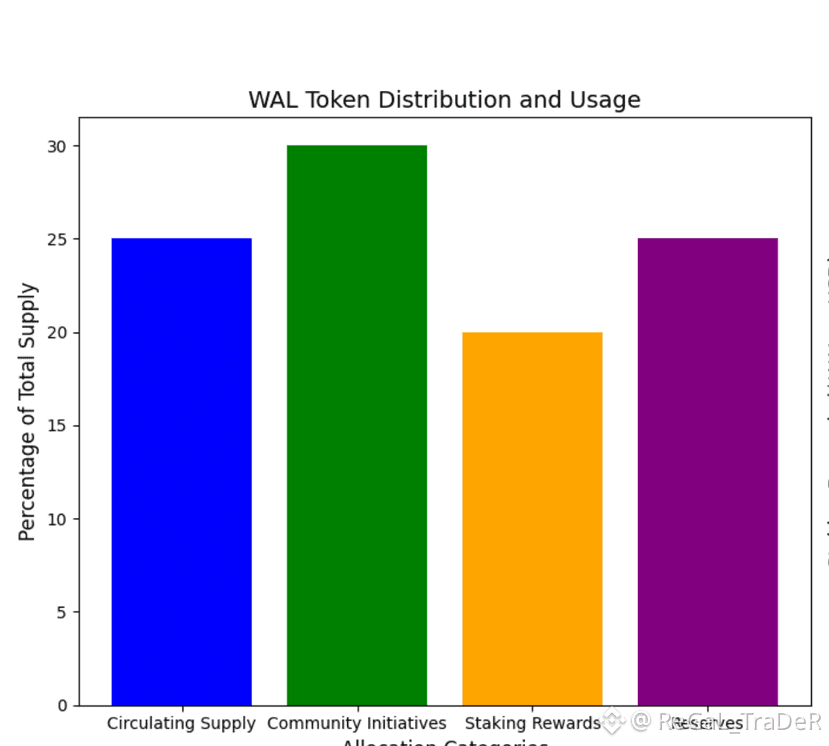
You know what’s interesting about this model? It creates a self-reinforcing ecosystem. Storage nodes earn rewards from these fees by proving they’re keeping your data safe and available. Stakers who delegate their WAL to reliable nodes also share in those rewards. It’s like a neighborhood watch where everyone has skin in the game—good behavior gets rewarded, and the system runs on aligned incentives rather than blind trust. Over 60% of the total WAL supply (max capped at 5 billion tokens, with about 1.25 billion initially circulating) goes toward community initiatives, airdrops, subsidies, and reserves to bootstrap adoption and keep early rates reasonable through that 10% subsidy allocation.
Now, let’s talk about the delegated proof-of-stake (dPoS) system, which is where WAL really shines for security. Holders can stake their tokens directly or delegate them to storage node operators. These nodes compete based on how much stake they attract, forming committees each epoch (a set period) that determine which nodes get assigned to store shards of new blobs. Higher delegated stake means more responsibility and a bigger share of rewards, but it also comes with accountability. If a node fails to prove availability or behaves poorly—like going offline or trying to game the system—penalties kick in. These can include slashing (burning a portion of the stake) or fees on short-term stake shifts that discourage frequent switching, which would otherwise cause unnecessary data migration costs. Part of those penalties gets burned (creating mild deflationary pressure), and part may reward long-term, reliable stakers. Staked participants also get governance power, voting on protocol parameters like penalty levels weighted by their stake.
This setup addresses one of the biggest headaches in decentralized storage: ensuring data stays available without expensive full replication. Walrus uses Red Stuff, a clever two-dimensional erasure coding scheme. It breaks your blob into a matrix, applies encoding along columns and rows to create primary and secondary slivers, then distributes pairs of these across nodes. The result? High availability even if many nodes fail or act maliciously (Byzantine fault tolerance), with a storage overhead around 5 times the original size—far more efficient than copying the whole file everywhere. Recovery is fast and lightweight; you only need a quorum (like 2/3 honest nodes for critical reconstructions) and can rebuild just a sliver’s worth of data rather than the entire blob. Proof of Availability (PoA) adds another layer: anyone can verify that data remains stored and retrievable through cryptographic commitments and vector proofs, without downloading everything. Blobs exist as programmable objects on Sui, letting smart contracts handle lifetimes, extensions, deletions, ownership transfers, and even integration into DeFi or AI apps.
That programmability opens up real insights. In an AI-driven world, verifiable datasets become crucial—think tamper-proof training data or on-chain media for dynamic content. Walrus Sites lets you host fully decentralized static websites directly from stored blobs, eliminating reliance on traditional servers. Data becomes a liquid, ownable asset that can be verified, monetized in data markets, or used for real-time verifications in finance. By focusing narrowly on efficient blob storage rather than trying to do everything, the protocol gains depth in areas like high-throughput reads/writes via Sui’s architecture.
Of course, no system is without risks, and it’s important to look at them honestly. The dPoS model, while effective, can face stake concentration if a few large holders dominate delegations, potentially reducing decentralization over time. Node churn (nodes coming and going) is handled well by Red Stuff’s self-healing, but poor performance still incurs costs that penalties help deter. Specialization is both a strength and a limitation: Walrus excels at unstructured blobs but may need broader adaptations if storage demands evolve dramatically or if competing general-purpose solutions gain traction. On cross-chain aspects, while Walrus is deeply integrated with Sui for coordination and security, any future bridges or interoperability features (to bring data to other ecosystems) introduce classic risks like smart contract vulnerabilities or dependency on external validators—though the core design prioritizes internal PoA and incentives to minimize reliance on such elements.
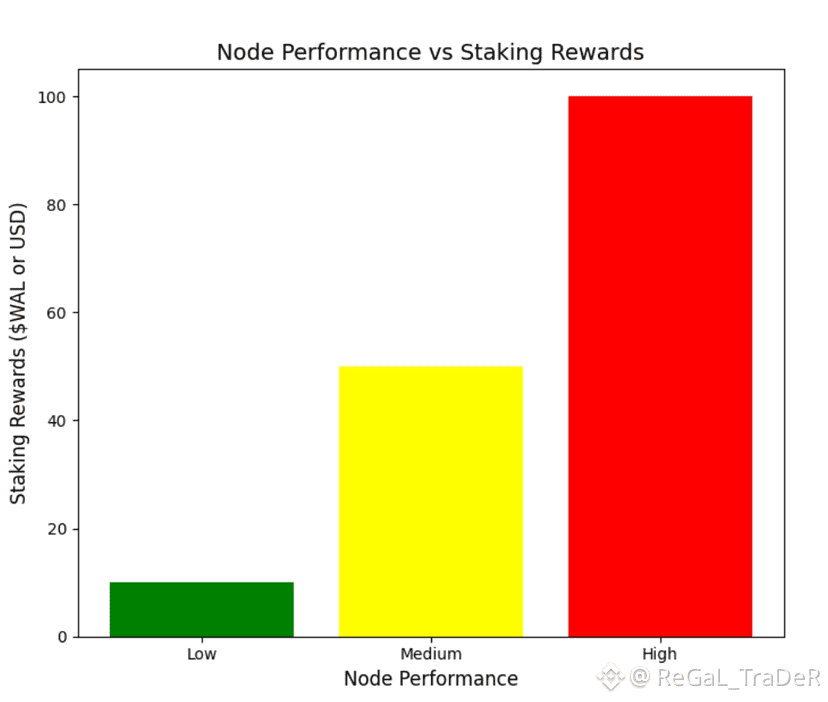
From an investment and usage perspective, the tokenomics add thoughtful layers. Burning mechanisms from penalties support long-term value alignment, while subsidies and community allocations (including developer grants and research) aim to grow the network sustainably. Early circulating supply and vesting schedules for contributors and investors provide some predictability.
In conclusion, WAL powers more than payments—it’s the glue holding together incentives, security, governance, and efficiency in Walrus’s decentralized storage vision. By combining upfront fiat-stable payments, dPoS with strong slashing, advanced erasure coding, and Sui programmability, the protocol offers a grounded approach to making data reliable and valuable in the AI era. It’s not promising to revolutionize every corner of blockchain but delivers focused reliability where it counts: verifiable availability for large files without the overhead of full copies. For builders working on data-heavy apps, media platforms, or verifiable AI, this creates practical opportunities. The quiet strength lies in its balanced design—rewards encourage participation, penalties enforce accountability, and technical choices prioritize real-world usability over hype. As adoption grows, watching how stake distribution, node performance, and ecosystem integrations evolve will be key. What do you think—does this kind of specialized, incentive-driven storage solve a pain point for you, or are there other aspects of decentralized data you’d like to see prioritized next?