A while ago, I was testing an AI agent that needed to work with video data. Nothing fancy. Just a few datasets to see how it handled pattern recognition. I’d already worked with decentralized storage before, so I wasn’t expecting magic but I also wasn’t expecting friction at every step.
Uploads slowed to a crawl when the network got busy. Fees quietly crept higher than expected. When I tried to retrieve the data later, it felt like negotiating with half-awake nodes scattered across the network. It worked, eventually but it didn’t feel reliable. And that’s the problem.
After years of iteration, large-data workflows in crypto still feel fragile.
That frustration isn’t accidental. It’s baked into how most storage networks design governance and incentives.
When availability is guaranteed through brute-force replication, costs balloon. When incentives are loosely enforced, nodes cut corners. When governance is vague or slow, nothing gets corrected until users leave. Developers hesitate to build anything data-heavy, and real usage never compounds. It’s not just inefficiency it’s uncertainty. And uncertainty kills adoption faster than bad UX ever could.
Think of it like a badly run warehouse. Everything is duplicated “just in case,” but no one knows which copy is correct. When something breaks, fixing it takes more effort than replacing it entirely. Safety through excess sounds comforting until you’re the one paying for it.
This is where Walrus takes a different stance.
Instead of trying to be a universal file system for everything, Walrus narrows its focus deliberately: large binary blobs. Media files. Datasets. Model weights. The kind of data that simply doesn’t belong inside transaction-heavy blockchains.
Built on Sui’s object model, Walrus treats storage metadata as native and composable, not something bolted on after the fact. Fewer abstractions. Clearer accountability. Less room for ambiguity. Every design choice feels intentional.
At the core is the Red Stuff erasure coding scheme. Rather than fully replicating files across the network, data is split into slivers and distributed with a replication factor of roughly 4.5x. That’s enough redundancy to survive node failures without the massive overhead of full duplication.
When a node drops out, the network doesn’t panic and rebuild everything. It repairs only what’s missing. Efficient, targeted, and predictable.
This is where governance stops being theoretical and starts becoming operational.
Storage nodes are required to prove they’re storing their assigned slivers. Challenges are random. Miss one, and penalties apply automatically. No trust assumptions. No excuses. Performance isn’t claimed it’s verified.
Epoch transitions add another layer of quiet resilience. Committees rotate on roughly Sui’s daily cadence, but Walrus overlaps these transitions instead of cutting cleanly. New nodes come online while old ones phase out, and data assignments migrate gradually. Governance events don’t cause downtime a mistake that’s crippled more than a few otherwise solid protocols.
The WAL token is tightly woven into this system.
Users pay storage fees in WAL, locking tokens upfront for the duration of their storage term. Those fees don’t get dumped immediately they’re released gradually to storage operators across epochs. To even participate, operators must stake WAL. Delegators can back them, increasing both assignment weight and reward share.
Fail availability proofs, and slashing kicks in. Part of the slashed WAL is burned, introducing a subtle deflationary pressure tied directly to bad behavior. WAL isn’t inflationary noise it’s an accountability mechanism.
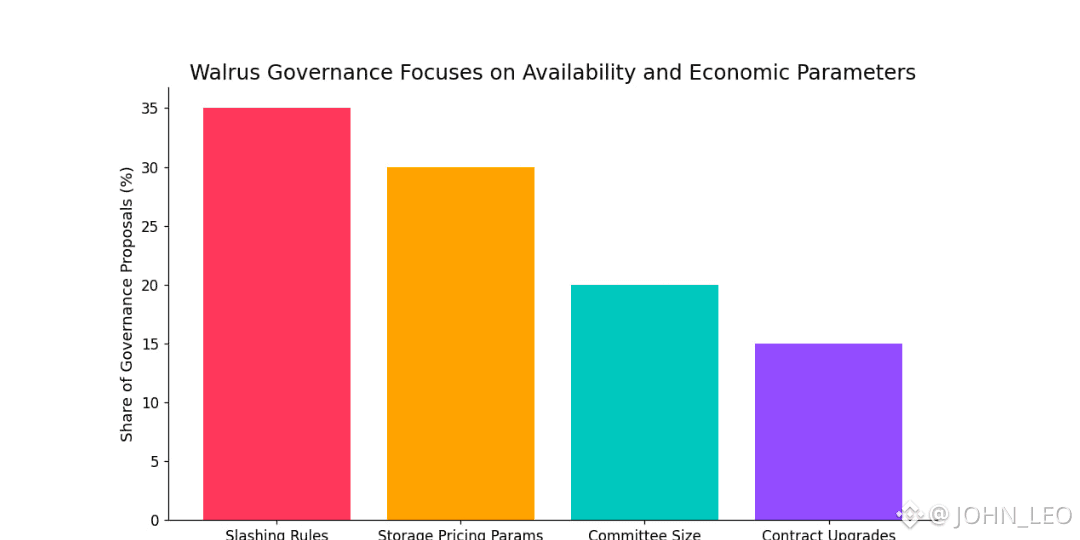
Governance itself is stake-weighted, practical, and time-bound. Staked WAL gives voting power over real parameters: slashing thresholds, committee sizing, upgrade paths. Votes resolve within epochs, not months. This isn’t governance theater. It’s operational control rules get fixed because they’re costly when wrong, not because they’re unpopular on social media.
Liquid staking added another dimension. With protocols like Haedal, delegators can mint haWAL, maintaining liquidity while still securing the network. That attracted capital quickly when it launched in 2025. Some of it was mercenary, as always. The real test will be whether long-term delegators remain once incentives normalize.
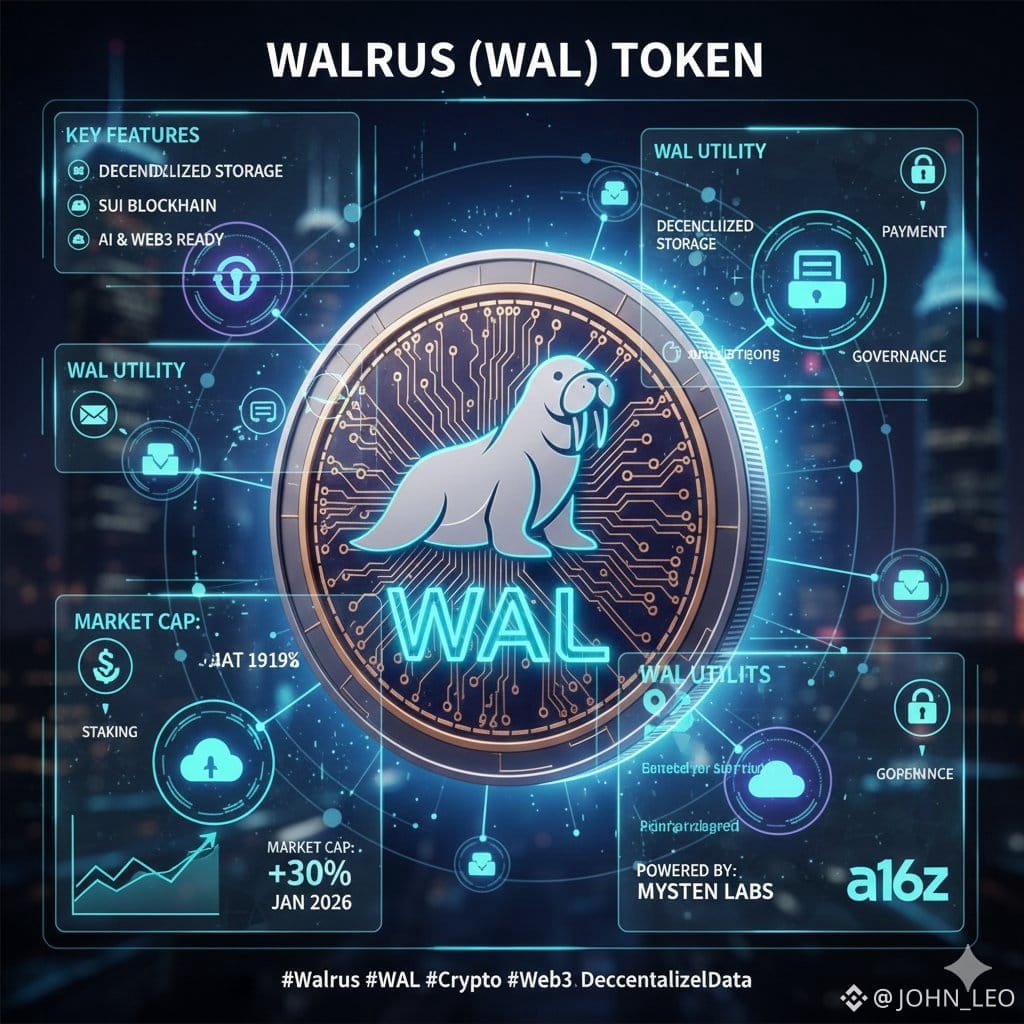
From a market perspective, WAL sits around a $190M valuation, with roughly 1.6B tokens circulating out of a 5B max supply. What matters more than the number is the structure behind it. Node participation has remained relatively distributed, with over a hundred active operators reported in late 2025. For a storage network, that predictability matters far more than headline price action.
Short-term trading has followed familiar cycles. Airdrops. Subsidy announcements. Liquid staking launches. Spikes, then fades. I’ve traded those cycles myself. They’re fine if you’re disciplined. But they say very little about whether the protocol actually works.
Long-term value depends on usage.
If AI agents, media platforms, and data markets start defaulting to Walrus not because it’s new, but because it’s predictable and verifiable then fee flow and staking demand become structural, not narrative-driven.
There are real risks. Filecoin has scale and mindshare. Arweave offers permanence, which some builders prefer. Walrus’s time-bound storage model won’t fit every use case. Cross-chain access for Ethereum and Solana needs to move from roadmap to routine. And there are failure scenarios that matter: coordinated downtime, challenge bugs, cascading slashing events that temporarily drop availability below quorum.
Subsidies are another open question. They help bootstrap usage but they don’t last forever. Eventually, real demand has to carry the system.
In the end, governance like this doesn’t prove itself through announcements or token charts. It proves itself quietly when data is still there tomorrow, and the day after, without anyone needing to think about it.
When developers reach for Walrus by default for large data not because it’s trendy, but because it’s dependable that’s when the governance model has done its job.
And that’s when WAL stops being “just another token” and starts acting like infrastructure.