
@Plasma Crypto payments are often framed as a speed contest: the quickest chain wins, end of story. The problem is that speed isn’t the thing that breaks most payment systems. Uncertainty is. People responsible for moving money—especially across borders or at scale—need transfers that land consistently, fees that don’t surprise them, and trails that auditors can follow without guesswork. A transfer that’s slightly slower but always dependable beats a lightning-fast system that only behaves when everything is calm.
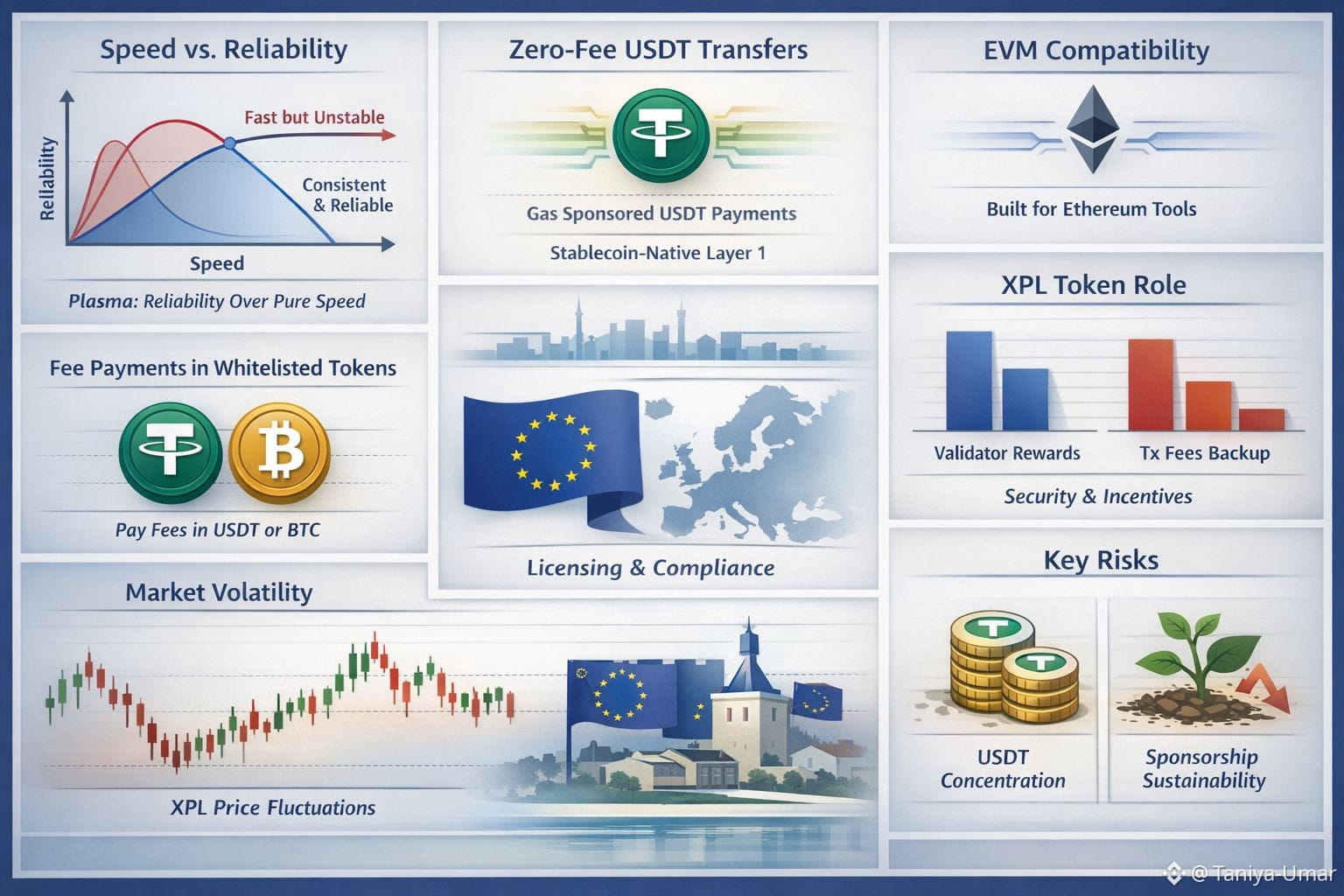
That’s the lens through which Plasma makes sense. Plasma positions itself as a stablecoin-native Layer 1, built with USD₮ (USDT) payments as a first-class feature rather than an add-on. The point isn’t to impress engineers with a benchmark screenshot; it’s to reduce the number of tiny frictions that turn “crypto payments” into a support nightmare. If the goal is everyday money movement, the system has to feel predictable when the network is busy, when fees elsewhere spike, and when users do not want to think about gas tokens at all.
Plasma’s signature move is its tightly scoped “zero-fee” USD₮ transfer flow. The project documents a protocol-managed relayer that sponsors gas for direct USDT transfers, with controls designed to limit abuse and keep the behavior consistent. That scope matters. It’s not pretending everything is free forever; it’s trying to make the most common action—sending stablecoins from A to B—feel as close to ordinary payments as possible. It’s a subtle shift, but it’s the difference between a rail that works for enthusiasts and a rail that can be embedded inside products used by regular people.
This is also why the topic is trending now. Stablecoins have outgrown the “just for trading” story and started to look like a parallel settlement layer. Visa has said overall stablecoin transaction volume is more than $51 trillion over the last 12 months. And the mainstream stakes are getting sharper: Standard Chartered has warned U.S. banks could lose up to $500 billion in deposits to stablecoins by 2028. When banks and regulators start treating stablecoins as a deposits-and-payments question—not a speculative toy—reliability stops being a nice-to-have.
Under the hood, Plasma is making a few other pragmatic bets. It’s EVM compatible, which lowers the barrier for teams that already build with Ethereum tooling. It also documents a direction toward letting users pay fees in whitelisted tokens like USD₮ or BTC through a protocol-managed paymaster—still flagged as under active development—which is basically an attempt to make fee payment feel like a product choice rather than a separate asset-management chore. If that kind of design works in practice, it’s less about “speed” and more about reducing the ways a payment can fail because someone didn’t have the right token at the right moment.
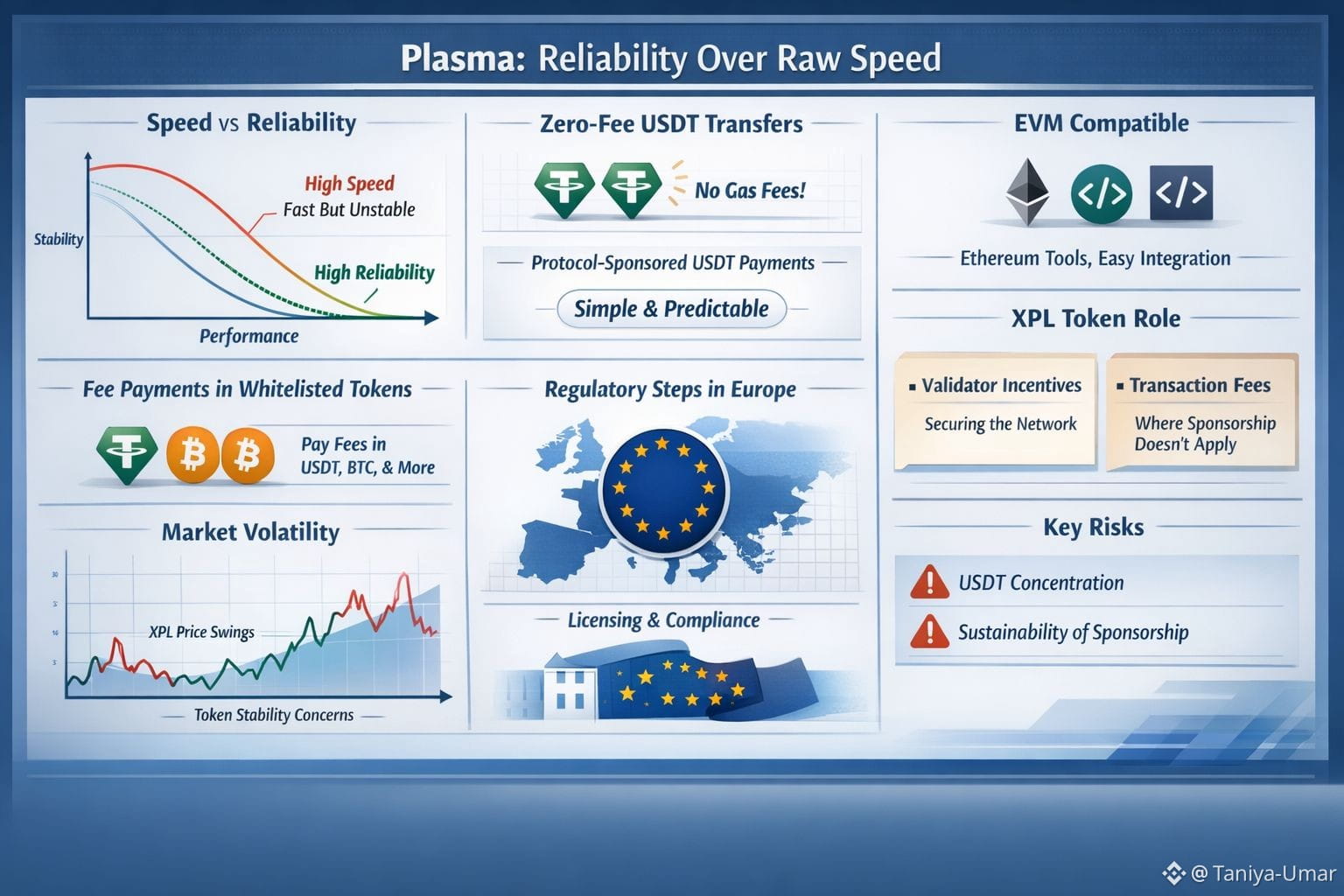
That brings us to the part that gets misunderstood: the $XPL token (often written as $xpl) isn’t rendered irrelevant by gasless transfers—it just has a more specific job. Plasma’s documentation frames XPL as the native token used for transaction fees where sponsorship doesn’t apply and as the incentive asset for validators who secure the network. So Plasma is trying to deliver a stablecoin-first user experience while keeping a conventional security and incentive layer underneath. In a way, that’s the whole thesis: users shouldn’t be forced to care about XPL to send dollars, but the network still needs a token that aligns the people running it.
Of course, markets don’t grade on intention. XPL’s early trading story has been volatile, and that price instability isn’t a side note; it’s part of the reliability conversation. When the token that helps secure and incentivize the network whipsaws, observers naturally ask whether validator economics stay healthy, whether any gas sponsorship remains sustainable, and whether real usage grows into the expectations that were priced in.
Regulation has a way of cutting through the hype. It forces projects to show whether they’re building real payment rails or just telling a good story. Plasma’s steps toward Europe, including licensing and establishing a presence there, fit a wider pattern: stablecoins are being steered into clearer frameworks with firmer supervision and sharper accountability. It’s not universally popular, but it’s consistent with what the next stage of adoption demands—proof of controls and resilience, not just claims of throughput.
None of this makes Plasma inevitable. A rail built so tightly around USDT inherits concentration risk, and any “fee-free” mechanism prompts the fair question of who ultimately pays and how long that model holds. Still, the title fits for a reason. In payments, speed is easy to market. Reliability is harder to build, harder to maintain, and much harder to fake. Plasma is interesting precisely because it’s choosing the unglamorous problem—making stablecoin payments feel dependable—and tying that ambition to a protocol design and a token, $xpl, that will have to earn trust the slow way: by working on the messy days, not just the calm ones.