
Most Layer 1s start with a familiar promise: more throughput, lower fees, better scalability. Plasma starts somewhere else entirely with a simple observation that most crypto rails still treat stablecoins like guests instead of residents.
Stablecoins aren’t experimental anymore. They’re not a side feature of DeFi. They’re one of the most widely used financial instruments onchain, moving trillions in value and anchoring real economic activity across borders. Yet the infrastructure they rely on still feels mismatched volatile fees, awkward UX, and workflows that assume every user is a trader first.
Plasma flips that assumption.
Instead of building a general-purpose chain and hoping stablecoins fit, Plasma designs the chain around stablecoins. Settlement is the product. Everything else supports it.
That design choice alone sets the tone for what Plasma is trying to become: a payments-native settlement layer where stablecoins behave less like crypto tokens and more like financial rails.
A Chain Built for Predictable Money, Not Speculation
Plasma treats stablecoins as first-class citizens at the protocol level. That means fewer hacks layered on by apps and more guarantees enforced directly by the chain.
The philosophy is blunt and intentional:
If stablecoins are how people actually move value, then the base layer should make those movements cheap, fast, and boring — in the best possible way.
With over $160B already locked into the stablecoin economy, Plasma is betting that the next phase of adoption won’t come from new tokens, but from better settlement.
Performance That Serves Payments, Not Benchmarks
Under the hood, Plasma’s architecture reinforces that same story.
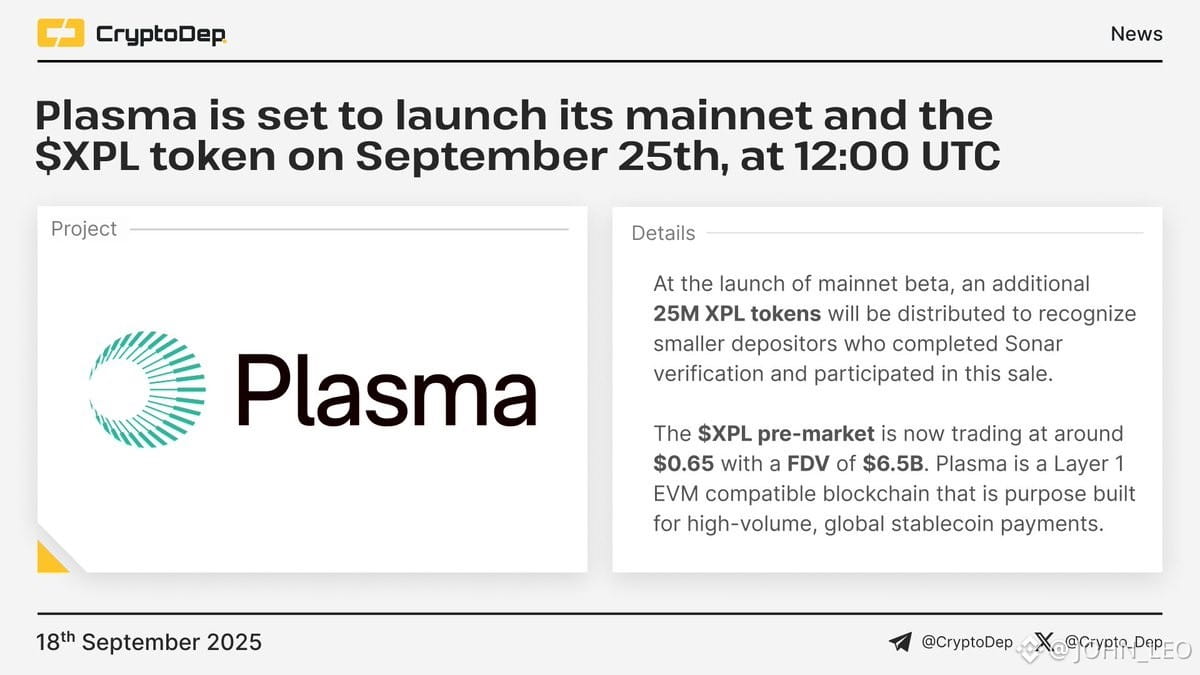
Its consensus layer, PlasmaBFT, is a pipelined version of Fast HotStuff. Rather than processing consensus steps one by one, Plasma overlaps them, reducing latency and tightening finality even when the network is busy. Finality is deterministic and typically lands within seconds.
That matters for payments. Settlement chains don’t get to say “wait for confirmations.” They either work, or they don’t.
Execution runs on an EVM built with Reth, cleanly separated from consensus via the Engine API. For developers, the surface feels familiar Ethereum-like contracts, opcodes, and tooling. Underneath, though, the performance profile is tuned for fast, predictable settlement rather than generalized computation chaos.
Bitcoin Anchoring Without Pretending It’s Easy
Plasma’s Bitcoin angle isn’t just narrative it’s structural.
The chain introduces a trust-minimized bridge that brings native BTC into the EVM environment via a verifier network and MPC-based withdrawal signing. The result is pBTC, a 1:1 backed Bitcoin representation tied directly to Bitcoin’s security assumptions.
This isn’t hand-waved as “trustless.” Plasma is clear that the bridge’s credibility will depend on real-world hardening over time. But the intent is obvious: anchor neutrality and censorship resistance to Bitcoin while keeping EVM usability intact.
For a settlement-focused chain, that matters more than flashy composability.
Where Plasma Really Separates Itself: Stablecoin-Native UX
This is where Plasma stops sounding like another L1 and starts sounding like infrastructure.
Instead of pushing stablecoin UX problems onto apps, Plasma moves them into the protocol itself.
Zero-fee USD₮ transfers are handled via an API-managed relayer and a protocol-funded paymaster. Users don’t need XPL. They don’t prepay gas. They don’t think about fees. The chain sponsors the transfer, with strict scope, identity-aware controls, and rate limits to prevent abuse.
It’s not a rebate. It’s not a promo. It’s simply how stablecoin transfers are supposed to work.
Then there’s custom gas tokens. Plasma allows users to pay gas in whitelisted ERC-20s like USD₮ or even BTC via pBTC. Oracle pricing determines the gas cost, the paymaster handles execution in XPL, and the stablecoin is deducted seamlessly. No special wallets. No duct-taped middleware.
From the user’s perspective: “I stay in stablecoins.”
From the builder’s perspective: “I don’t rebuild fee abstraction from scratch.”
The final piece is confidential stablecoin transfers shielded amounts and metadata designed for payroll, B2B flows, and institutional use cases. Plasma isn’t just thinking about retail payments. It’s designing for environments where privacy isn’t optional.
A Normal EVM Surface, A Different Set of Priorities
Connecting to Plasma feels ordinary:
Mainnet Beta, Chain ID 9745, ~1s block time, public RPC, standard explorer.
But the priorities underneath are different.
Stablecoins are what users move.
XPL is what secures the network.
That separation is intentional. XPL exists to coordinate consensus and economics, not to force itself into every transaction.
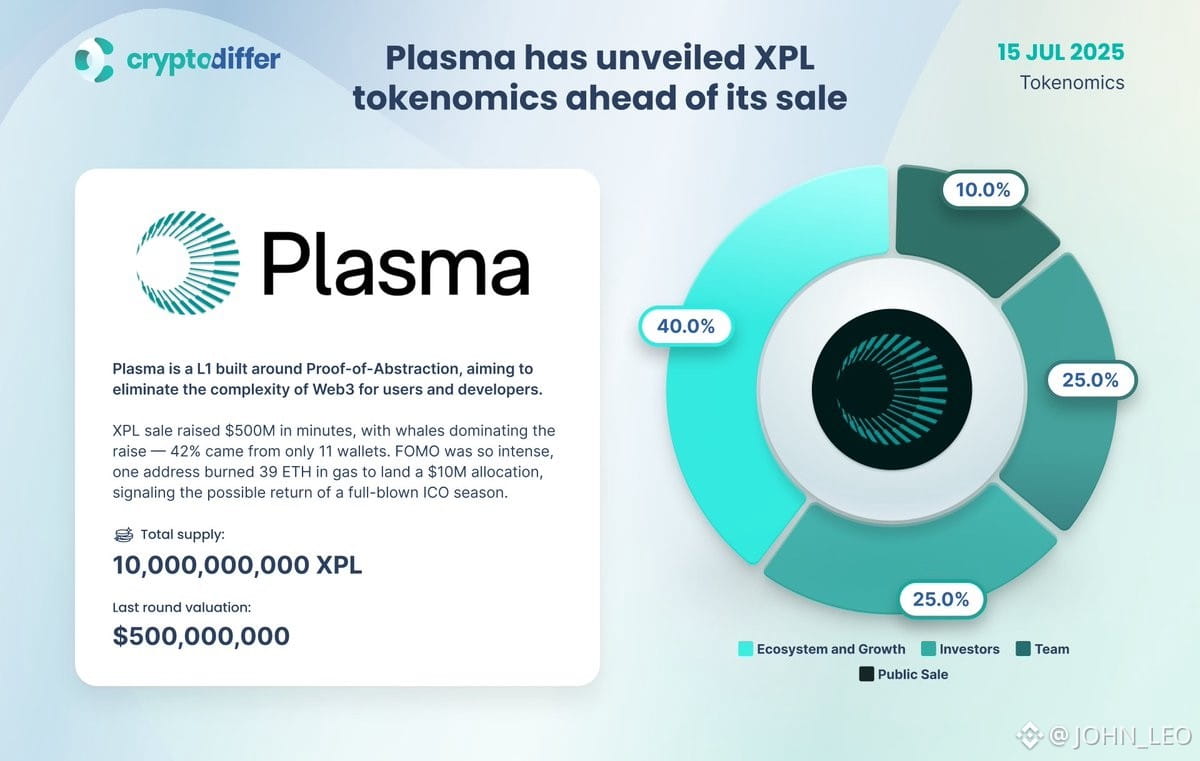
With a 10B XPL supply, Plasma lays out its distribution cleanly: public sale, ecosystem growth, team, and investors with transparent unlock schedules and jurisdiction-aware compliance baked into the launch process.
Nothing flashy. Just structured.
The Quiet Signal: Real Network Activity
As of January 27, 2026, Plasma isn’t quiet because nothing is happening it’s quiet because the activity looks like infrastructure, not hype.
~145.6M total transactions
~359K transactions in 24 hours
~8.6K new addresses
~2.5K contracts deployed in a single day
~1,540 XPL in daily fees
That doesn’t scream speculation. It looks like settlement.
The Bigger Picture
Plasma isn’t trying to make crypto louder. It’s trying to make it disappear into usability.
If stablecoin transfers feel instant, predictable, and gasless…
If builders stop rebuilding the same payment plumbing…
If Bitcoin anchoring adds real neutrality over time…
Then Plasma becomes something most chains never quite manage to be:
a financial rail that people use without thinking about the chain underneath.
That’s a harder path than chasing narratives but it’s how real infrastructure gets built.
Plasma isn’t selling a token story.
It’s selling settlement that actually works.



