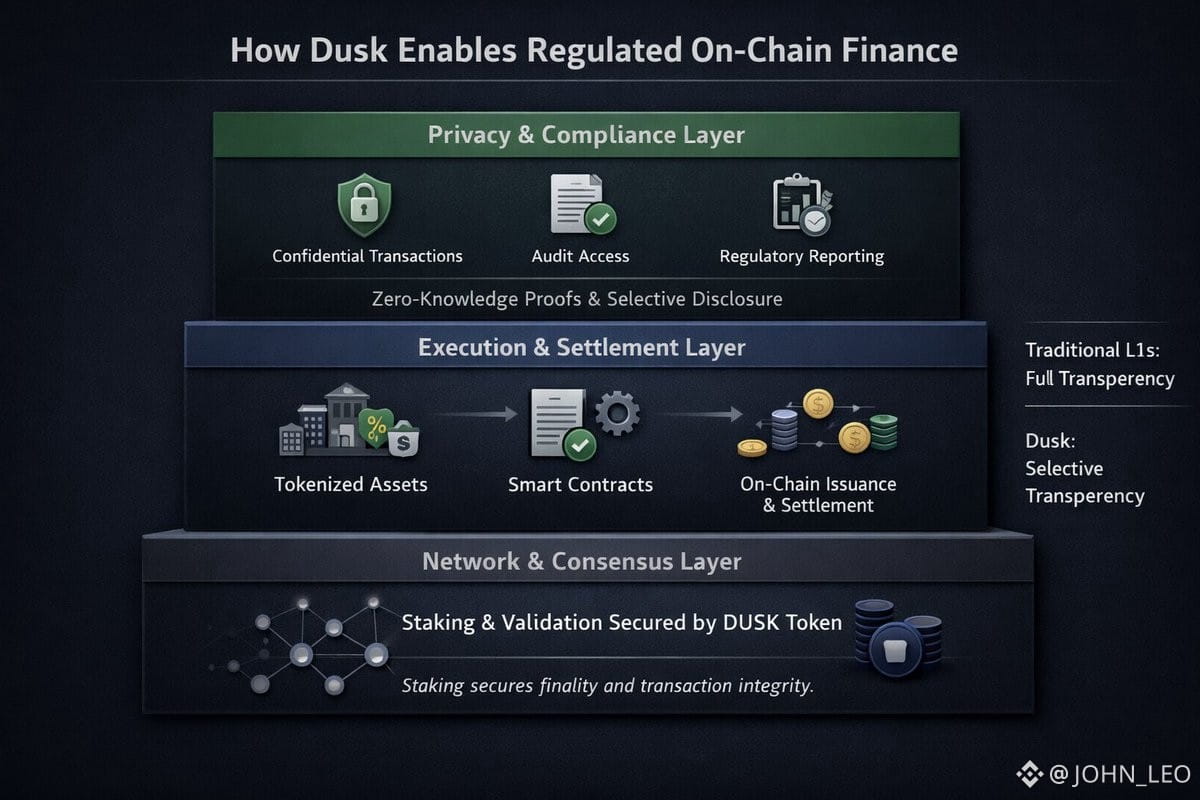
Most blockchains still live in a fantasy world.
A world where everything is public, every balance is visible, every move is broadcast and we’re told that’s somehow fine for global finance. It isn’t. Anyone who has spent five minutes around real capital knows the truth: serious money needs privacy, but it also needs rules, proofs, and clean settlement.
That’s where Dusk stands apart.
Dusk isn’t trying to convince institutions to “get comfortable” with radical transparency. It starts from a more honest premise: privacy isn’t a bug in finance it’s a requirement. But privacy without accountability breaks compliance. And compliance without privacy turns markets into surveillance systems. Dusk is deliberately building in the narrow space between those two extremes.
At its core, Dusk is a Layer-1 designed specifically for financial applications that require confidentiality without abandoning oversight. Not privacy as a wallet gimmick, but privacy at the transaction model and asset lifecycle level. The kind of privacy you need to manage cap tables, positions, allocations, vesting, and settlement without leaking sensitive data to the entire world.
This is why Dusk talks about confidential smart contracts and confidential securities logic instead of generic DeFi primitives. In real markets, assets don’t just move they obey restrictions. They carry rules. They settle under conditions. Dusk is built to support that reality instead of pretending everything is a simple token transfer.
What makes Dusk especially interesting is that it doesn’t force a single privacy mode. Value on Dusk can move transparently when disclosure is required, and it can move shielded when confidentiality is essential. That flexibility mirrors real financial workflows far better than chains that insist on either total visibility or total opacity.
Architecturally, Dusk behaves like infrastructure, not a toy chain. It prioritizes settlement, security, and finality at the base layer first then builds execution on top so developers don’t have to wrestle the entire stack just to ship a usable product. It’s a quiet design choice, but a telling one. This is how systems are built when failure isn’t an option.
Behind the scenes, the work isn’t about hiding users it’s about making markets function. How do assets remain compliant without revealing sensitive data? How do restrictions exist without exposing positions? How does settlement stay verifiable when details are protected? These are boring questions to hype-driven crypto. They’re everything to real finance.
Dusk’s approach to tokenization reflects that mindset. Tokenized real-world assets don’t just need speed and cheap fees. They need privacy that doesn’t destroy oversight, and compliance rails that don’t turn the chain into a panopticon. Dusk is clearly trying to supply those missing pieces.
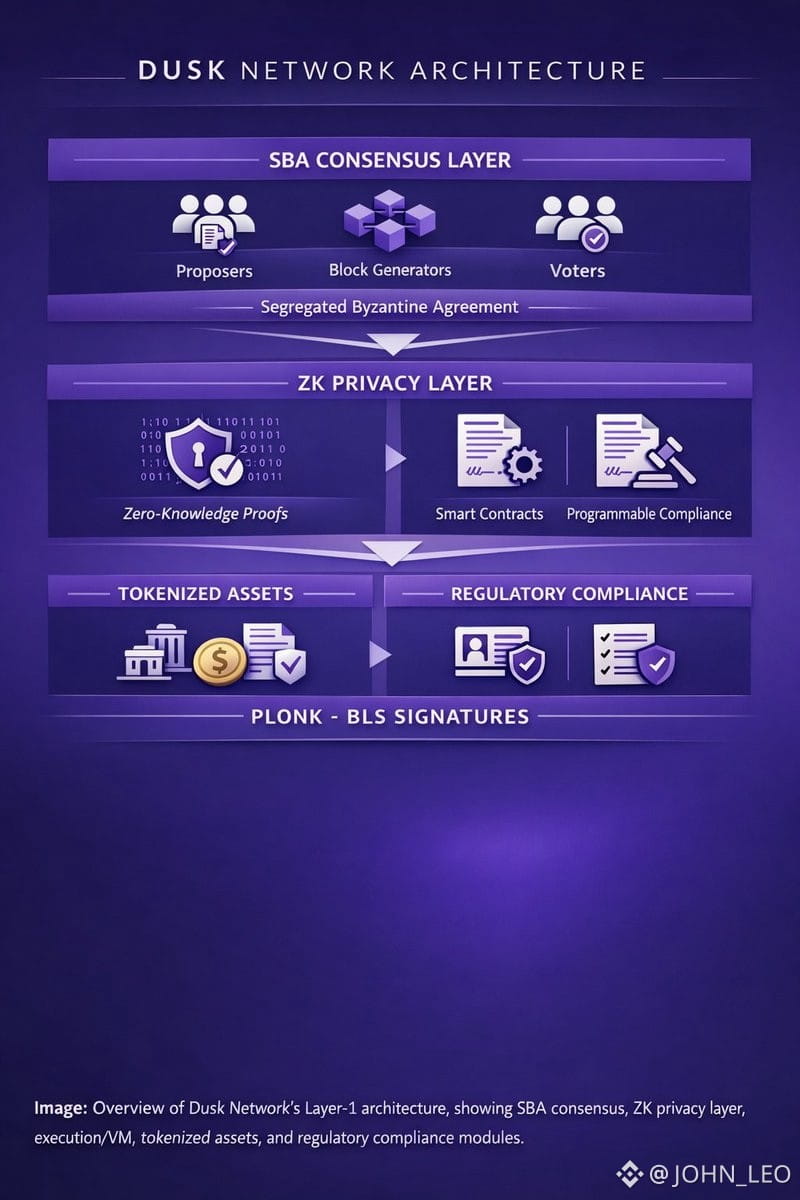
Even the token itself fits the infrastructure narrative. $DUSK exists to secure the network, pay for activity, and align validators with long-term stability and finality. Emissions are designed around sustaining a security budget over time — not pumping short-term excitement.
Lately, Dusk has been moving from abstract infrastructure toward something more tangible. The appearance of Dusk Trade as a waitlist-style gateway to tokenized assets signals a shift toward a real front door something users can touch, not just read about.
There was also a moment in January 2026 that mattered. Dusk published a bridge-related incident notice and paused bridge services as a precaution. Crucially, it was framed as an operational wallet/bridge issue, not a base protocol failure. How teams communicate and act during these moments is often more revealing than any roadmap and this looked like infrastructure behavior, not damage control theater.
Right now, Dusk doesn’t feel like it’s chasing attention. On-chain activity shows movement, not noise. Public updates remain grounded, not promotional. And that’s exactly why it belongs on a serious watchlist.
Dusk isn’t trying to win crypto Twitter.
It’s trying to build the boring, difficult, unglamorous foundation that real markets actually need:
privacy you can live with, proofs you can defend, and settlement that feels final enough for institutions to trust.
And in this space, that might be the most bullish signal of all.