

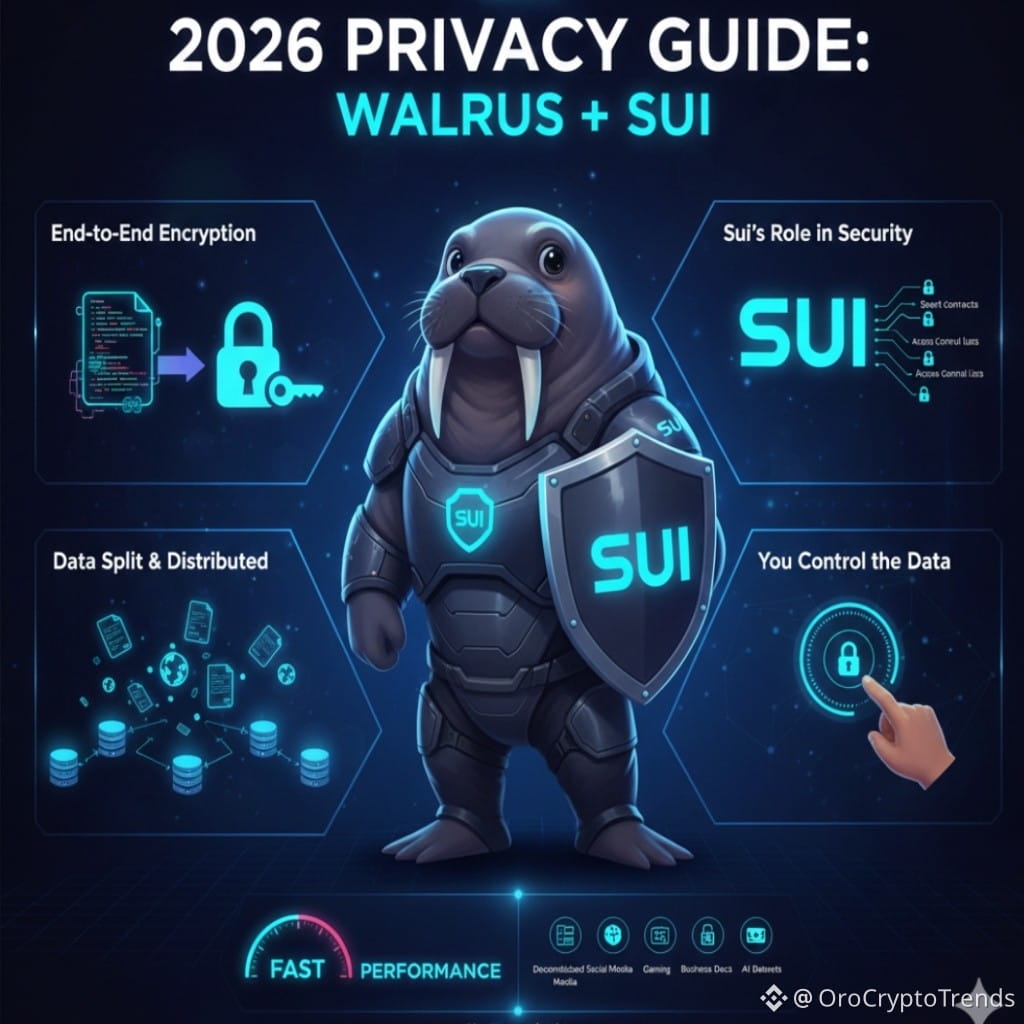
Understanding Data Privacy in Web3 Storage
How Walrus uses encryption and decentralization on Sui to keep your information safe
In the evolving landscape of Web3, the conversation isn’t just about data ownership—it’s about true data privacy. As the world shifts more applications onto blockchain infrastructures, questions arise: Where does my data reside, and who, if anyone, can access or view it? Users are more privacy-conscious than ever, demanding not just decentralized access, but also trustworthy mechanisms that keep their information out of reach from prying eyes.
Walrus addresses this need head-on with a comprehensive commitment: secure, private, and robust storage, engineered atop the Sui blockchain. Here’s a deeper dive into how Walrus safeguards your information in 2026—and why its approach sets a new standard for the privacy and functionality of decentralized applications.
1. Why Privacy Actually Matters
By design, blockchains are transparent and open to all participants. While this is ideal for trustless transactions and verifiable histories, it presents a challenge for anyone dealing with private documents, sensitive business data, or personal information. Imagine a public blockchain as a glass office in a busy city—anyone walking by can peer in. That level of openness, while powerful for some use cases, is a liability for privacy.
Walrus tackles this by shifting the model. Instead of the glass office, think of a high-security vault adjacent to the office—visible for accountability, but impenetrable for privacy. The Sui blockchain provides the coordination and transaction records, but your actual data is tucked away, encrypted and off-chain, in a system engineered to keep it hidden from everyone except those you authorize. This hybrid approach ensures you retain the benefits of decentralization and transparency, without exposing your private information to the world.
2. Encryption: Locked Down from the Start
Walrus doesn’t wait until your data hits the network to start safeguarding it—the process begins right on your own device.
Here’s how the process works:
Before leaving your laptop, phone, or any endpoint, your file is encrypted at the source.
You alone control the encryption key, unless you decide to share it with someone you trust.
The storage nodes in the Walrus network only ever receive this encrypted, unreadable data.
Because of this client-side encryption, storage providers never see your unprotected data. Even if a node operator attempts to pry into the files they’re hosting, all they encounter is meaningless, indecipherable code. This ensures that your privacy doesn’t rely on trusting strangers or intermediaries—only you and your chosen contacts can unlock your information.
3. Breaking Up and Spreading Out
Walrus takes data protection a step further by fragmenting your files and distributing them across multiple storage nodes. Rather than uploading a complete file to a single location, Walrus slices it into several encrypted segments and spreads them out, each to a different node in the network.
Envision writing a confidential letter, tearing it into pieces, encrypting each snippet, and securing them in separate safes scattered throughout different cities. No single safe contains enough information to reconstruct the letter—and even if someone accessed all the safes, they’d still face the nearly impossible task of decrypting each piece.
This distributed architecture offers dual benefits:
Security: No single storage node possesses the entire file, so breaching one server yields nothing of value. To compromise your data, an attacker would have to infiltrate several nodes and still possess your unique decryption key.
Reliability: Because fragments are redundantly stored, your data remains accessible even if some nodes go offline. The network can automatically reassemble your file from the available pieces, ensuring you never lose access due to outages or hardware failures.
4. How Sui Makes Everything Stronger
Walrus’s robust privacy model is amplified by its deep integration with the Sui blockchain.
Sui introduces several key enhancements:
Smart contracts oversee permission management, ensuring that only authenticated users can access or modify your data according to precise, programmable rules.
You can cryptographically demonstrate ownership or rights to a file without ever exposing its actual contents—preserving privacy while enabling trustless verification.
Applications can confirm that files are correctly stored and available, without needing to download or view the actual data, thanks to efficient storage proofs.
This setup is like upgrading your security system from manual locks and guards to an automated, tamper-proof digital protocol. With Sui, there’s no need for intermediaries or slow approval processes; everything is handled transparently, securely, and efficiently by code.
5. Privacy Without the Usual Slowdowns
Traditionally, adding layers of privacy and security slows down storage systems and applications, making them cumbersome to use. Walrus, however, is engineered to avoid these trade-offs.
Through techniques like parallel data fetching, rapid storage proofs, and Sui’s highly efficient consensus and transaction processing, Walrus ensures that private storage doesn’t come at the expense of speed. Whether you’re safeguarding social media archives, in-game assets, sensitive business documents, or encrypted AI datasets, you can expect seamless performance. Walrus brings privacy and usability together, so you don’t have to choose one over the other.
6. You’re in Charge of Your Data
Perhaps the most transformative aspect of Walrus is how it shifts control firmly into your hands.
You alone generate and hold the encryption keys that protect your data.
You decide—at any time—who gets access, and for how long.
Smart contracts on Sui allow you to grant, update, or revoke access permissions in real time, with no central authority overriding your choices.
It’s like giving someone a digital keycard that you can disable instantly, rather than handing over a physical key you can’t get back. Your files remain yours, and no provider or third party can access, monetize, or share them without your explicit consent. This model upholds the core Web3 ideal: empowering users with autonomy while eliminating reliance on centralized gatekeepers.
In the world of Web3, storage privacy is every bit as critical as wallet security. Walrus brings together a suite of powerful technologies: end-to-end client-side encryption, distributed file fragmentation, programmable smart contract access, and the unmatched speed and reliability of Sui. This multi-layered approach ensures your data remains private, resilient, and always under your control—while still enabling decentralized applications to function smoothly and responsively.
Ready to explore Web3 in 2026? Don’t just settle for knowing what a platform does—demand to know how it protects your digital life.
By understanding privacy-first tools like Walrus, you equip yourself to make smarter, safer choices as you navigate the next era of the internet.
Disclaimer:Not Financial Advice

