
@Vanarchain People have been talking about “context” in crypto for years, usually as a metaphor: context as community, as narrative, as vibes. What’s different about Kayon in Vanar is that it treats context as an engineering problem. Vanar’s public framing is a five-layer stack where the base chain handles execution, Neutron handles “semantic memory,” and Kayon handles “contextual AI reasoning.” That framing is landing now because the industry’s obsession has quietly shifted from “How fast can this chain go?” to “Can this system explain itself when money, rules, and real identities are involved?” In 2026, that question is showing up everywhere AI agents touch finance, compliance, and business operations.
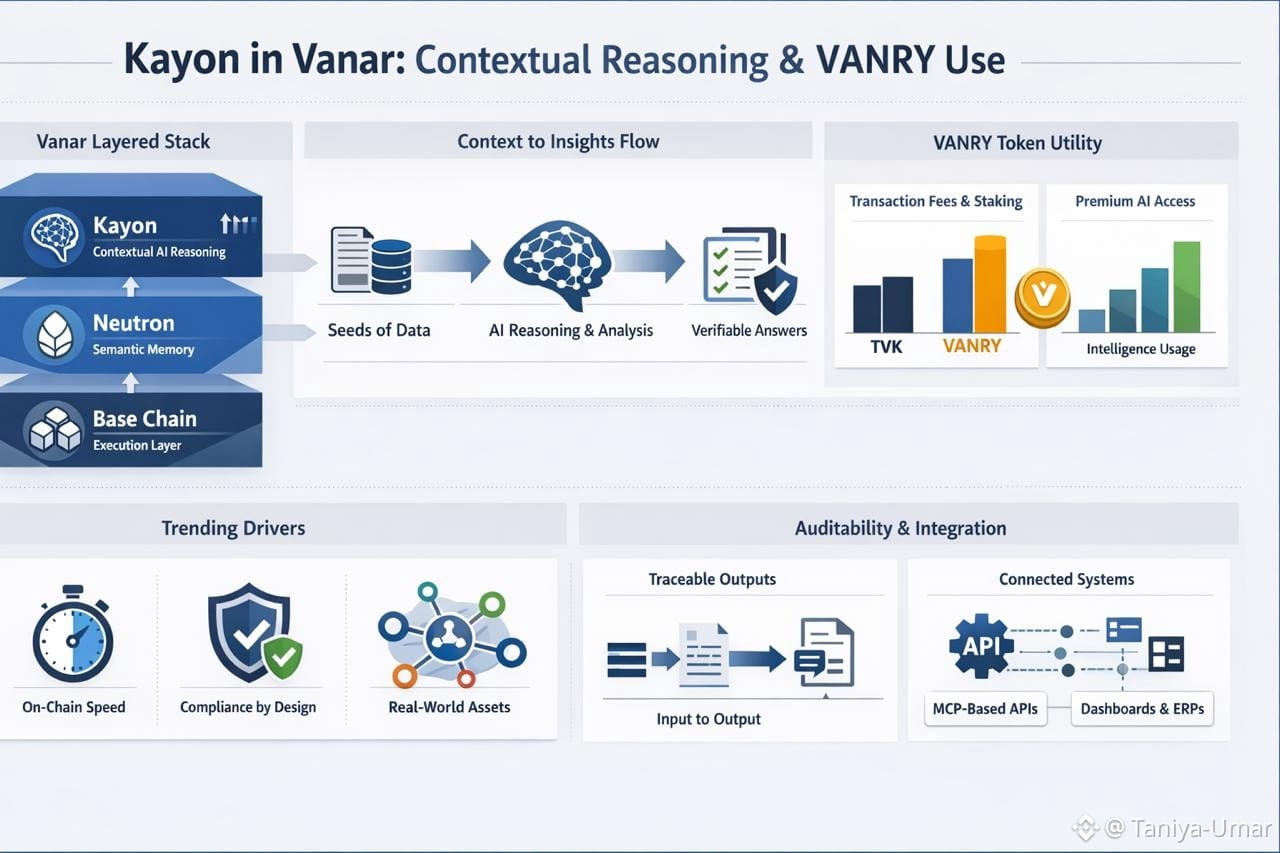
Kayon sits above Neutron, which Vanar describes as a layer that turns raw files and records into compact “Seeds” that preserve meaning and relationships rather than leaving data as inert blobs. In plain language, Neutron is meant to make information behave less like an attachment and more like a searchable memory. Kayon then reasons over that memory. Instead of a person manually hopping between a block explorer, a spreadsheet, and a pile of PDFs, the goal is to ask a question the way you’d ask a colleague and get an answer that still maps back to something verifiable. Vanar’s examples lean toward the pragmatic: “Which wallets bridged over X last week?” and similar cross-filter questions that are easy to say and annoying to assemble by hand.
Under the hood, it helps to picture Kayon as a translator plus a judge. The translator part takes a prompt and turns it into structured queries across on-chain activity and any datasets you’ve connected. Vanar says Kayon exposes MCP-based APIs to connect to explorers, dashboards, ERPs, and custom backends, which is a bet on integration rather than a closed “assistant” experience. The judge part is the contextual reasoning: it doesn’t just fetch rows; it tries to interpret timing, relationships, and constraints, then produce an “auditable” explanation of how it got there. That word, auditable, is doing a lot of work here—and it’s exactly the kind of work AI systems are being forced to do as they move from demos into environments where someone has to sign off.
This is also why the topic is trending now. A lot of “AI + blockchain” projects either push the thinking off-chain or hide the logic behind opaque services, and people are tired of that tradeoff. The moment you talk about payments, tokenized real-world assets, or customer records, “trust me” stops being acceptable. Vanar leans on “compliance by design,” including claims about monitoring rules across many jurisdictions and automating reporting. I don’t treat any broad compliance claim as automatically proven—real compliance is messy and country-specific—but I do think the direction is telling. The market is rewarding systems that attempt to make rules and reasoning first-class citizens, not awkward add-ons bolted to the side.
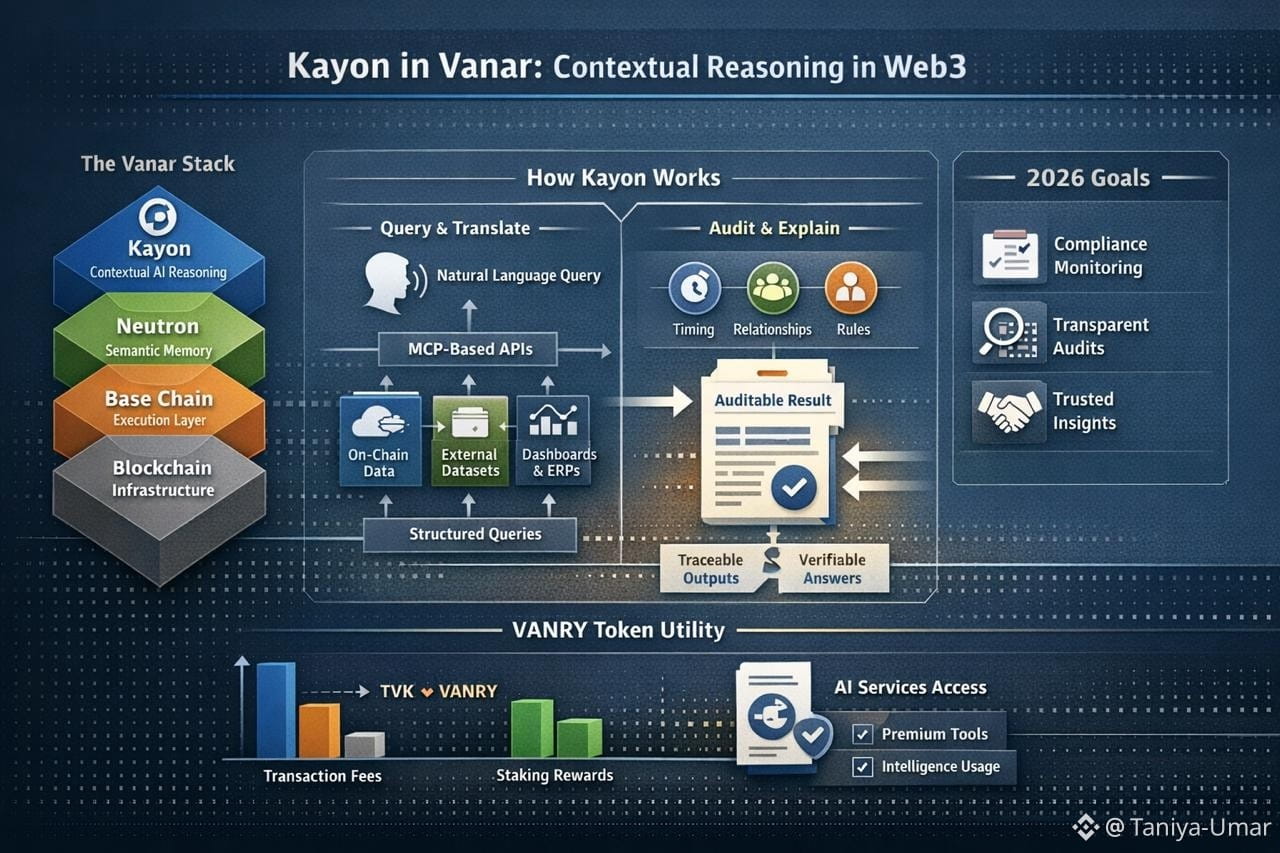
VANRY is the practical glue in this story, because a reasoning layer that nobody uses is just a demo. Vanar’s documentation describes VANRY as the token used for transaction fees and staking, tying it to day-to-day network activity and security incentives. The project also ran a token transition from TVK to VANRY on a one-to-one basis, which explains why older exchange histories still reference TVK. The newer angle showing up in January 2026 coverage is the idea of paying VANRY to access premium AI tooling (including Neutron and Kayon features), effectively turning the token into a meter for “intelligence usage,” not just blockspace. If that model is implemented cleanly, it’s a meaningful shift: you’re pricing the cost of asking and reasoning, not only the cost of sending and storing. Of course, it also raises a simple question that’s worth sitting with: will people accept paying per insight if the insight isn’t consistently reliable?
The healthiest stance, in my view, is curious but strict. “On-chain reasoning” is a heavyweight promise, and the gap between polished messaging and developer reality can be wide. I judge systems like this by two questions: can you trace an output back to specific inputs, and can you constrain what the system is allowed to do when it’s uncertain? Vanar’s emphasis on auditable outputs and compliance guardrails points in the right direction. If Kayon ends up making blockchains easier to interrogate without breaking auditability, it will matter beyond Vanar, because it nudges the whole space toward something more adult: systems that can explain themselves, admit uncertainty, and still be usable by normal people.