
@Plasma People talk about “gas fees” like they’re a pricing problem, but in use they behave more like a trust problem. You can hold the asset you want to send, then discover you’re missing a second token that exists mostly to pay the network. For newcomers it feels arbitrary, and for users it’s a paper cut.
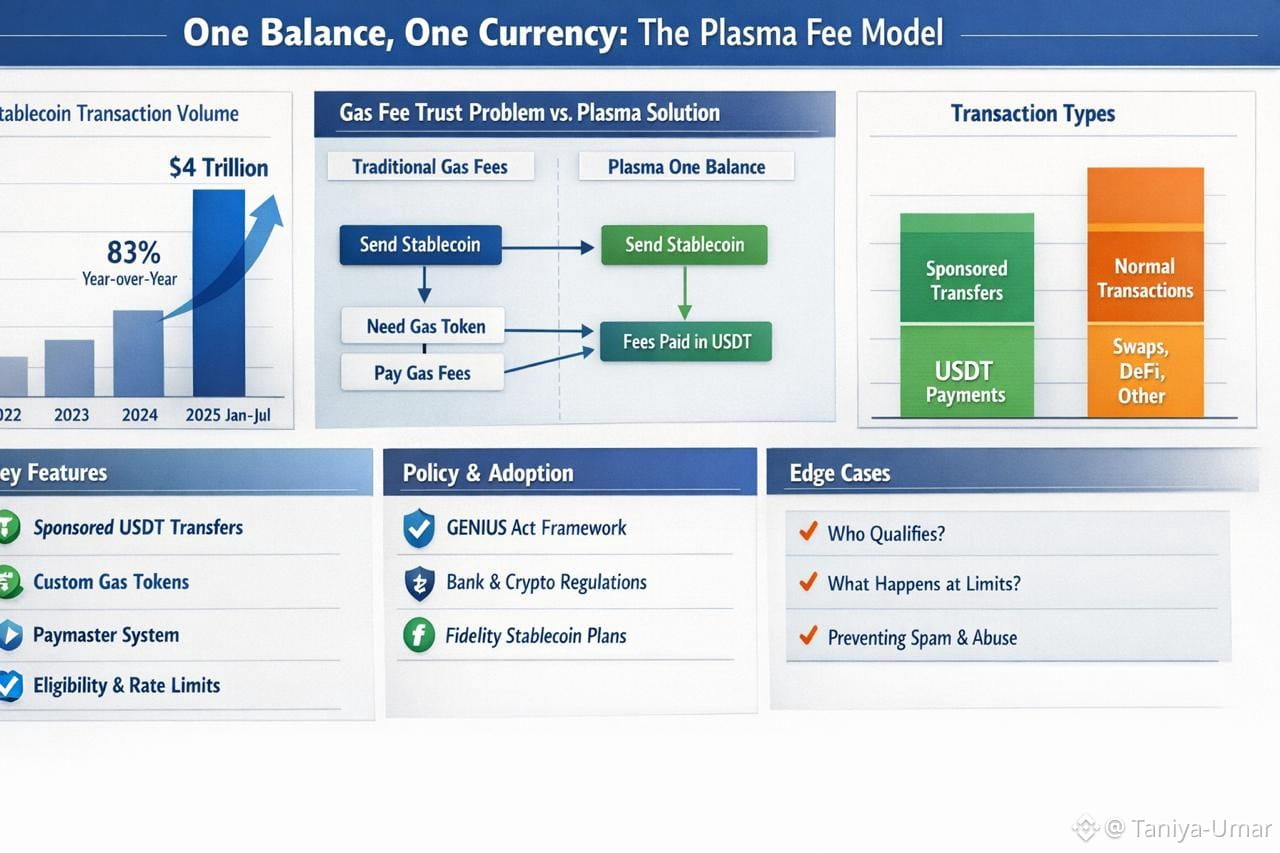
The Plasma fee model is trending because it tries to remove that setup step by design. Plasma is an EVM-compatible Layer 1 aimed at stablecoin payments, and its documentation leans into a promise: keep the familiar gas math, keep prices predictable, then sponsor or re-denominate fees so users aren’t forced into a separate “gas token” economy.
The headline feature is protocol-sponsored USD₮ transfers. Plasma maintains a paymaster contract that covers gas for eligible token transfers, specifically basic transfer calls, and it uses lightweight eligibility checks and rate limits to reduce abuse. The practical difference is not just pennies saved; it’s that you can receive stablecoins and send stablecoins without first learning where to buy XPL.
The second piece is what makes “one currency” feel literal. Plasma supports custom gas tokens through a protocol-maintained paymaster, letting applications whitelist ERC-20 tokens, including stablecoins, to be used as gas inside their flows. Fees still exist and validators still get paid, but the user sees a single balance move down in the same unit they already think in.
This timing lines up with stablecoins becoming financial plumbing. TRM Labs reported that as of August 2025, stablecoins reached their highest annual transaction volume to date, rising 83% year over year and topping $4 trillion in transaction volume from January to July 2025. When that much value is moving, small frictions stop being acceptable “crypto quirks” and start looking like defects.
It also lines up with account abstraction. Plasma notes paymaster-compatible wallet flows and compatibility with EIP-4337 and EIP-7702 smart accounts. Circle, explaining EIP-7702, argues that needing native gas tokens is a major blocker for payment UX and describes paymasters that let fees be paid in USDC without deploying a smart wallet first.
Policy and brand behavior are nudging the conversation from “will stablecoins matter?” to “how will they be offered?” In the U.S., the GENIUS Act created a federal framework for payment stablecoins, and Reuters reported the White House convening banks and crypto firms over rules that could shape whether third parties can pay rewards on stablecoin holdings. Separately, Fidelity announced plans to launch its own dollar-pegged stablecoin on Ethereum.
Plasma’s go-to-market choices make the fee story feel less theoretical. Plasma One is framed as a stablecoin-native neobank, bundling a dollar balance with spending, saving, and transfers, and it leans on fee-free USDT transfers as a core feature for users in markets where “getting dollars” is the point. That’s a useful stress test: if the product expects everyday behavior, the network has to support everyday expectations, including clear failure modes when eligibility and rate limits kick in.
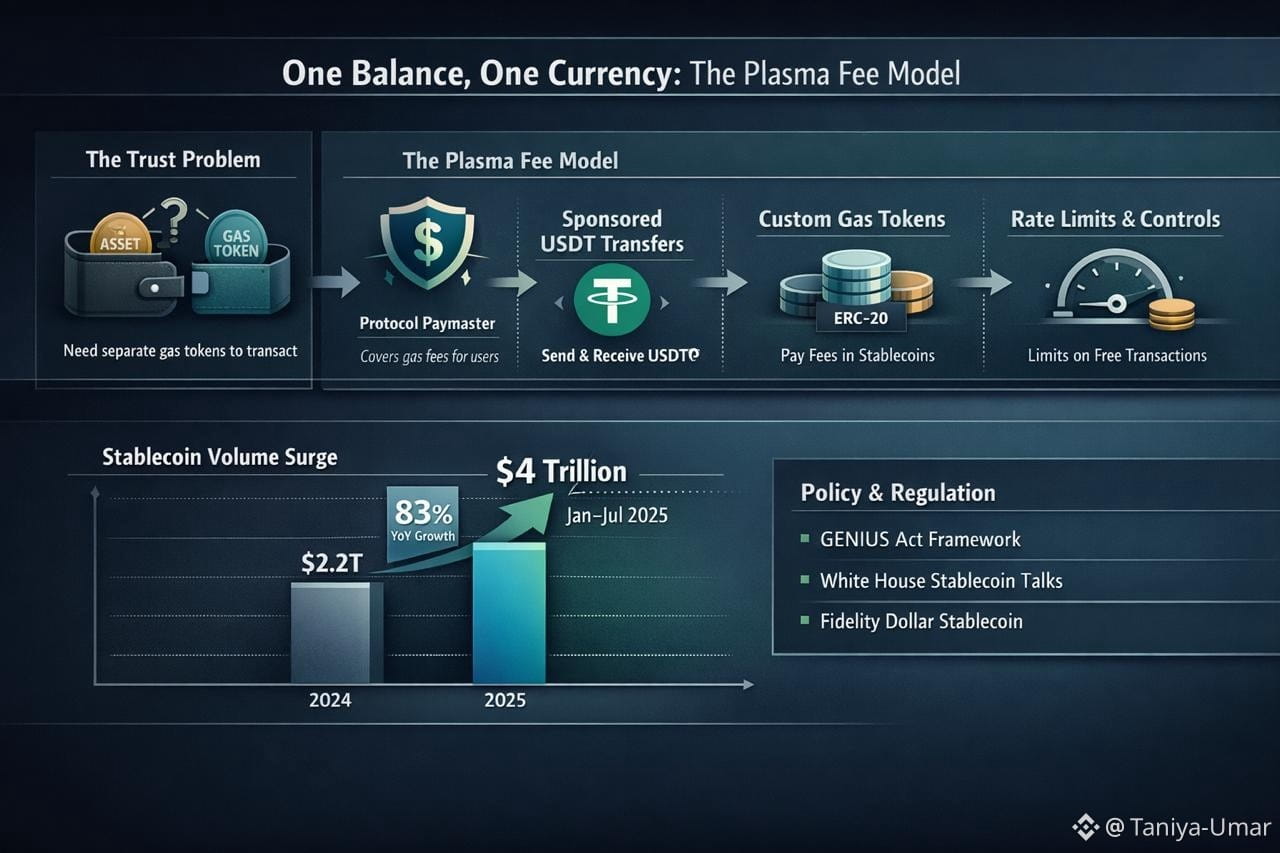
Bitfinex’s overview also notes that the sponsored path is specific, while other transactions still incur normal fees to sustain validators and the network’s economic security.
There’s a quiet realism in how Plasma frames “free.” Sponsored transfers are limited to specific calls, with controls, because somebody pays for computation no matter what. Subsidy is policy, and policies create edge cases: who qualifies, what happens when limits are reached, and whether “free” becomes a vector for spam.
If this sounds familiar, it’s because other parts of the ecosystem are converging on the same idea with different mechanics. OneBalance describes a setup where the user pays one consolidated fee to the app in the input token, while the toolkit helps the app handle underlying gas and paymaster costs. The common thread is empathy: most people want to move money and understand the cost without doing homework first.
I’ve started to think “one balance, one currency” is less a promise and more a test. Can you make fees feel consistent? Can you let people pay in what they already hold? Can you keep the whole thing explainable in one breath? Plasma’s fee model is a serious attempt at passing that test, and what I like about it is the assumption that confusion is a problem to solve, not a user’s fault.