
Everyone talks about Real-World Assets.
Very few talk about the infrastructure that makes them work.
As crypto matures, the conversation is shifting from speculation to execution, from hype cycles to systems that can support real capital, real institutions, and real users.
That’s exactly where DIA fits.
Let’s take a deeper dive into why $DIA matters, how it’s positioned in today’s market, and why it’s increasingly relevant for the next phase of onchain finance.
1️⃣ What DIA Really Is (Beyond the Buzzwords)
DIA is an open-source, trust-minimized oracle network designed to bring verifiable, transparent data onchain.
Unlike traditional oracle models that operate as black boxes, DIA focuses on:
Open data sourcing
Transparent methodologies
Fully auditable data pipelines
Community-verifiable feeds
This design philosophy isn’t cosmetic — it’s critical.
As DeFi expands into RWAs, tokenized treasuries, private credit, commodities, and structured products, protocols need data that can be proven, not just delivered.
Bad data doesn’t just cause liquidations — it breaks trust.
2️⃣ Why Oracles Matter More in the RWA Era
RWAs introduce offchain complexity:
Pricing real estate
Valuing commodities
Tracking bonds, yields, and funds
Managing compliance-sensitive assets
In this environment, oracle design becomes a systemic risk factor.
DIA addresses this by making the entire data lifecycle visible:
Where the data comes from
How it’s processed
How it’s delivered onchain
This is why DIA is often described as “infrastructure-first crypto.”
It’s not optimized for noise — it’s optimized for reliability.
3️⃣ Market Structure: Calm ≠ Weak
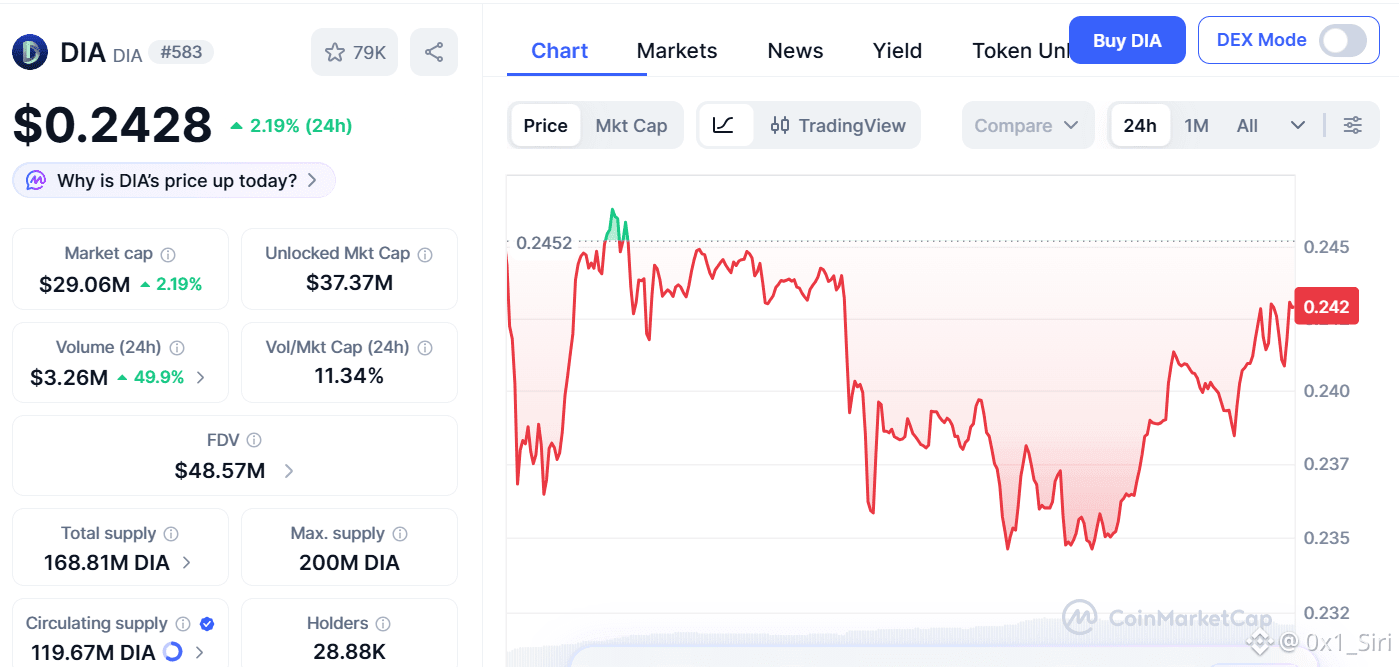
At current levels (~$0.24–$0.26 range), $DIA shows:
Stable holder count
Consistent trading volume
Tight price compression
This type of structure often appears before expansion, especially for infrastructure tokens.
Historically, the market prices applications first and infrastructure later — once adoption becomes undeniable.
Quiet charts don’t mean inactive ecosystems.
4️⃣ DIA Lumina: Built for the Next Wave of Onchain Finance
DIA Lumina represents a major evolution in oracle design.
It enables:
Custom data feeds for complex assets
RWA-ready oracle infrastructure
Modular, composable data pipelines
Greater control for builders and protocols
For teams building serious financial primitives, not just short-term DeFi experiments, this is the type of tooling that reduces long-term risk.
Lumina isn’t about speed alone.
It’s about correctness, transparency, and future-proofing.
5️⃣ Why Builders Are Watching DIA Closely
If you’re building:
RWA protocols
Tokenized funds or treasuries
Lending markets with real-world exposure
Rollups or app-chains needing custom oracle logic
You don’t just need data; you need data you can defend.
That’s where DIA’s architecture stands out.
Infrastructure that survives regulation, audits, and institutional scrutiny isn’t flashy — it’s intentional.
🔮 The Bigger Picture
RWAs are a multi-trillion-dollar opportunity.
But narratives don’t scale systems.
Infrastructure does.
DIA isn’t chasing attention.
It’s positioning itself where trust, transparency, and verification become non-negotiable.
Price may go quiet.
Foundations don’t.
$DIA is building — and the protocols that matter are paying attention.