
@Vanarchain When people talk about Neutron Seeds on Vanar, they often start with a vivid claim: take something bulky, like a 25-megabyte file, and compress it into something small enough to store and verify on a blockchain. That grabs attention, but the more interesting idea is what the compression is meant to unlock. Vanar describes Neutron as a layer that compresses and restructures data into programmable “Seeds,” with the aim that an app can treat a document less like a dead attachment and more like a unit of usable knowledge.
The timing makes sense. Over the last year, people have been reminded that plenty of “decentralized” products still lean on centralized clouds and external links for the data that actually matters. Cointelegraph framed Neutron as a response to the pattern where blockchains reference files stored elsewhere, creating fragile failure points when infrastructure stumbles or when links rot over time.
In parallel, everyday AI use has surfaced a different pain: most tools have no durable memory. You can do careful work with one model, switch to another, and find yourself re-explaining the same context from scratch. That’s why myNeutron keeps showing up in the discussion. It’s presented as a personal knowledge base that lets you capture documents, webpages, and even AI chats, then turn them into searchable Seeds you can reuse across different AI tools.
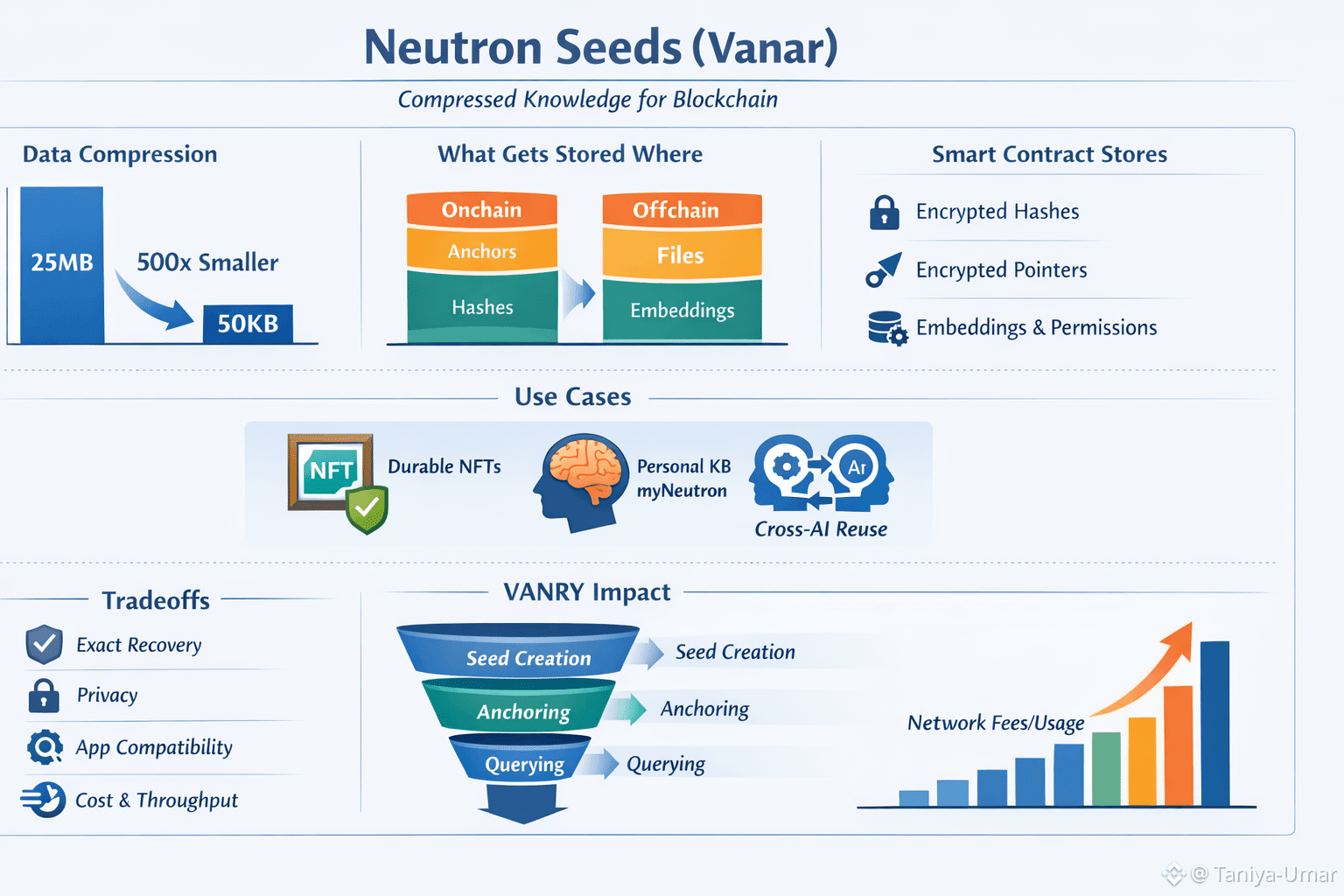
So what is a Seed in plain language? Think of it as a compact knowledge object that stands in for a file and makes the contents easier to retrieve, verify, and reuse. Vanar’s documentation says a Seed can include text, visuals, files, and metadata, which already hints that it’s not just “zip on a chain.” The part I like most is the moderation in it. Instead of pretending everything belongs onchain, it leans into a hybrid approach: store Seeds offchain so the system doesn’t grind under its own weight, and use onchain anchoring as the reliable reference point for verification and long-term trust.
The mechanics are where the concept either becomes useful or stays a slogan. Vanar repeats an example compression of 25MB down to roughly 50KB, and Cointelegraph reports similar numbers when describing Neutron Seeds that can be stored onchain. The docs add a more sober layer: when a Seed is stored onchain, a specialized smart contract can hold encrypted file hashes for content checks, encrypted pointers to compressed files, embeddings up to a stated limit, and ownership and permission settings.
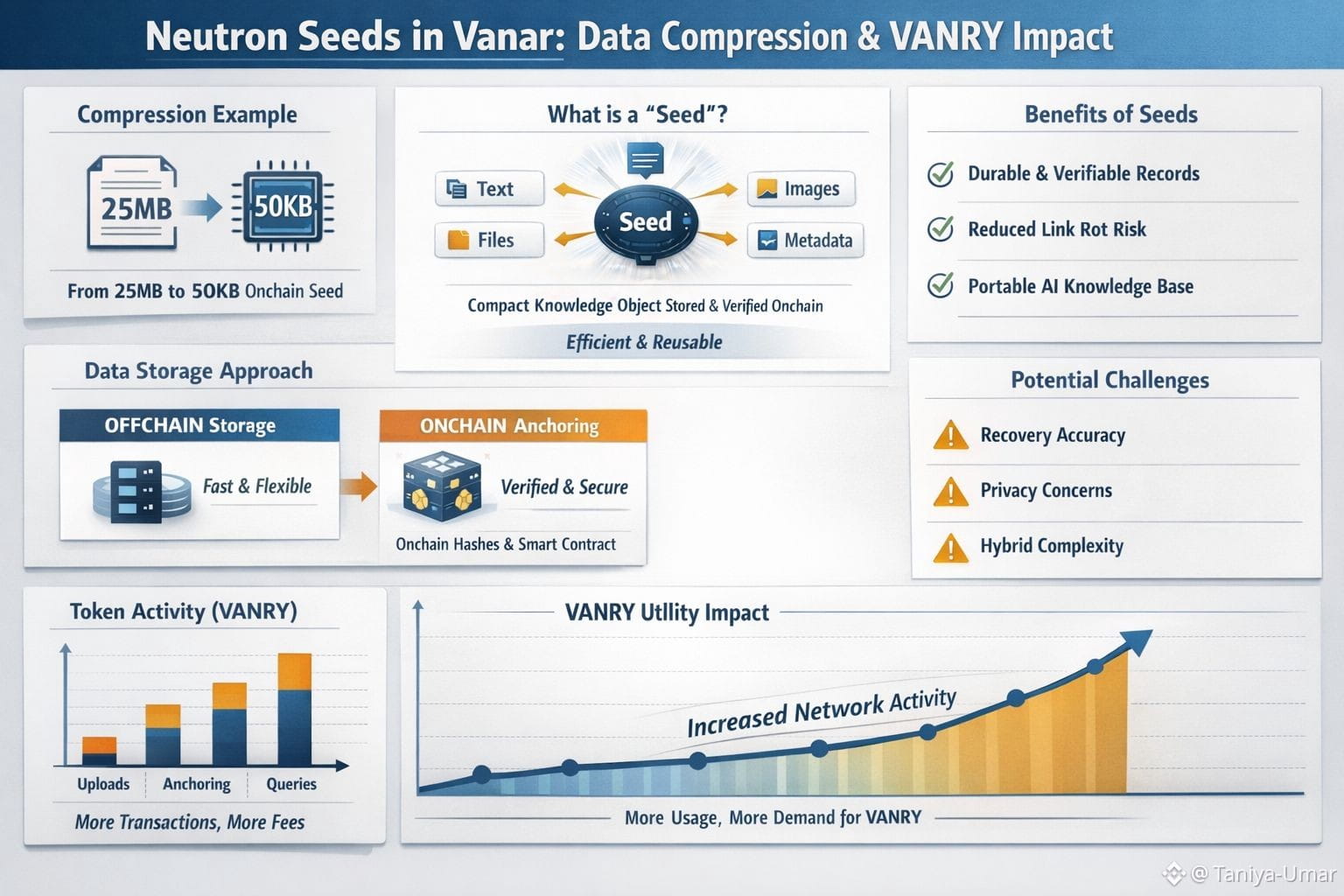
I’m drawn to the idea for boring, real reasons. Data availability is why so many NFTs and tokenized assets age badly: links break, metadata disappears, and the proof that mattered at mint time becomes hard to verify later. A Seed, if it’s durable and verifiable, could make tokenized records less fragile because the thing you need to check is closer to the chain itself. But it’s also worth asking what gets traded away. Any system that restructures information has to answer whether recovery is exact, what the privacy guarantees mean in practice, and how different apps avoid drifting into incompatible interpretations.
There is also a quieter kind of progress here that matters more than marketing. The idea is being pushed into documentation, interfaces, and workflow, which is where most blockchain storage narratives usually stall. Vanar’s own docs outline how Seeds are defined and how the onchain pieces are structured, and the myNeutron site makes a bet on everyday users who just want their context to stop evaporating. Still, it’s fair to question cost and throughput. Even compressed data has to be paid for, replicated, and served, and “hybrid” designs can reintroduce operational complexity if the boundaries are fuzzy.
That brings us to VANRY. The token’s history matters because it shows the project isn’t entirely new: major venues documented the earlier 1:1 swap and rebrand from Virtua (TVK) to Vanar (VANRY). In day-to-day terms, VANRY is positioned as the network token used for transactions and chain operations. If Neutron-style storage and verification features see real adoption, the most grounded way to talk about impact is simple: more uploads, anchoring, and querying means more fee-paying activity. That won’t settle the bigger question, though. The real test is whether developers choose Seeds because they make systems more reliable, not because they make for a good demo.