
@Plasma The word “Plasma” used to mean a specific Ethereum scaling idea from 2017: move activity to smaller “child” chains, keep compact commitments on Ethereum, and let users exit back to the base chain if an operator misbehaves. It was clever, but it asked too much of ordinary people. Exits were hard to reason about, timing mattered, and the safest behavior was often to wait.
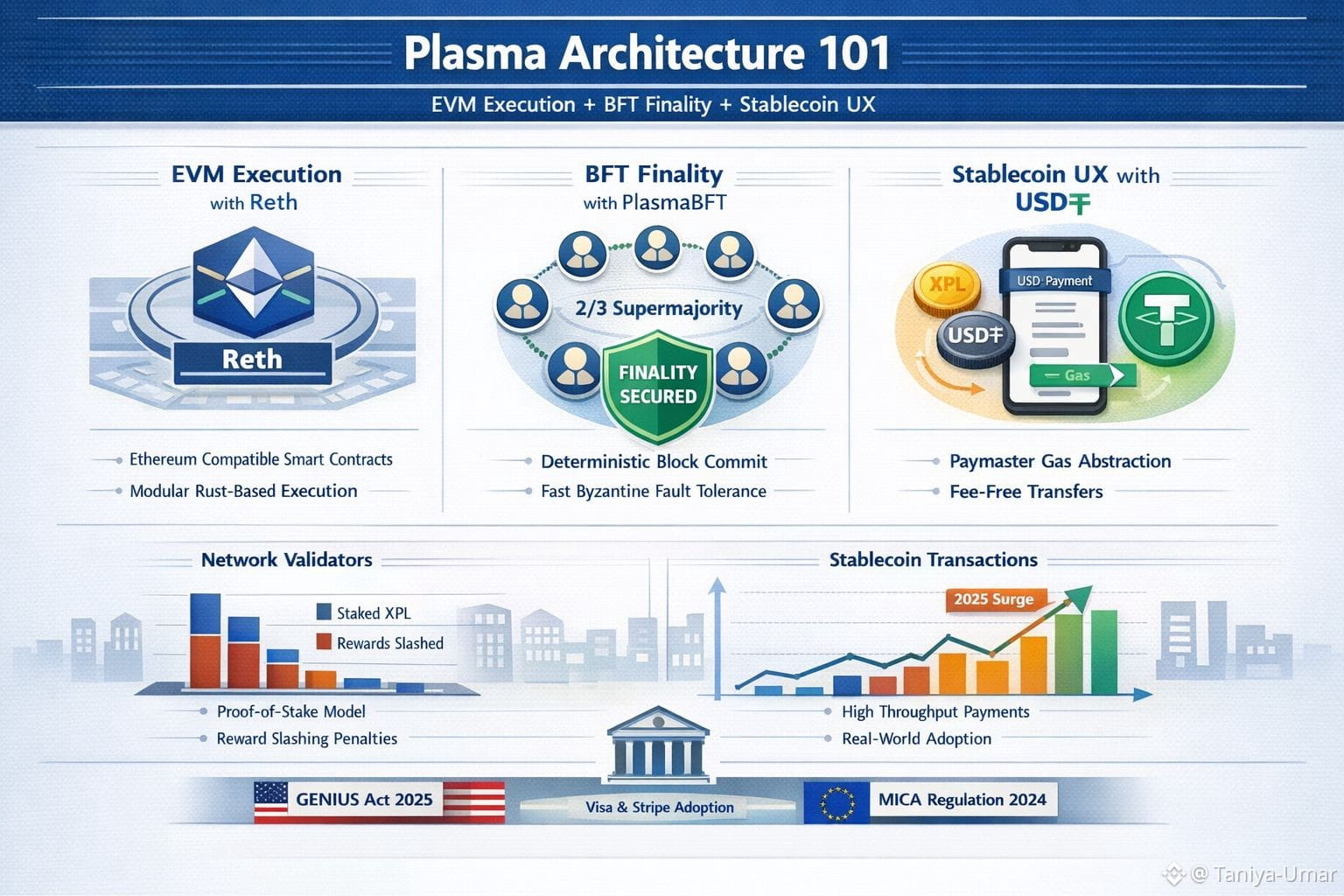
In early 2026, Plasma is also the name of a newer protocol with a more pragmatic mission: stablecoin payments at scale. Plasma positions itself as a high-throughput Layer 1 designed around USD₮ as the primary use case, without breaking compatibility with the EVM world. In practice, that means developers can reuse what they already know, transactions can reach finality in a cleaner, more decisive way through BFT, and everyday users can interact in stablecoins without the constant friction of needing a separate volatile token just to move money.
EVM execution is the familiar piece. Plasma’s docs say it runs a general-purpose EVM environment and that the execution layer is powered by Reth, a modular Ethereum execution client written in Rust. The value here is continuity. Most stablecoin infrastructure is already EVM-shaped, from custody contracts to merchant settlement logic to the tooling teams use for monitoring and audits. When money is the product, “mostly compatible” is not comforting, so matching Ethereum semantics closely becomes a safety property, not a marketing slogan.
Finality is where the architecture starts to feel purpose-built for payments. Plasma says it is secured by PlasmaBFT, a pipelined implementation of Fast HotStuff that targets lower latency while keeping classic BFT safety assumptions. In probabilistic systems you wait for confirmations, then you wait a little longer because you’ve seen reorgs and edge cases. Deterministic finality turns settlement into a clean state change: validators vote, and once a supermajority commits a block, a transfer is final in a way an accounting system can rely on without extra heuristics.
Stablecoin UX is the third leg, and it is where the protocol and the XPL token meet. Plasma documents “custom gas tokens” via a paymaster flow: the user selects an approved token such as USD₮, the paymaster prices gas using oracle rates, pays the network fee in XPL, and then deducts the stablecoin from the user. The user gets a dollars-first experience, while the chain keeps a native token for resource pricing and validator incentives. Plasma also documents a protocol-supported path to gasless USD₮ transfers for tightly scoped payment calls.
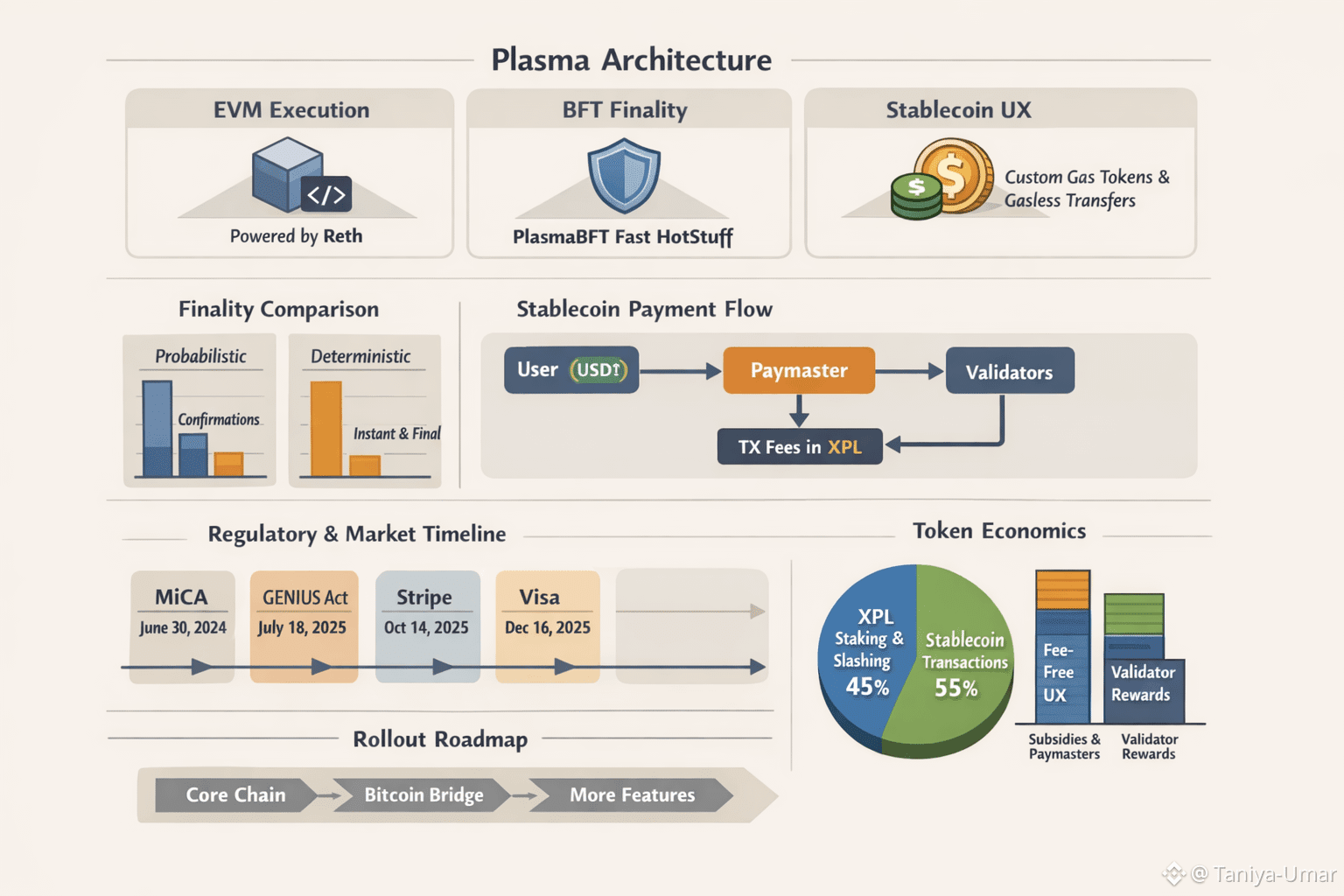
XPL, in that context, is less a consumer-facing badge and more the mechanism that makes the system cohere. Plasma’s docs frame XPL as the native token tied to running the network and rewarding validators in a proof-of-stake model. The Plasma FAQ also spells out a distinctive penalty approach: reward slashing rather than stake slashing, where misbehaving validators lose rewards without automatically losing principal. It makes a messy chain reaction less likely, yet it shifts the burden onto the kinds of consequences validators actually feel over time: credibility damage and the simple cost of missing out on rewards.
There is a design tension here. If you make stablecoin transfers feel “fee-free,” someone still pays for computation, and the protocol has to decide where that cost lands. Plasma’s answer seems to be: keep XPL as the metered resource, and use paymasters and token-based fee options to make the experience predictable. It’s sensible, but it raises the bar for validator economics and fee transparency.
This wave didn’t arrive randomly—it arrived with paperwork and production launches behind it. The U.S. put a stake in the ground with the GENIUS Act on July 18, 2025, while Europe’s MiCA timeline brought stablecoin-relevant rules into force for ARTs and EMTs on June 30, 2024. Then the market did what it usually does when rules get clearer: it shipped. Stripe announced stablecoin payments for subscriptions on October 14, 2025, and Visa followed with USDC settlement availability for U.S. institutions on December 16, 2025. Put those together and you get a rare moment where the “why now?” doesn’t need much guessing.
Real progress still matters, and Plasma’s documentation points to an incremental rollout: ship the core chain architecture first, then extend capabilities such as a Bitcoin bridge and other features over time. The open question is whether this stays boring under pressure: validator decentralization, upgrade discipline, censorship demands, and how “fee-free” experiences are sustained without hidden fragility.