
@Dusk Tokenization has spent years in a strange limbo: widely discussed, occasionally piloted, rarely felt by the people who actually have to run market infrastructure day to day. Early 2026 looks different because the slow-moving institutions that shape settlement and collateral are attaching timelines to their experiments. The Eurosystem’s “Pontes” project is meant to link market DLT platforms with TARGET Services so certain transactions can settle in central bank money, with a pilot planned by the third quarter of 2026.
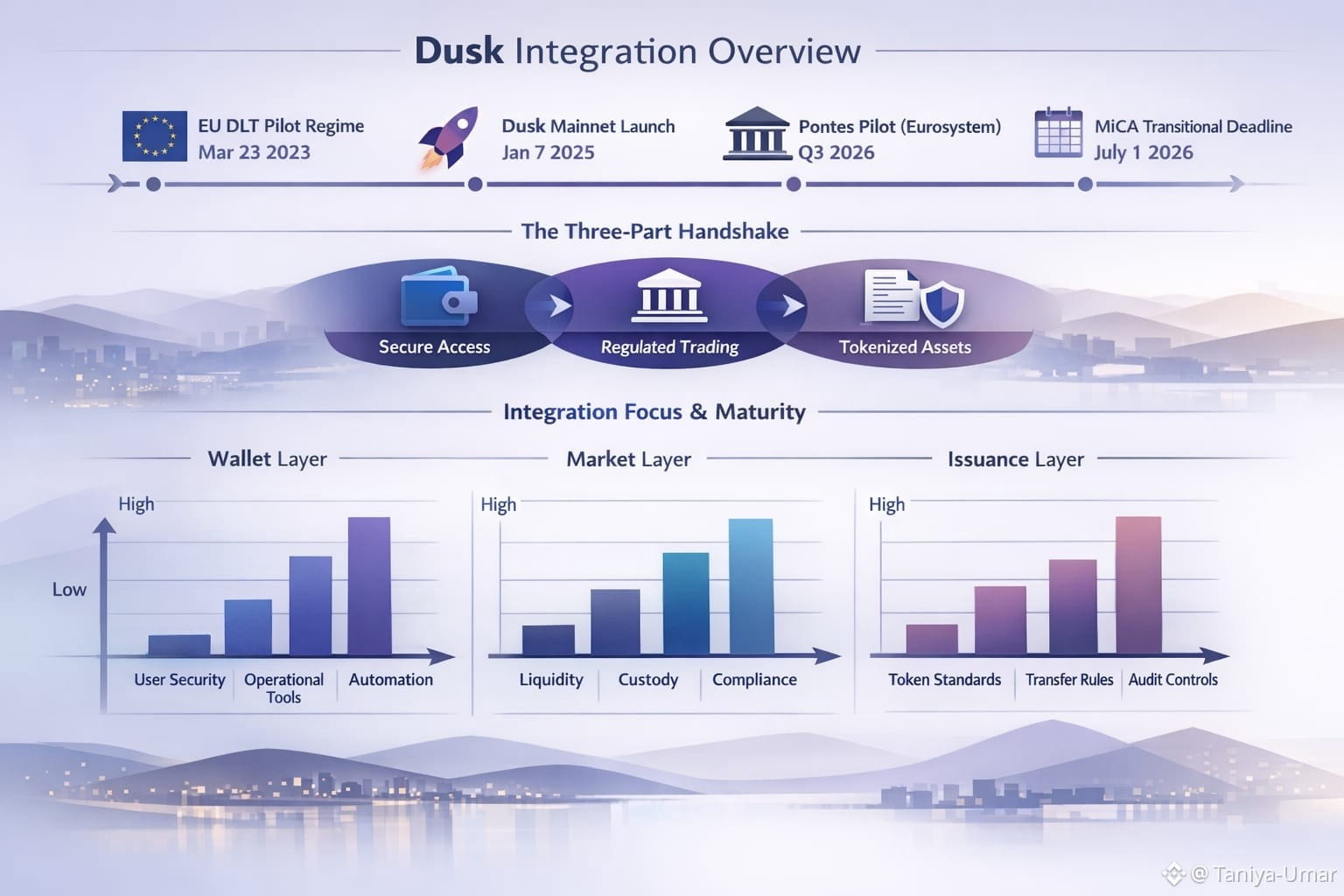
In the UK, the Bank of England has been similarly direct about exploring whether a wider range of tokenised assets could be accepted as collateral. That’s not a flashy headline, but it’s a serious one. Collateral is where legal definitions, operational controls, and risk management stop being abstract and start becoming binding. If tokenised instruments can function there, they can function in the places where finance actually scales.
This is exactly why integration work has become the real story. “Assets on-chain” is not a system. A system is a wallet people can safely use, a market with enforceable rules and credible custody, and an issuance process that produces instruments others are willing to hold. When those layers don’t line up, you feel it fast: onboarding drags, trades settle awkwardly, and compliance review becomes the bottleneck that everyone complains about later.
Dusk is interesting because it aims directly at that three-part handshake. It describes itself as a privacy blockchain for regulated finance, and the key word there is “regulated,” not “privacy.” The point isn’t secrecy for its own sake. Most issuers and traders don’t want balances, counterparties, and trading patterns turned into permanent public metadata, but regulated markets still need auditability and controlled disclosure. Dusk’s stance is that confidentiality and compliance can coexist if selective visibility is designed into the rails rather than bolted on afterward.
The wallet layer is the first handshake because it’s where trust begins. Dusk’s Web Wallet is designed to work directly in a browser, with the plain goal of making safe behavior easier for everyday users. The Rusk Wallet is the command-line counterpart for people and teams who need repeatable control—automation, operational checks, treasury workflows, and direct interaction with the network without having to invent a signing pipeline from scratch. That split can sound minor, but it’s one of the clearest signals that a network is thinking about real operations: ordinary users need guardrails, while operators need reliability.
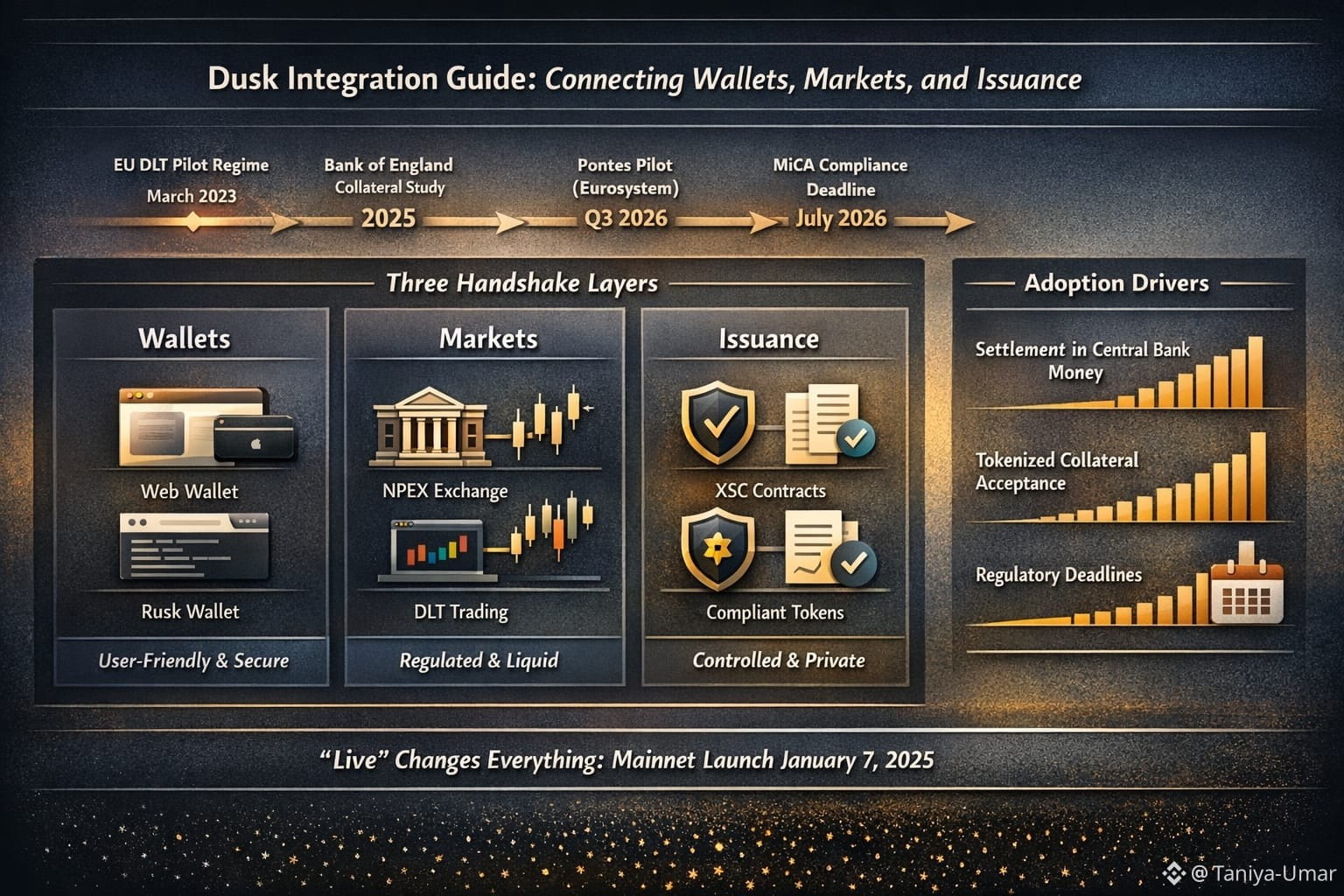
Markets are the second handshake, and credibility lives here. DUSK trades on mainstream crypto venues, which helps with liquidity and discovery, but the more consequential signal is the attempt to connect to regulated-style trading. Dusk’s partnership with the Dutch SME exchange NPEX has been positioned around building a blockchain-powered securities exchange and engaging with the EU’s DLT Pilot Regime, which has been applying since March 23, 2023. Whether or not every detail lands exactly as envisioned, the direction matters: custody and exchange design are treated as core market structure, not as an afterthought you tack on once volume appears.
Issuance is the third handshake, and it’s where teams often get surprised by the sheer number of details that aren’t optional. Tokenization is easy to define and hard to operationalize because real instruments come with transfer restrictions, disclosures, corporate actions, and jurisdictional rules. Dusk points to its XSC Confidential Security Contract standard as a way to create and issue privacy-enabled tokenised securities while still supporting the controls that regulated assets need. And the timing pressure is real: Europe’s MiCA regime is no longer a distant horizon. Its rollout and transitional window for some providers through July 1, 2026 is forcing implementation work instead of vague promises.
Finally, the developer layer determines whether integrations stay maintainable. DuskEVM is described as an EVM-equivalent execution environment that lets teams deploy smart contracts with familiar tooling while inheriting settlement guarantees from the Dusk stack. That doesn’t remove the hard questions—permissions, disclosure triggers, recovery paths—but it reduces the friction that quietly kills pilots.
I keep coming back to a simple thought: “live” changes everything. Dusk’s mainnet going live on January 7, 2025 mattered because it forced the network out of the realm of whitepapers and into the realm of operational reality. If tokenization sticks this time, it won’t be because the idea suddenly got prettier. It’ll be because wallet, market, and issuance integrations finally fit together well enough that the system feels boring in the best way—predictable, legible, and safe enough to run every day.