In crypto trading, most retail traders lose money because they rely on random indicators, emotional decisions, or chasing price moves.
Professional traders, however, follow smart money — the buying and selling activity of whales, institutions, and market makers — to make high-probability trades.
This approach is called Smart Money Concept (SMC) or Order Flow Trading.
Let’s break down each component using a structured infographic approach.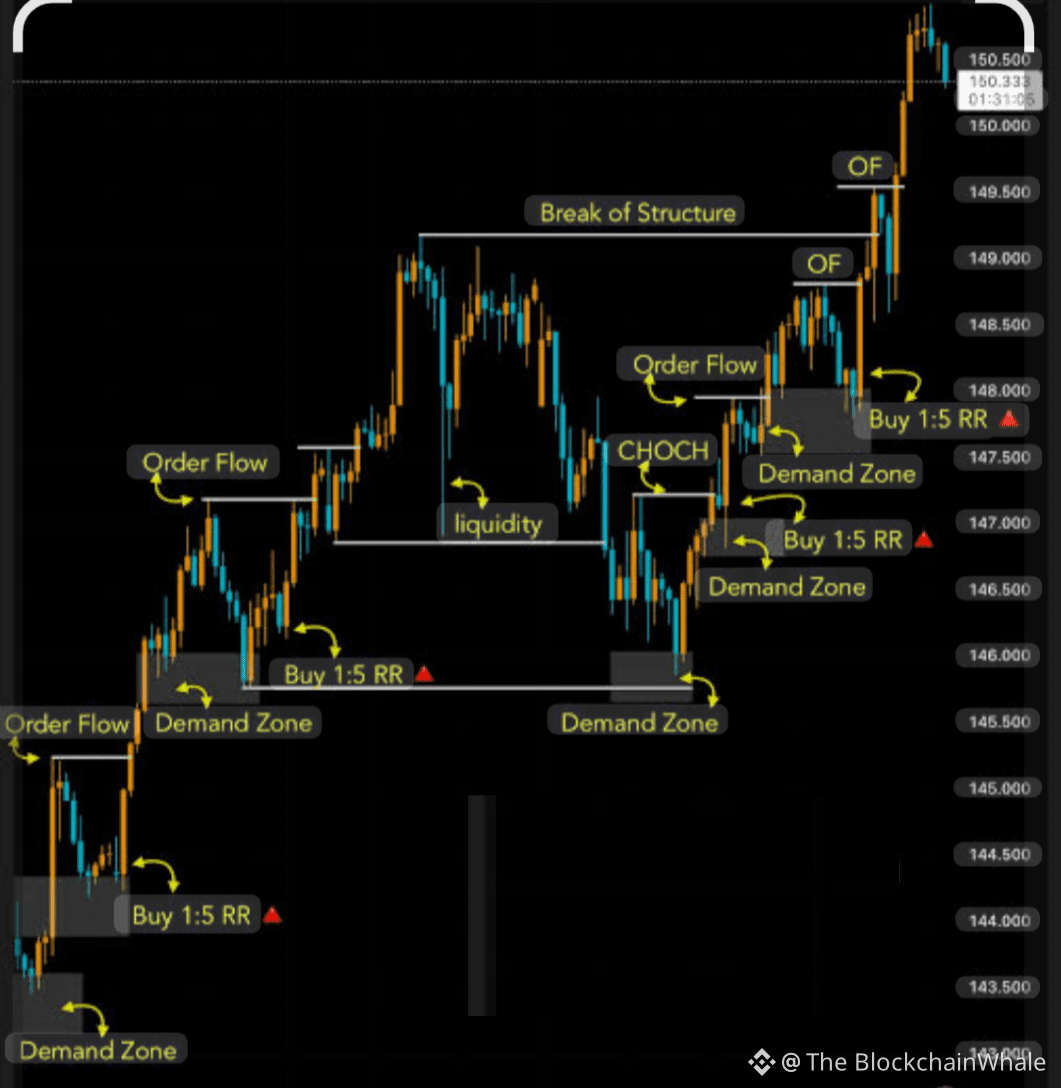
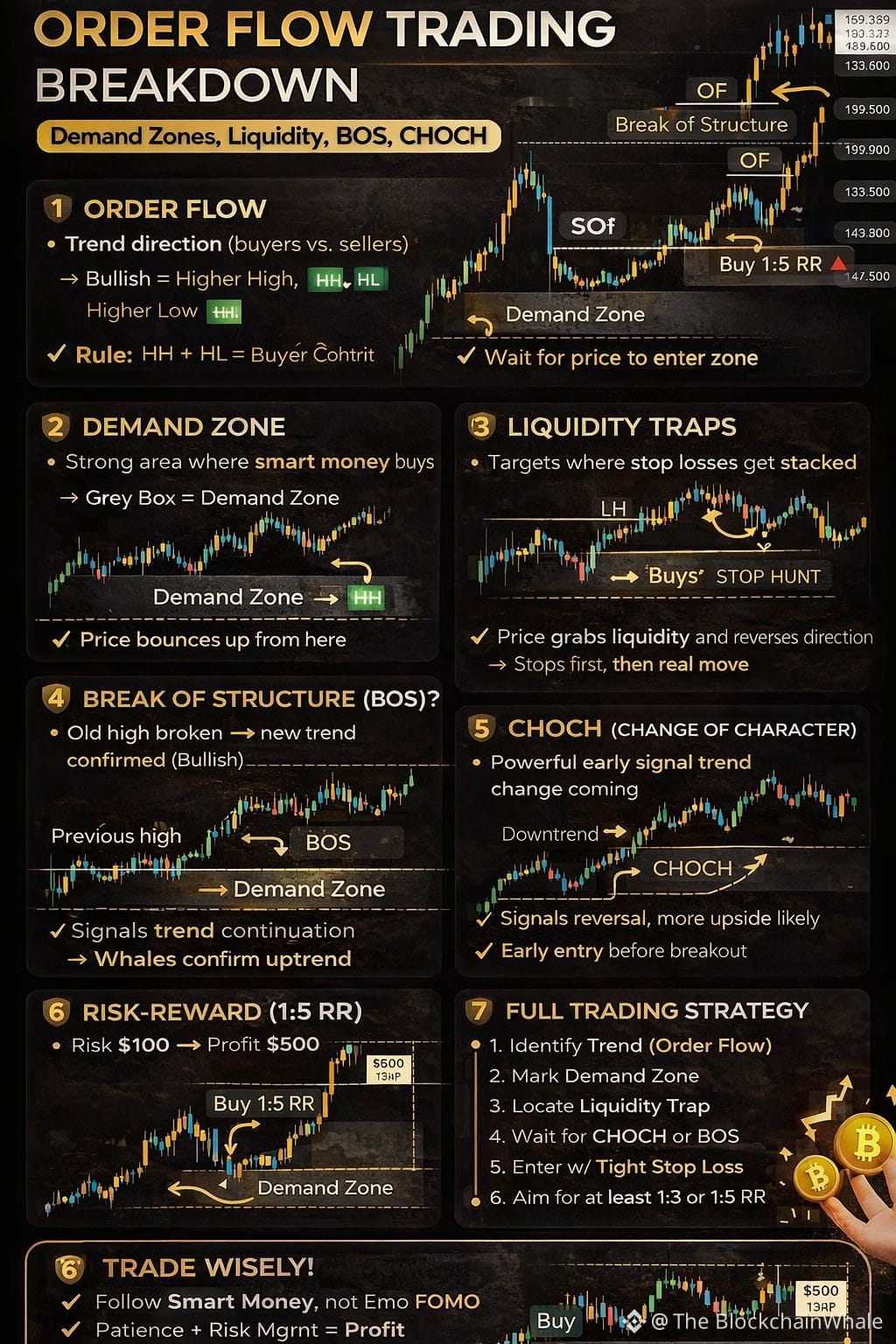
1️⃣ Order Flow – Who Controls the Market?
Order Flow shows which side is dominating: buyers or sellers.
Bullish order flow is identified by:
Higher Highs (HH)
Higher Lows (HL)
Bearish order flow is the opposite: Lower Highs, Lower Lows.
Rule of thumb:
Trade with the trend, never against it.
✅ Key point: Wait for price to enter a zone where the order flow confirms trend direction.
This ensures you are trading with momentum instead of fighting it.
2️⃣ Demand Zone – Where Smart Money Buys
A Demand Zone is an area where big players place significant buy orders.
Usually represented as a grey box on charts
Acts as strong support
Price often bounces up when it reaches this zone
Strategy:
Wait for price to enter the Demand Zone before taking a long position.
❌ Avoid buying randomly in the middle of price swings.
3️⃣ Liquidity Traps – Hunting Stop Losses
Liquidity traps are zones where stop-loss orders get stacked.
Market makers hunt these stops before the real move
Price often temporarily breaks these levels, triggering retail stop losses
Then the market reverses in the intended smart money direction
Lesson: Understand liquidity to avoid getting stopped out prematurely.
✅ Whales always grab liquidity before a major move.
4️⃣ Break of Structure (BOS)
BOS occurs when previous highs or lows are broken, signaling trend continuation.
Example:
Price breaks an old high → Bullish BOS
Confirms that buyers control the market
Use: BOS confirms momentum and validates potential entries.
5️⃣ CHOCH – Change of Character
CHOCH is a powerful early signal of trend reversal.
Appears when the market shows early signs of changing direction
Downtrend suddenly shows higher highs or higher lows → trend shift
Signals a potential upside before breakout
Use: Enter early at high-probability setups while minimizing risk.
6️⃣ Risk-Reward (RR) – 1:5 Example
Successful traders always focus on Risk-Reward ratio, not just entry.
Example:
Risk $100 → Target $500 (1:5 RR)
Even if you lose multiple trades, one successful high RR trade can cover losses and generate profit
✅ Key: Small stop-loss + large take-profit = consistent long-term profits.
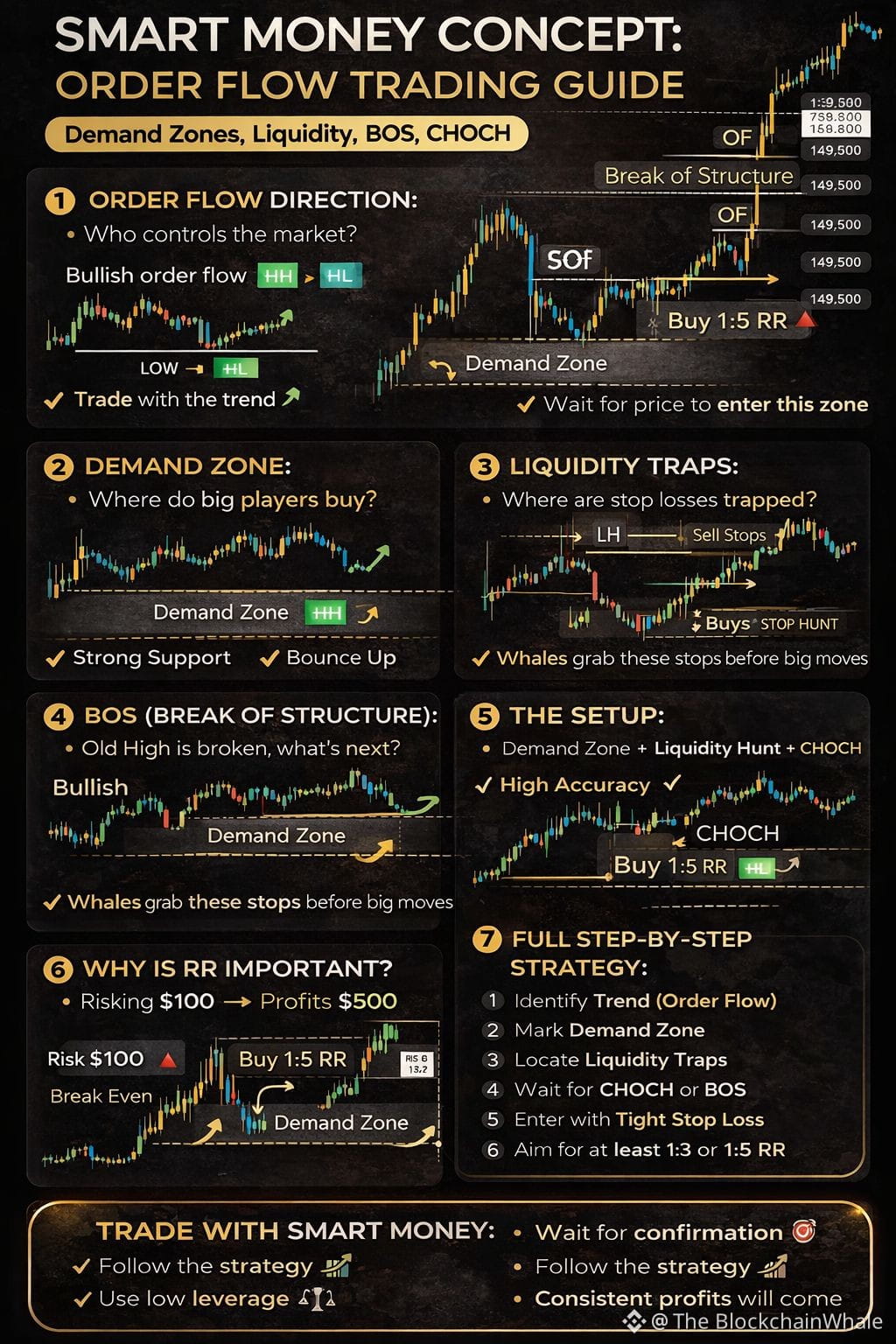
7️⃣ Full Trading Strategy (Step-by-Step)
Here’s how to combine SMC principles into a structured strategy:
Identify Trend → Observe Order Flow (HH + HL for bullish)
Mark Demand Zone → Areas of smart money buying
Locate Liquidity Traps → Identify stop loss clusters
Wait for CHOCH or BOS → Early confirmation signal
Enter with Tight Stop Loss → Minimal risk
Aim for 1:3 or 1:5 RR → Maximize potential reward
✅ Only trade when all conditions align.
❌ No confirmation → No trade.
8️⃣ Trade Wisely – Mindset Matters
Trading is not just about price action — mindset is crucial.
Follow Smart Money, not emotions
Avoid FOMO or random entries
Patience + Risk Management = Long-term Profit
Retail traders chase price. Smart money waits for price to come to them.
🔥 Final Thoughts
Smart Money Concept (SMC) and Order Flow Trading help traders:
Understand real market structure
Avoid stop-loss traps
Enter high-probability trades
Manage risk with proper RR
By learning Demand Zones, Liquidity Traps, BOS, CHOCH, and proper Risk-Reward, traders move from reactive gambling to strategic decision-making, just like professional institutions.