
The concept of the metaverse-a network of interconnected immersive virtual worlds-requires a new layer of trusted digital infrastructure Blockchain technology provides this foundation enabling key functions that make persistent user-owned virtual environments possible This infrastructure operates in the background ensuring security ownership and seamless interaction without requiring users to understand its complexity.
Digital Ownership Through NFTs
Within virtual worlds items like avatars clothing land parcels and tools are often represented as Non-Fungible Tokens (NFTs).An NFT is a unique digital certificate of ownership recorded on a blockchain.This means a virtual item is not merely an image or code controlled by a central company.Instead it is a portable asset that you truly own.You can prove its authenticity carry it across compatible platforms and sell or trade it with others with every transaction permanently and transparently verified on the blockchain.
Automated Operations with Smart Contracts
The rules of the virtual world are enforced by smart contracts These are self-executing programs stored on the blockchain that run automatically when predetermined conditions are met For example a smart contract can automatically transfer a digital item from a seller to a buyer once payment is received without an intermediary It can govern access to exclusive areas distribute rewards to participants in an event or manage the shared economics of a virtual community This automation ensures that interactions are trustless and function exactly as programmed
While ownership records are on the blockchain the larger digital files—like 3D models high-resolution textures and environment data—are stored off-chain. Decentralized storage networks are used for this purpose.Instead of relying on a single central server these systems distribute data across a global network of computers.This makes the virtual world's assets more resilient to failure censorship or tampering.The blockchain then stores a secure immutable link to this distributed data tying the proof of ownership directly to the asset itself.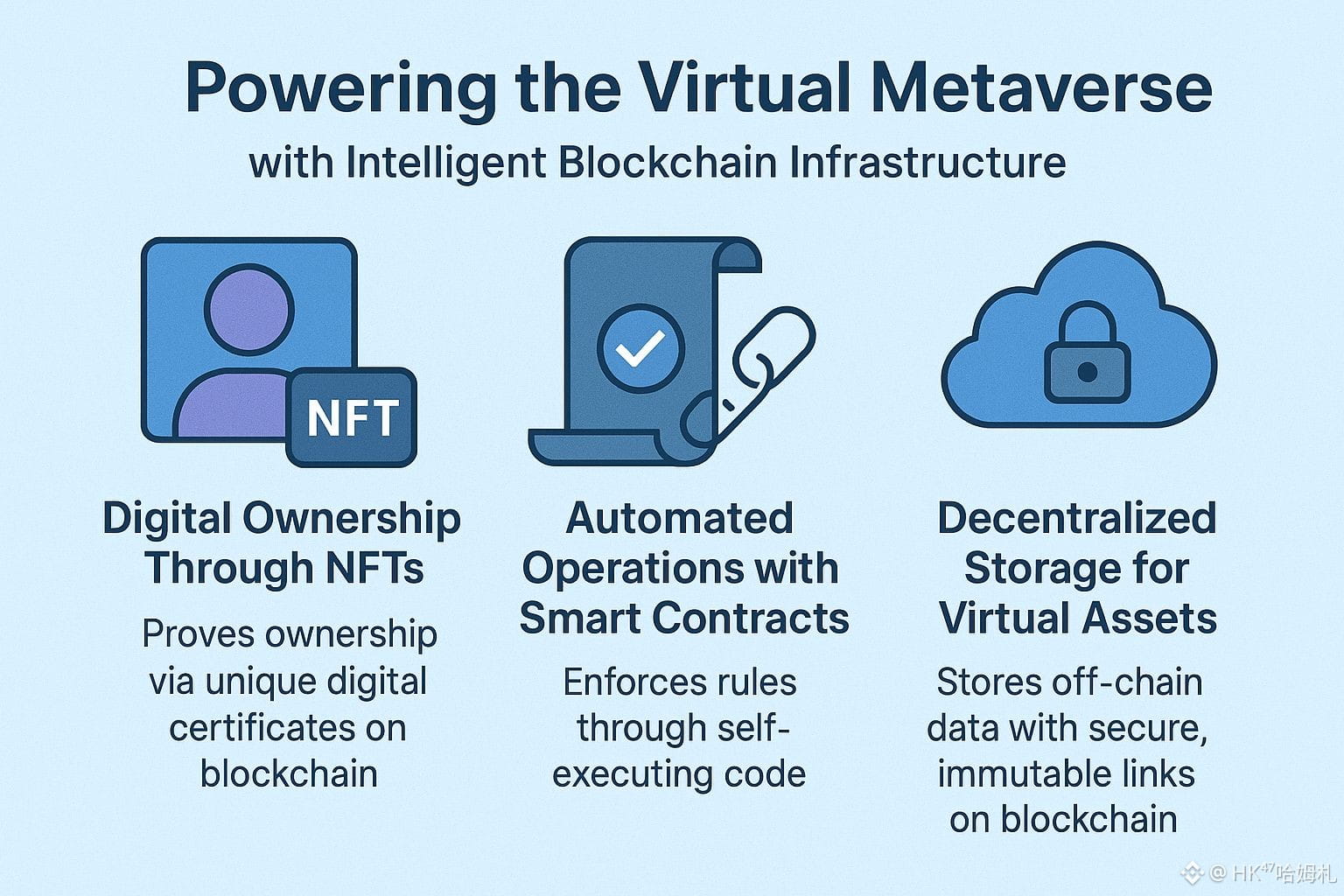
Together these components form an intelligent blockchain infrastructure that supports a functioning metaverse It shifts control from centralized entities to users establishes a transparent framework for digital economies and ensures the persistence and portability of virtual experiences This underlying technology is what allows the metaverse to evolve into a more open and user-centric digital frontier
