
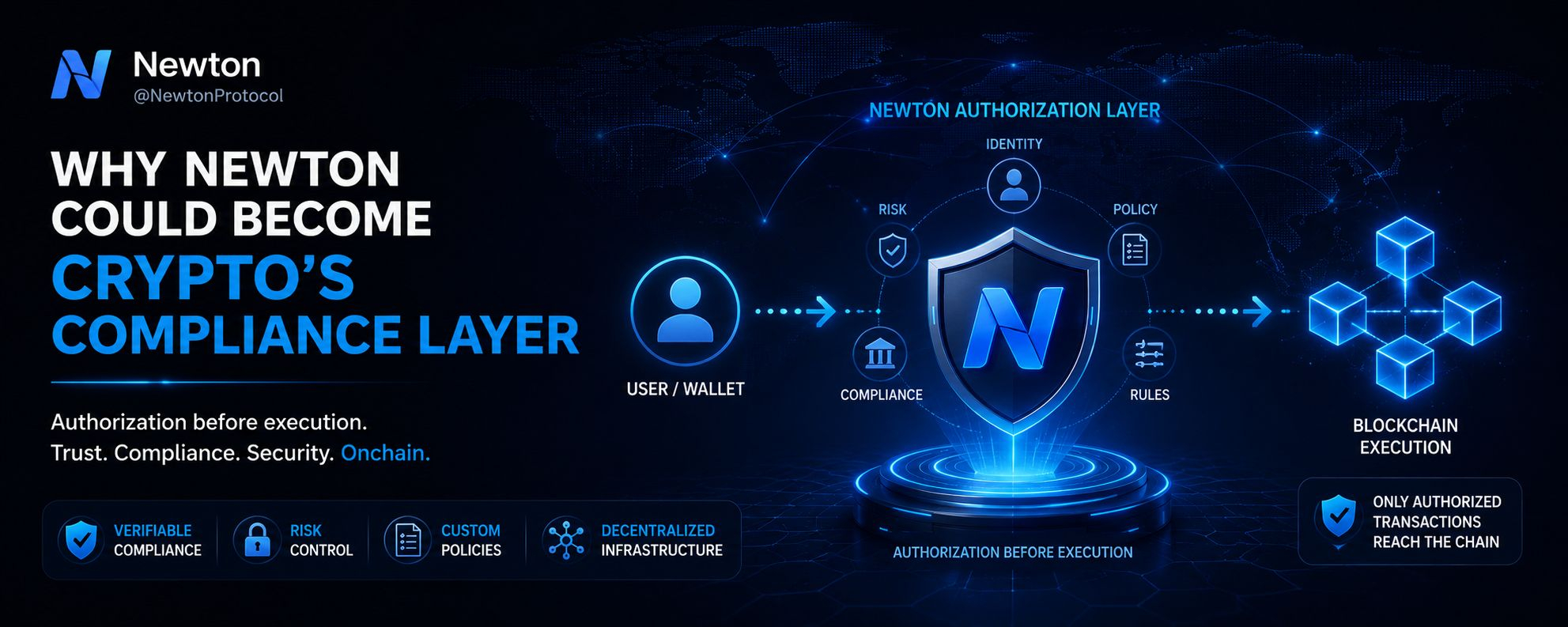
The more I explore @NewtonProtocol , the more I understand why some infrastructure projects quietly become more valuable than the ones everyone talks about.
$NEWT isn't trying to compete for attention by promising another faster chain or higher TPS.
It's trying to solve a problem that has been sitting in front of the industry for years.
One reason this feels especially relevant today is the launch of the Newton Mainnet Beta.
Instead of talking only about future ideas, @NewtonProtocol is now giving builders and the community a chance to experience how its authorization-first infrastructure can work in practice.
That makes the vision behind $NEWT feel much more tangible.
A few months ago, if someone had asked me what blockchain was missing, I probably would've said better scalability, cheaper transactions, or smoother cross-chain transfers.
After spending time with the Newton whitepaper, I realized I was looking in the wrong place.
We built systems that can move billions of dollars in seconds.
But we never built a neutral way to decide whether those transactions should be allowed before they happen.
That idea stayed in my head for days.
In traditional finance, payments don't move the moment someone clicks a button.
They pass through authorization, fraud checks, identity verification, spending rules, and risk controls first.
Crypto flipped that model.
Execution became instant.
Authorization almost disappeared.
The more I thought about it, the more unusual that felt.
Today, compliance mostly exists outside the blockchain. Exchanges perform KYC.
Analytics companies score wallet risk. Regulators investigate after funds have already moved.
Everything happens after execution.
Very little happens before it.
As I explored more about the Newton Mainnet Beta, it became easier to connect the whitepaper with real progress.
It's one thing to describe an authorization layer on paper, but it's much more interesting to see the ecosystem moving toward making that vision usable for developers and real-world applications.
That's exactly where @NewtonProtocol feels different.
Instead of asking institutions to trust another centralized company, it introduces a decentralized authorization layer that allows applications to verify identity, compliance, custom policies, and transaction rules before execution ever reaches the blockchain.
To me, that's a much bigger shift than simply making another blockchain faster.
As more banks, stablecoin issuers, RWAs, payment companies, and even AI agents enter crypto, I don't think speed alone will decide which infrastructure survives.
The projects that quietly solve trust, authorization, and verifiable compliance may end up becoming the foundations that everyone else builds on.
I'm not saying $NEWT will definitely become that standard.
But after reading the architecture and thinking about where the industry is heading, I can finally understand why Newton isn't trying to become another blockchain.
It's trying to become something almost every blockchain may eventually need.
If crypto eventually reaches billions of users, do you think the most valuable infrastructure will be the chains that settle transactions... or the networks that decide which transactions should be authorized before settlement even begins?
