
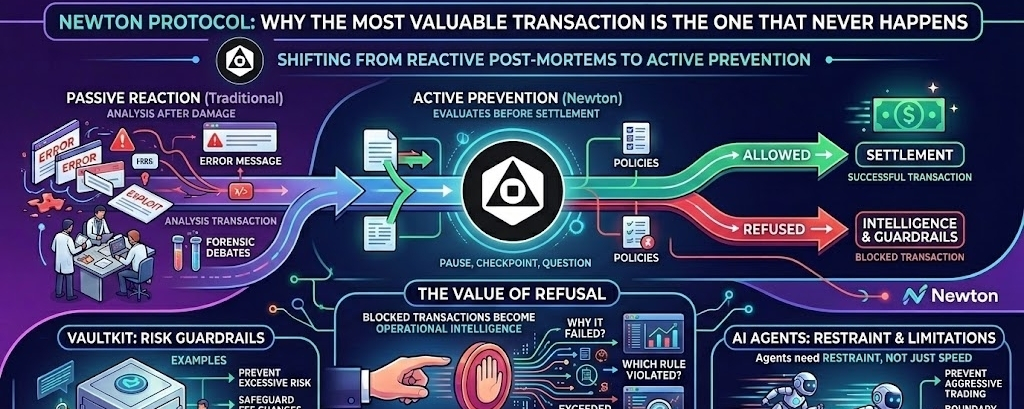

I have spent enough time around crypto to notice that we rarely celebrate the moments when nothing happens.
That sounds odd because this industry is built on movement. We measure activity through transactions, trading volume, TVL, yield, new wallets, and price action. Every dashboard rewards motion. Every announcement promises faster execution, higher throughput, or greater efficiency.
Failure, on the other hand, is treated like clutter.
A transaction fails. Gas is spent. The wallet throws an error. Someone complains on social media, refreshes the page, and tries again.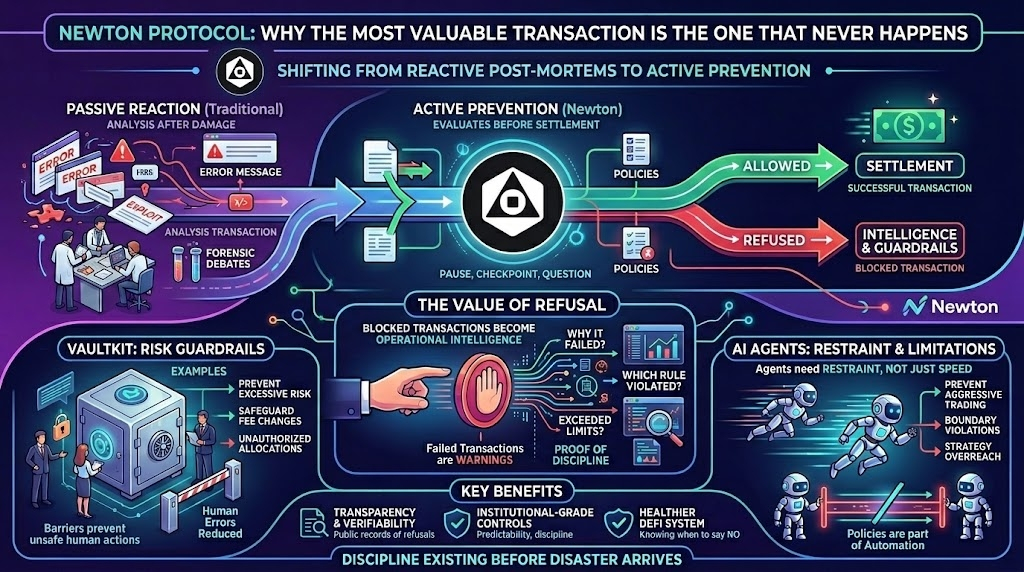
The story usually ends there.
But over the last few weeks, while reading more about Newton Protocol, I found myself looking at failed transactions from a completely different angle. Instead of asking why something did not execute, I kept wondering whether the refusal itself might be one of the most valuable parts of the entire process.
That is not how I used to think.
For a long time, I assumed success was the only outcome worth measuring. If a transaction settled, the system worked. If it failed, something had gone wrong. The distinction felt obvious.
Now I am not so sure.
The more autonomous crypto becomes, the more I think we should pay attention to the moments when a system deliberately says no.
That quiet refusal may tell us more than another successful execution ever could.
---
One thing I have noticed about blockchain discussions is that we often analyze risk after the damage has already happened.
A lending protocol suffers bad debt.
A vault becomes overexposed.
An automated strategy buys the wrong asset.
An exploit drains millions.
Then everyone begins reconstructing the timeline.
Which parameter was wrong?
Who approved the proposal?
Why was nobody watching?
Could the exploit have been prevented?
Crypto has become incredibly good at forensic analysis.
We create dashboards, publish postmortems, and debate governance decisions for weeks.
What we rarely ask is whether the entire sequence could have stopped before it ever reached the blockchain.
That is where Newton Protocol caught my attention.
Instead of treating policy as documentation that people are expected to remember, Newton attempts to turn those policies into something the network can actively enforce before settlement.
That may sound like a subtle architectural decision.
I do not think it is.
I think it changes where trust begins.
---
The phrase that keeps coming back to me is "pre-execution."
At first glance, it sounds technical.
The more I thought about it, the more human it became.
Every experienced person develops habits that happen before action.
Before signing a contract, you read it again.
Before sending money, you double-check the address.
Before investing, you reconsider the downside.
Those pauses are rarely exciting.
They are also the reason many expensive mistakes never happen.
Blockchain has historically been different.
Once the transaction is signed, execution becomes the story.
Newton introduces another moment.
A pause.
A checkpoint.
A question.
Should this transaction happen at all?
I find that incredibly interesting because it shifts intelligence away from reacting to mistakes and toward preventing them.
---
When I looked at Newton's Mainnet Beta running on Base and Ethereum, I realized this idea is no longer just theoretical.
Policies can evaluate transactions before settlement.
If an action satisfies predefined rules, execution continues.
If it violates those rules, execution stops.
That sounds straightforward until you think about what the refusal actually creates.
Instead of leaving behind nothing but an error message, the blocked transaction becomes evidence.
It tells a story.
Not simply that execution failed.
It explains why.
Which rule was violated?
Which policy rejected the action?
Which limit was exceeded?
That transforms a failed transaction from meaningless noise into operational intelligence.
I think that distinction matters far more than people currently appreciate.
---
One example that helped me understand this better is VaultKit.
When people hear about vault management, the conversation usually revolves around returns.
Which strategy generated higher yield?
Which allocation outperformed?
Which curator made the smartest decisions?
Those questions matter.
But they all assume execution already happened.
VaultKit introduces another perspective.
Before someone changes fee structures, adjusts risk caps, enables new markets, or reallocates assets, those actions can first be evaluated against defined policies.
That feels like a healthier relationship between governance and execution.
Instead of relying entirely on human memory or manual oversight, the system itself participates in protecting user capital.
I find that reassuring.
Not because humans become unnecessary.
Because humans become less dependent on never making mistakes.
---
Imagine managing a vault during a particularly volatile market.
Prices swing rapidly.
Liquidity shifts.
Opportunities appear and disappear within minutes.
Pressure builds.
Every decision feels urgent.
Under those conditions, even experienced managers can become overly aggressive.
Perhaps the strategy attempts to allocate more capital into one market than originally intended.
Without safeguards, that allocation proceeds.
Only later does someone realize concentration risk became excessive.
With Newton, the action can be interrupted before funds move.
That interruption is not merely an inconvenience.
It tells the vault manager something important.
The strategy reached its boundary.
The policy worked exactly as intended.
The system did not simply process instructions.
It evaluated them.
To me, that represents a completely different philosophy of infrastructure.
---
The same idea becomes even more compelling once AI agents enter the picture.
I find it fascinating how often conversations around AI focus almost entirely on capability.
Can an agent trade faster?
Can it rebalance portfolios automatically?
Can it optimize yield?
Can it monitor hundreds of markets simultaneously?
Those are interesting questions.
They are also incomplete.
The more capable an autonomous system becomes, the more important its limitations become.
Speed alone has never made me feel comfortable.
A machine capable of reallocating millions of dollars within seconds also needs equally sophisticated mechanisms for restraint.
Otherwise efficiency becomes acceleration without direction.
Newton seems to recognize this.
Policies are not obstacles to automation.
They are part of automation.
That distinction feels incredibly important.
---
I also think repeated refusals become valuable data.
Suppose an AI agent continually attempts actions outside permitted boundaries.
At first glance, those failed attempts might appear wasteful.
I disagree.
Patterns begin to emerge.
Maybe the agent has become too aggressive.
Maybe market volatility is exposing weaknesses in the strategy.
Maybe the policy itself needs refinement.
Or perhaps the environment has fundamentally changed.
Without those blocked attempts, none of those insights become visible.
Ironically, the failures teach us more than uninterrupted success.
That realization stayed with me.
Sometimes the system's most honest communication is not what it allowed.
It is what it refused.
---
Another aspect I appreciate is verifiability.
Private software rejects requests all the time.
Banks decline transactions.
Trading firms enforce internal rules.
Centralized exchanges freeze withdrawals.
In every case, users are expected to trust the operator.
Blockchain has always promised something different.
Transparency.
Auditability.
Shared records.
Newton extends that philosophy into policy enforcement.
A blocked transaction is not simply hidden inside someone's internal logs.
It can become part of a verifiable record explaining why execution never occurred.
That matters because trust changes when evidence exists.
Instead of asking someone whether safeguards worked, participants can inspect the record themselves.
For builders, that means better debugging.
For vault managers, it creates clearer accountability.
For allocators, it provides stronger confidence.
For users, it replaces vague assurances with observable behavior.
That feels like meaningful progress.
---
I also keep thinking about institutions.
That word gets overused in crypto.
Every project claims institutional adoption is right around the corner.
Reality is usually more complicated.
Large capital allocators rarely chase excitement.
They evaluate discipline.
Policies.
Governance.
Risk management.
Operational consistency.
Performance certainly matters.
But sustainable performance depends on systems behaving predictably under stress.
A spectacular return means very little if risk controls disappear the moment markets become volatile.
I suspect institutions care deeply about the decisions that never happened.
The trade that exceeded limits.
The allocation that violated policy.
The governance action that crossed predefined boundaries.
Those refusals reveal whether controls remain intact when pressure increases.
Performance charts rarely capture that.
Policy records might.
---
Of course, I do not think elegant architecture guarantees adoption.
Crypto has repeatedly shown that technically impressive ideas can struggle if developers ignore them.
Newton still faces difficult questions.
Will builders integrate policy enforcement into their applications?
Will vault curators accept another layer inside execution?
Will users understand why pre-settlement verification matters?
Can policy infrastructure remain flexible without becoming overly restrictive?
Those questions deserve honest answers.
Technology alone cannot create trust.
Communities, developers, and users ultimately decide whether good infrastructure becomes meaningful infrastructure.
That challenge remains ahead.
---
Even so, I find myself returning to one simple observation.
Maybe we have misunderstood failure for years.
Maybe every blocked transaction is not evidence that a system broke.
Sometimes it is evidence that the system worked exactly as designed.
That feels like an important distinction.
The future of autonomous finance will almost certainly involve increasingly capable software making increasingly important financial decisions.
When that happens, success will not only be measured by how efficiently capital moves.
It will also be measured by how intelligently systems refuse unsafe actions.
For me, that is where Newton Protocol becomes genuinely interesting.
Not because it promises faster execution.
Not because it introduces another token into an already crowded market.
But because it quietly asks a question that much of crypto still avoids.
What if the healthiest financial system is not the one that says yes to everything?
What if the strongest system is the one that knows exactly when to say no—and can prove why it did?
I cannot say with certainty that Newton will become the standard for onchain policy enforcement.
Time will answer that far better than any article can.
What I do know is that the project has changed the way I think about transactions.
I no longer see every failed transaction as wasted gas or a frustrating error.
Some failures are warnings.
Some are guardrails.
Some are proof that discipline existed before disaster had the chance to arrive.
And if AI agents are truly going to manage more capital across decentralized finance in the years ahead, those quiet moments of refusal may become one of the most valuable signals any blockchain can produce.
@NewtonProtocol #NEWT #Newt #newt $NEWT
